Support

Potemkin Stairs

About

The Potemkin Stairs is not just an architectural masterpiece, but a true symbol of Odessa and one of the most famous landmarks in Ukraine. This monumental Classicist structure, recognized as an architectural monument of the first half of the 19th century, serves as the formal entrance to the city from the sea, connecting Primorsky Boulevard with the harbor and the sea port. Many famous writers, including Mark Twain and Jules Verne, admired its magnificence.
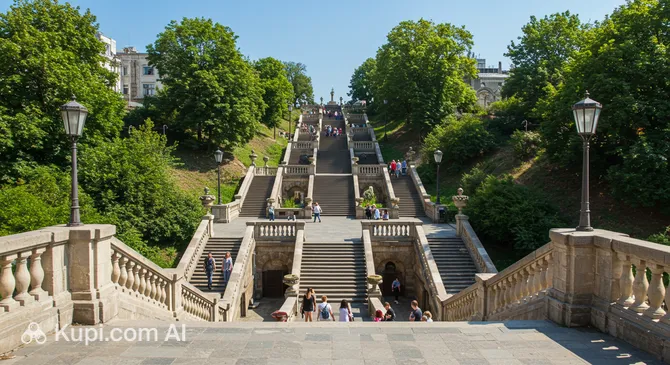
Potemkin Stairs. Illustration.
Source: Kupi.com AI

Traveller photos:

Conceived as a grand project, the stairs are famous for their unique perspective. The base is significantly wider than the top, but thanks to this optical trick, when viewed from above, it appears to have the same width throughout its length, and only the spacious landings are visible. Conversely, if you look from the bottom up, a continuous cascade of 192 steps is revealed, and it seems as if the staircase is pointing straight into the sky. The top landing offers a breathtaking panorama of the Gulf of Odessa.

The construction of the stairs represents an outstanding engineering solution of its time. It is built in the form of a giant wedge of local limestone and rests on a system of arched galleries and vaults. Initially, the stairs had 200 steps, but over time, as the port area was expanded, the bottom eight steps were hidden under the roadway. The stairs received their world-famous name after the release of Sergei Eisenstein's film "Battleship Potemkin," one of the key scenes of which was filmed right here.

Today, a walk along the Potemkin Stairs is a must for everyone visiting Odessa. It is an opportunity not only to touch history and appreciate the architectural design but also to feel the unique atmosphere of the seaside city. A funicular also operates next to the stairs, which can be a convenient alternative for ascending to the boulevard.

Contacts

Since the Potemkin Stairs is a public architectural monument, it does not have specific contact details like a phone number or email address. It is open to the public 24/7 and serves as one of the main pedestrian arteries, connecting Primorsky Boulevard with the Marine Terminal area. You can reach the stairs via numerous public transport routes heading to the city center, and for a more comfortable ascent or descent, a funicular operates right next to it.

How to contactContact
AddressOdesa, Odesa Oblast, Ukraine, 65000

What to Do

A visit to the Potemkin Stairs is primarily an opportunity to enjoy one of the best panoramic views in Odessa. From its upper steps, a magnificent picture of the sea port, the picturesque harbor, and the endless expanses of the Gulf of Odessa unfolds. This place seems created for taking memorable photos and simply contemplating the city's maritime life. We recommend taking a leisurely walk down or up this historic structure to fully experience its impressive scale and architectural uniqueness.

Walking the stairs is not only a visual pleasure but also a true immersion into the city's cultural atmosphere. As one of the main symbols of Odessa and an iconic landmark of all Ukraine, it allows every visitor to touch history. A visit to the Potemkin Stairs often becomes a starting point for exploring the city center, as many other interesting places, including Primorsky Boulevard, are within walking distance.

Getting There

The Potemkin Stairs is located in the very heart of the city, on Primorsky Boulevard, making it easily accessible from anywhere in the center. Most tourist routes through Odessa pass through here, so if you are staying in the central part of the city, the best way to reach the stairs is a pleasant stroll. Along the way, you can enjoy the architecture and atmosphere of old Odessa. The top of the stairs offers a panoramic view of the Marine Terminal, while the bottom leads to Primorskaya Street, near the port.

For those who prefer public transport, many buses and minibuses (marshrutkas) run to Primorsky Boulevard and nearby streets. You can take routes going to the "Lanzheronovskaya Street" stop at the top or the "Marine Terminal" (Morkvokzal) stop at the foot of the stairs. For example, minibuses No. 10, 110, 120, 190, 210, and others stop near the boulevard. This is a convenient way to get there from more distant areas of the city. You can also always use taxi services, which will quickly and comfortably take you directly to the landmark.

The Odessa Funicular, which runs parallel to the Potemkin Stairs, deserves a special mention. It connects Primorsky Boulevard with Primorskaya Street and is not only a convenient way to get around but also an attraction in its own right. If you are tired or do not want to climb the 192 steps on foot, a ride in one of the cable cars is an excellent alternative. It allows you to save energy and enjoy the views as you slowly ascend or descend alongside the famous architectural monument.

Nearest city: Odesa

History & Facts

The history of the Potemkin Stairs dates back to the 19th century, but even before it was built, there was a simple path here, cut into the limestone, leading to the old Turkish fortress of Yeni-Dunja. Later, a wooden staircase with 220 steps appeared. The first stone predecessor of the famous structure was the Depaldo Stairs, built in 1823, which was significantly more modest—with only 142 steps.

The stairs acquired their modern grand appearance after a large-scale reconstruction that lasted from 1837 to 1841. A whole constellation of prominent architects and engineers worked on the project, including Francesco Boffo, Avraam Melnikov, Charles Potier, and John Upton. Originally, the stairs consisted of exactly 200 steps, divided into ten equal flights. However, during the improvement works on Primorskaya Street, the bottom eight steps were covered, and today their total number is 192.

Over its long life, the stairs have changed many names, reflecting the rich history of Odessa. At various times, it was called the Richelieu, Boulevard, Port, Great, and Stone Stairs. During the Soviet period, from 1919 to 1941, it was named after the Feldman Boulevard. It was only after the release of Sergei Eisenstein's world-famous film "Battleship Potemkin" that its current name—Potemkin—was finally established, becoming a symbol of the city.

Time Needed

It is worth setting aside 30 minutes to an hour to see the Potemkin Stairs. This time will be enough to leisurely descend and ascend all 192 steps, making stops on the spacious landings for a rest. For a person in good physical shape, the descent or ascent itself will take no more than 10-15 minutes one way, but the main value of visiting this Odessa landmark is the opportunity to enjoy the views and feel its scale.

Most of the time is spent taking photos from different angles and admiring the panorama. From the top, near the Monument to Duke de Richelieu, there is a magnificent view of the Marine Terminal and the Gulf of Odessa. From below, the stairs appear in all their glory, demonstrating the famous optical illusion where only the steps are visible. If you want to save time or energy, you can use the funicular that runs parallel to the stairs. The ride takes just over a minute and allows you to look at the architectural masterpiece from the side.

Thus, for a complete and leisurely acquaintance with the Potemkin Stairs, including a walk, a photo session, and perhaps a funicular ride, it is best to plan for about an hour. If you also want to stroll along Primorsky Boulevard, which begins at its top, feel free to allocate 1.5–2 hours for this entire iconic location in Ukraine.

Working Hours

The Potemkin Stairs is a public heritage site and one of the city's key pedestrian arteries, so it is open to visitors 24/7 all year round. This landmark has no official opening hours, and access to it is completely free. You can walk its famous 192 steps at any time convenient for you, whether it's early morning to watch the sunrise over the sea or late evening to enjoy the views of the port lights.

No tickets or prior reservations are required to visit the stairs themselves. However, it is worth knowing that a funicular runs parallel to the stairs, providing a convenient alternative for ascending or descending. The funicular has its own operating schedule, which may change depending on the season, and a fare is charged for the ride. If you plan to use the funicular, it is recommended to check the current schedule on-site.

5:00 – 23:00

Nearby

A walk along the Potemkin Stairs is just the beginning of your acquaintance with the rich history and culture of Odessa. Located in the heart of the city, it serves as an ideal starting point for exploring the surroundings, where every corner holds its secrets and legends. Exploring nearby attractions will allow you to dive deeper into the unique atmosphere of this seaside city and form a more complete impression of its multifaceted character.

Iconic monuments, magnificent theaters, cozy restaurants, and atmospheric bars are within walking distance of the famous steps. To help you plan your route, we have prepared a list of interesting places located very close by. This will allow you to easily combine a visit to the Potemkin Stairs with other exciting discoveries.

NameDistance
Monument to the Duke de Richelieu0.1 km
Odesa National Academic Opera and Ballet Theater0.3 km
Ministerium0.5 km
Boho Bar0.6 km
Flacon0.6 km
Monument to Leonid Utyosov0.7 km
Monica Pinza Pasta Bar0.7 km

Reached the bottom of the page?

Looks like you know this route inside out