Support

Roman Theatre of Mérida

About

The Roman Theatre in Mérida is one of the most outstanding and well-preserved monuments of ancient architecture in Spain. Located in the city of Mérida, it is the jewel of the archaeological ensemble of the ancient city of Emerita Augusta, which was the capital of the Roman province of Lusitania. Today, this site, included in the UNESCO World Heritage List, captures the imagination with its monumentality and rich history.
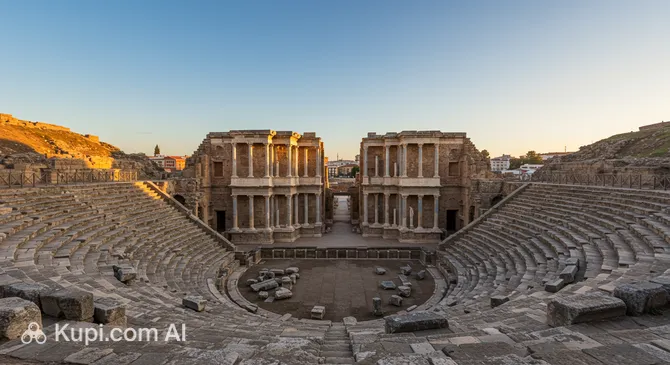
Roman Theatre of Mérida. Illustration.
Source: Kupi.com AI

Traveller photos:

The theatre was built in 16–15 BC by order of Marcus Vipsanius Agrippa, the son-in-law and close associate of Emperor Augustus himself. The structure, designed for 6,000 spectators, was built in strict accordance with the canons of the famous Roman architect Vitruvius, making it similar to other famous ancient theatres, such as the one in Pompeii. Part of the seating was skillfully built into the hillside, a characteristic feature of Roman urban planning.

Special attention should be paid to the magnificently preserved back wall of the stage (scaenae frons) with its two-tiered colonnade and sculptures, which was added during a reconstruction in the 1st century AD. Thanks to its excellent condition and extensive restoration, the theatre has not turned into silent ruins. Every year during the summer months, the famous Classical Theatre Festival takes place here, bringing the ancient stones to life with the sounds of tragedies and comedies, just as they did two thousand years ago.

Contacts

All the city's archaeological sites, including the Roman Theatre, are managed by a single organization — the Consortium of the Monumental City of Mérida (Consorcio de la Ciudad Monumental de Mérida). This body is responsible for preserving the monuments, organizing tours, and hosting events.

For the most up-to-date information on ticket prices, opening hours, and schedules for special events, such as the famous Classical Theatre Festival, it is highly recommended to consult official sources. The most reliable way to plan your visit is to find the official Consortium website online or visit the tourist portals of the city of Mérida. This will allow you to get accurate and verified data directly from the organizers.

How to contactContact
AddressPlaza Margarita Xirgu, s/n, 06800 Mérida, Badajoz, Spain
Phone+34 924 00 49 08
Websitewww.consorciomerida.org

What to Do

Visiting the Roman Theatre in Mérida is a true immersion into history. You can walk along the ancient stone stands where thousands of spectators once sat and climb the steps leading to the upper tiers. The beautifully restored stage front, decorated with tall columns and statues of Roman gods and heroes, is particularly striking. Look closer, and you will notice specific, more prestigious seats for senators and nobility, which were separated from the rest of the audience by a marble partition.

The theatre is famous for its unique acoustics, which can still be appreciated today. Because of this, and its excellent state of preservation, it has not become silent ruins. On the contrary, it is an active cultural venue. Theatrical productions and concerts are held here regularly, but the main event is the famous International Classical Theatre Festival, which attracts art lovers from all over the world. Attending a performance in such a place means seeing ancient drama come to life within its original walls.

Even if your visit doesn't coincide with the festival, the Roman Theatre offers plenty of impressions. It is an ideal place for leisurely walks among the majestic ruins, where every stone breathes history. The atmosphere of ancient Rome is felt everywhere here, making the theatre a wonderful location for memorable photo sessions and for discovering the great heritage of Mérida and all of Spain.

Getting There

You can reach the city of Mérida, where the theatre is located, from Spain's major tourist hubs. The city is situated in the autonomous community of Extremadura and is regularly served by trains and buses from cities like Madrid and Seville. A train journey from Madrid takes about 4–5 hours, and the bus takes roughly the same. Mérida's train station is conveniently located near the historical part of the city, allowing you to begin exploring its rich heritage immediately.

The Roman Theatre itself is within walking distance of the city's key points, making it very easy to visit. A walk from the train station or the central streets of Mérida takes no more than 10–15 minutes. The theatre is located next to other significant ancient monuments, such as the Amphitheatre and the National Museum of Roman Art, making it easy to combine several tours in one day. The city's cathedral or the Basilica of Saint Eulalia can serve as landmarks — both are about 500 meters from the theatre. Thanks to this compactness, exploring the historical center can be planned as a pleasant walking tour.

Nearest city: Merida

History & Facts

One of the most interesting features of the Roman Theatre in Mérida is its clever location. Ancient engineers brilliantly utilized the natural landscape, building the spectator stands into the slope of San Albín Hill. This solution not only reduced the volume of construction work but also provided magnificent acoustics and an excellent view of the stage for all spectators. The scale of the structure is still impressive today: the theatre, with a diameter of nearly 90 meters, could hold up to 6,000 people. The seating was divided into three tiers, reflecting the social hierarchy of Roman society at the time.

The theatre did not remain unchanged throughout its long history and was rebuilt several times. The most significant reconstruction occurred at the turn of the 1st and 2nd centuries AD, when the monumental and richly decorated stage front (scaenae frons) was erected, which remains its main distinguishing feature today. Later, in the 330s, during the reign of Emperor Constantine I, new decorative elements were added, and an elegant pavement was laid around the building. These changes indicate that the theatre remained an important cultural center of the city for centuries.

During Late Antiquity, with the decline of the Roman Empire, the theatre was abandoned and gradually buried under layers of earth. Over time, only the upper parts of the stands remained visible above the surface, giving rise to a curious local legend. The locals called these ruins the "Seven Chairs" (Las Siete Sillas). According to legend, seven Moorish rulers sat on these stone "seats" while deciding the fate of the city. This folkloric image adds even more mystery and charm to the history of this majestic monument.

Time Needed

When planning a visit to the Roman Theatre in Mérida, you should aim for 1.5–2 hours. This is usually enough for a thorough and leisurely tour of not only the theatre itself but also the adjacent sites. This timeframe will allow you to walk through all the tiers without rushing, examine the magnificent stage in detail, and soak up the atmosphere of this unique place.

It is important to note that a visit to the theatre is inextricably linked to viewing the nearby Roman Amphitheatre—they form a single archaeological complex, and entry is granted with a combined ticket. The mentioned one and a half to two hours include a walk through both monuments. You will have time to stand in the arena where gladiators once fought and walk around the stands, comparing these two grand structures for spectacles that stand side by side.

If you are short on time, you can manage in one hour by focusing on the main elements of the theatre and amphitheatre. On the other hand, for enthusiasts of ancient history, archaeology, or photography, this may not be enough. To dive deeper into the heritage of ancient Emerita Augusta, you can easily set aside half a day, complementing your visit with a trip to the National Museum of Roman Art, located just steps away, which houses many original sculptures and artifacts found during the theatre's excavation.

Working Hours

The opening hours of the Roman Theatre in Mérida may vary, so it is important to check for up-to-date information before your visit. Generally, the attraction is open to visitors daily, but the exact schedule depends directly on the time of year and the hosting of special events, such as the International Classical Theatre Festival.

To ensure your visit goes smoothly, it is highly recommended to check the current opening hours on the official website of the Consortium of the Monumental City of Mérida (Consorcio de la Ciudad Monumental de Mérida) or at local tourist offices. This is especially important during festival days and public holidays, when the standard schedule may be subject to change.

9:00 – 18:30

Nearby

A visit to the Roman Theatre is just the starting point for exploring the rich heritage of Mérida, one of Spain's most impressive ancient cities. The city, which was once the capital of a Roman province, is literally dotted with historical monuments, many of which are just a few steps from the theatre. Exploring the surrounding area will allow you to dive deeper into the atmosphere of ancient Emerita Augusta and gain a fuller picture of its inhabitants' lives.

Fortunately, the historical center of Mérida is very compact. This means that after seeing the theatre and the neighboring amphitheatre, you can easily continue your walk, discovering other iconic spots. From museums housing priceless artifacts to the remains of ancient forums and cozy parks—everything of interest is located very nearby.

NameDistance
National Museum of Roman Art0 km
Roman House of the Amphitheatre0.1 km
Portico of the Municipal Forum of Augusta Emerita0.3 km
Braseria ChapaTapa0.3 km
Shangri-La Vegetarian Bar0.3 km
Mérida Museum of Art0.3 km
Temple of Diana0.4 km

Reached the bottom of the page?

Looks like you know this route inside out