Support

St Paul’s Catacombs

Nearby places of interest

About

St. Paul's Catacombs are one of the most impressive and significant archaeological monuments in Malta, located in the town of Rabat, right by the walls of the ancient capital Mdina. This vast underground necropolis is the largest evidence of the early Christian era on the island and provides a unique window into the history and burial traditions that existed here from the 3rd to the 8th century AD.
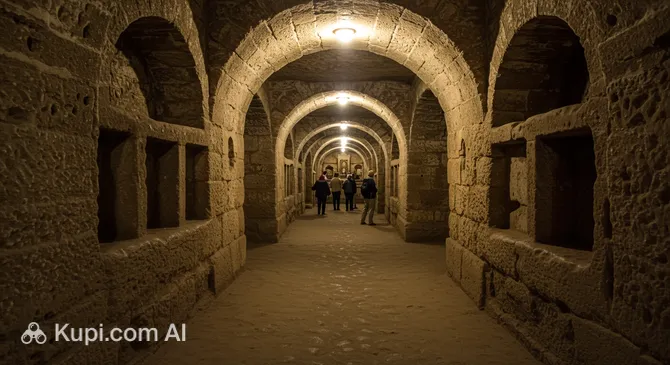
St Paul’s Catacombs. Illustration.
Source: Kupi.com AI

Traveller photos:

Upon descending underground, you will find yourself in a labyrinth of narrow corridors, burial chambers, and halls carved directly into the rock. Unlike the Roman catacombs, secret services were never held here—they were used exclusively for burials. The complex consists of several sections, each with its own separate entrance, reflecting the different communities that used this site to bury their deceased.

The catacombs are named after the Apostle Paul. According to tradition, after being shipwrecked off the coast of Malta in 60 AD, he found refuge in a grotto that later became part of this burial complex. Thanks to this legend, St. Paul's Catacombs have become an important pilgrimage site and attract tourists from all over the world who wish to touch the ancient history of Christianity.

Contacts

For the most up-to-date information on opening hours, ticket prices, and visiting conditions for St. Paul's Catacombs, it is recommended to visit the tourist information centers in Mdina or nearby Rabat. Detailed information can also often be found on the official website of Heritage Malta, the national agency that manages many of the country's historical sites.

How to contactContact
AddressHal-Bajjada, Ir-Rabat, Malta
Phone+356 2145 4562
Websiteheritagemalta.mt

What to Do

A visit to St. Paul's Catacombs is a unique opportunity to immerse yourself in a mysterious underground world that served as a necropolis from Phoenician times until the 8th century AD. The main activity for visitors is the self-guided exploration of the extensive network of underground corridors, halls, and burial chambers. You can move freely through the labyrinths, feeling the ancient atmosphere and imagining how the farewell rituals of the first Christian and Jewish communities of Malta took place here.

While walking through the catacombs, pay attention to the architectural and historical details. Inside, you will see numerous burial niches (loculi), as well as larger chambers designed for family burials. Of particular interest are the circular tables carved from stone, which were used for ritual meals in memory of the deceased. You can also examine symbols carved into the stone that are characteristic of early Christianity.

For a deeper understanding of the site's history, information plaques and displays are placed throughout the complex. They explain the significance of the catacombs, the burial rites of the time, and the life of early Christians on the island. Studying these materials will allow you to not only see the ancient tombs but also understand their immense cultural and religious significance.

Getting There

St. Paul's Catacombs are located in the town of Rabat, in the immediate vicinity of the fortified walls of ancient Mdina. Thanks to this proximity, getting there on foot from the historical center of the "Silent City" is very easy—a pleasant walk takes just a few minutes. This option is perfect for those already exploring the streets of Mdina. Finding the entrance is simple: tourist signs in the streets of Rabat will lead you directly to your destination.

For those traveling around Malta by public transport, the most convenient way to reach the catacombs is by bus. Regular routes depart from the capital, Valletta, towards Mdina and Rabat. The bus stop is located very close to the entrance of the complex, making the journey as comfortable as possible. If you are traveling by rental car, there is parking near the attraction where you can leave your vehicle during the tour.

Nearest city: Mdina

History & Facts

St. Paul's Catacombs are a unique underground complex located at the walls of the ancient capital of Malta, Mdina, which was known as Melite in ancient times. This site owes its origin to ancient stone quarries. After stone extraction ceased, the extensive galleries were converted into the island's largest necropolis of the Late Roman period, serving as a burial ground for residents for several centuries.

This impressive labyrinth of tombs is a testament to the island's rich history. Archaeological research has uncovered hundreds of shaft and chamber tombs here, used from the Late Phoenician to the Roman periods, roughly from the 4th century BC to the 2nd century AD. A unique feature of the catacombs is the variety of burial rites: both cremation areas and burials in amphorae are found here, reflecting the blend of cultural traditions of that time.

The catacombs get their name from Christian tradition, closely linked to the stay of Apostle Paul in Malta. According to tradition, after being shipwrecked off the coast of the island in 60 AD, the apostle preached Christianity here. Legend has it that he found refuge in one of the grottos of this complex. While there is no direct archaeological evidence for this, the story is firmly rooted in the country's culture and history.

The first scientific study of this historical monument was conducted only in 1894 under the leadership of Maltese archaeologist Antonio Annetto Caruana. His work marked the beginning of systematic study and preservation of this unique site. Today, the complex is managed by the national agency Heritage Malta and is open to visitors who wish to experience the ancient history of the island.

Time Needed

To explore St. Paul's Catacombs, it is recommended to set aside approximately 1–1.5 hours. This is usually enough time to leisurely walk through the main underground galleries, see various types of tombs, and view the unique circular tables used for memorial meals. The complex is quite extensive, and this amount of time will allow you to immerse yourself in the atmosphere of this ancient necropolis without being rushed.

If you are interested in history and archaeology or simply want to study all the details more thoughtfully, you should plan for a visit of up to 2 hours. This will give you the chance to carefully read all the information plaques that explain the history and features of the catacombs and fully appreciate the scale of this unique monument of the early Christian era in Malta.

Working Hours

St. Paul's Catacombs are usually open to visitors year-round. Standard opening hours are from morning until evening; however, they may vary depending on the season and public holidays. To avoid disappointment and plan your visit accurately, it is highly recommended to check the current schedule on the official website of the attraction immediately before your trip.

Although pre-booking tickets is not always mandatory, it can be a wise decision during the peak tourist season to guarantee entry and avoid potential queues. The availability and conditions for online ticket purchases should also be checked on the catacombs' official resource.

9:00 – 19:00

Nearby

Visiting such an iconic attraction as St. Paul's Catacombs is just the beginning of your journey into the rich history and culture of Mdina. To get a complete picture of the city and its surroundings, it is worth exploring other interesting places nearby. Often, the most striking discoveries await you just around the corner.

A walk through the nearby streets will allow you to dive deeper into the atmosphere of this ancient place. Near the catacombs, you will find other unique museums, historical buildings, and cozy establishments that will perfectly complement your impressions of traveling through Malta and make it even more rewarding.

NameDistance
St. Agatha's Catacombs0.1 km
L’Enoteca0.2 km
Wignacourt Museum0.2 km
St. Paul's Cathedral0.2 km
Casa Bernard0.3 km
Chez Eman Crêpes0.4 km
Yana's0.5 km

Reached the bottom of the page?

Looks like you know this route inside out