Support

Mdina Gate

Nearby places of interest

About

The Mdina Gate, also known as St. Paul's Gate, is the main and most ceremonial entrance to the ancient fortified city of Mdina in Malta. Built in 1724, this majestic Baroque gate serves not just as an entrance, but as a true portal into history, inviting travelers to immerse themselves in the atmosphere of the "Silent City." It replaced an older structure with a drawbridge and today stands as one of Malta's key architectural gems.
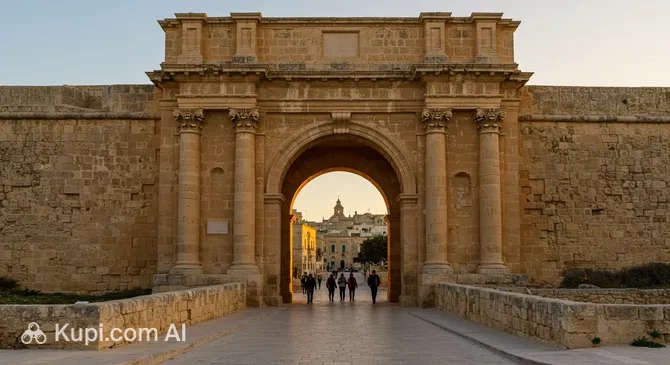
Mdina Gate. Illustration.
Source: Kupi.com AI

Traveller photos:

The architecture of the gate is striking in its splendor and attention to detail. The monumental portal is decorated with double pilasters, military trophies, and the coats of arms of Grand Master Antonio Manoel de Vilhena, at whose initiative it was built, as well as the city's own coat of arms. An impressive stone arched bridge leads to the gate, guarded by statues of lions. On the inner side, the passage is adorned with statues of Malta's patron saints — the Apostle Paul, St. Agatha, and the first bishop, Publius.

Beyond its aesthetic value, the Mdina Gate holds significant historical importance. A guardhouse that once protected the city's peace was located in the superstructure above the arch. Initially, the stone bridge was supplemented by a wooden drawbridge designed by the prominent French military engineer Sébastien de Vauban, emphasizing the defensive function of this structure in the past. Passing through this gate is the first step toward getting to know the rich heritage and unique atmosphere of the ancient Maltese capital.

Contacts

The Mdina Gate is a public historical monument and the main entrance to the city, so it does not have a separate phone number or email address. All necessary tourist information can be found on the official tourism portal of Malta, Visit Malta, or by contacting one of the tourist information centers on the island. Getting to the gate is very simple: it is located right at the entrance to the fortified city of Mdina, which is regularly served by buses from Valletta and other major cities.

How to contactContact
AddressVCM3+V9W, Mdina, Malta

What to Do

Visiting the Mdina Gate is a true immersion into history and culture. Start by carefully examining the architecture: on the outside, you will be greeted by a magnificent example of early 18th-century Baroque, decorated with the coat of arms of Grand Master Antonio Manoel de Vilhena surrounded by military trophies. After passing through the arch, don't forget to look back to see the inner part of the gate. Here, you will see relief images of Malta's patron saints — Publius, Agatha, and Paul — who seem to bless those entering the ancient city.

For the most observant travelers and fans of popular culture, there is a special secret. To the right of the main entrance, you can spot part of a more ancient, walled-up medieval gate. It was this old gate that appeared in the famous TV series "Game of Thrones" as the entrance to King's Landing (Season 1, Episode 3), making this spot a magnet for fans from all over the world. This is a great opportunity to take unique photos and feel like part of the legendary saga.

Once through the gate, you will find yourself on the threshold of the "Silent City." From here, your journey through the narrow streets with houses made of honey-colored sandstone begins, where every turn reveals new picturesque views. The main routes through Mdina start right behind the gate, leading to palaces, cathedrals, and observation decks. Additionally, it is worth taking time to walk through the former moat, which today has been transformed into a well-kept garden — a perfect place for a leisurely break and to admire the majestic bastions from the outside.

Getting There

Getting to the Mdina Gate is quite easy, as the ancient capital is located in the central part of the island of Malta, making it accessible from anywhere in the country. The most popular and economical way is by public transport. Regular bus routes connect Mdina with Valletta and other major settlements. The bus stop is just a few steps from the main entrance to the citadel, so you will be right at your destination.

If you prefer to travel by car, the drive to Mdina is also straightforward. Parking lots are located around the city walls where you can leave your vehicle. It is important to remember that Mdina itself is the "Silent City," with primarily pedestrian streets, and entry by private vehicle is strictly restricted. Therefore, after parking outside, you will enjoy a pleasant short walk to the majestic gate.

Alternatively, you can always use taxi services or ride-sharing apps, which will take you directly to the city entrance. Additionally, Mdina is a mandatory stop on most Hop-On Hop-Off tour bus routes. This is a convenient option for those who want to see several key attractions in Malta in one day with an audio guide and without worrying about public transport schedules.

Nearest city: Mdina

History & Facts

The current appearance of the Mdina Gate is the result of a large-scale reconstruction undertaken after the devastating earthquake of 1693, which caused serious damage to the ancient capital. Restoration work began in the first quarter of the 18th century at the initiative of the Order of Saint John. It was then, in 1724, that a majestic Baroque portal appeared on the site of the medieval entrance, created during the reign of Grand Master Antonio Manoel de Vilhena, whose coat of arms still adorns the facade today.

The project to transform the entrance to Mdina was entrusted to the talented French military engineer and architect Charles François de Mondion. His plan was comprehensive: simultaneously with the construction of the new gate, the Torre dello Stendardo was built nearby in 1725–1726. It replaced the older medieval tower, Torre Mastra, which was demolished to make way for a new, more modern and representative building in keeping with the spirit of the time.

In addition to its impressive architecture, the gate holds more ancient stories. Mdina, which is about 4,000 years old, has witnessed many epochal events. One of them explains why the gate is also known as St. Paul's Gate. According to the Acts of the Apostles, the Apostle Paul was shipwrecked off the coast of Malta in 60 AD. He spent three months on the island, converting local inhabitants to Christianity, including the Roman governor Publius, who became the first Bishop of Malta. This biblical connection forever etched the saint's name into the history of the ancient city and its main gate.

Time Needed

For a quick look at the Mdina Gate itself, you will need very little time — about 15–20 minutes. This is quite enough to examine its magnificent Baroque architecture, the bas-reliefs with coats of arms, and the overall monumental composition in detail. You will be able to take several memorable photos at the entrance, capturing the majestic stone bridge and the lion statues guarding the peace of the ancient city.

However, it is important to understand that the gate is only the beginning of your journey into the "Silent City." To truly feel the atmosphere and explore the treasures of Mdina, it is worth setting aside significantly more time. It is recommended to allow at least 2–3 hours for a full walk through this unique fortified city. During this time, you will have enough time not only to pass through the famous gate but also to wander through the narrow streets, visit St. Paul's Cathedral and other iconic landmarks, and enjoy the views from the ancient bastions.

Working Hours

Since the Mdina Gate is the main public entrance to the citadel, it is open to visitors 24 hours a day, all year round. Entry into the "Silent City" through it is completely free, and you do not need to buy tickets or book a visit in advance.

For the best experience, it is recommended to visit the gate during daylight hours. During the day, you can fully appreciate the exquisite Baroque architectural details and bas-reliefs, and take great photos against the backdrop of the majestic bridge. However, a walk through the gate at night, when the illumination comes on and the city lives up to its name, will offer a completely different, almost mystical and unforgettable experience.

Open 24/7

Nearby

After you have enjoyed the grandeur of the Mdina Gate, do not rush to leave this amazing place. The very essence of a journey to the "Silent City" lies in exploring its surroundings, as new discoveries await literally around every corner. A walk through the ancient streets will allow you to dive deeper into the atmosphere of medieval Malta and see other iconic spots located within walking distance.

Many interesting attractions, museums, and cozy restaurants are concentrated near the main gate, which will make your stay in Mdina even more fulfilling and memorable. Exploring these places will help you form a complete picture of the ancient capital's rich history and culture.

NameDistance
Mdina Dungeons Museum0 km
Mdina Old City0.1 km
St. Paul's Cathedral0.2 km
Casa Gourgion – A Nobleman's Home0.2 km
Root 810.2 km
Domus Romana0.3 km
Chez Eman Crêpes0.3 km

Reached the bottom of the page?

Looks like you know this route inside out