Support

Archaeological Site of Nea Paphos

About

Nea Paphos Archaeological Park is a vast open-air museum located in Paphos, in southwest Cyprus. This extensive complex, listed as a UNESCO World Heritage Site since 1980, consists of the ruins of an ancient city that once served as the island's capital. Walking through its territory is a true immersion into history spanning several millennia.
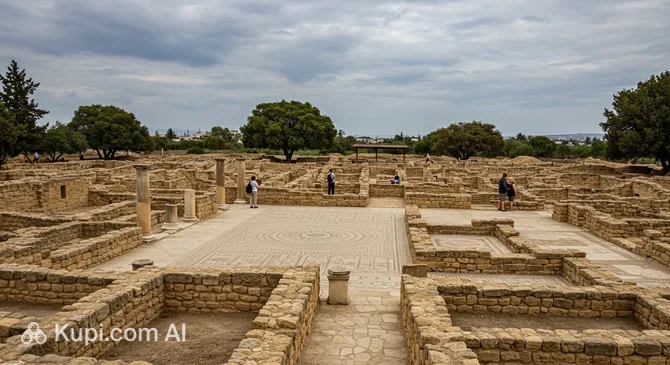
Archaeological Site of Nea Paphos. Illustration.
Source: Kupi.com AI

Traveller photos:

The stunning floor mosaics of the Roman period, discovered in the ruins of wealthy villas, are considered the park's crowning jewel. These works of art, found accidentally by a local farmer in 1962, depict scenes from Greek mythology and are striking in their detail and preservation. In addition to the famous mosaic houses, visitors can see the remains of an ancient Odeon theater, a marketplace (agora), and the ruins of a medieval fortress.

Nea Paphos is a place where traces of different civilizations intertwine: from prehistoric times to the Hellenistic, Roman, and Medieval eras. Visiting this archaeological site allows you not just to see ancient stones, but to truly feel the greatness and significance of a city that was a vital cultural, economic, and administrative center of the region for centuries. It is a must-see for anyone interested in history and archaeology.

Contacts

The Archaeological Park is one of the key attractions in Paphos and is located right by the city harbor, so finding it is quite easy. For the most up-to-date information on opening hours and events, it is recommended to contact the official sources.

How to contactContact
AddressQC45+C99, Paphos 8040, Cyprus
Phone+357 26 306217
Websitewww.visitpafos.org.cy

What to Do

The main activity at Nea Paphos Archaeological Park is taking a leisurely walk across its vast territory, where every step reveals a new page of history. For the convenience of visitors, there are special routes equipped with information boards. Most tourists' attention is drawn to the famous Roman mosaics, which are considered some of the finest in the entire eastern Mediterranean. You can see them in detail in the ruins of ancient villas: the House of Dionysos, the House of Theseus, the House of Aion, and the House of Orpheus. These remarkably well-preserved works of art depict scenes from ancient Greek myths and impress with their detail and craftsmanship.

Besides the mosaic villas, you can explore other significant structures of the ancient city. Be sure to visit the ruins of the Odeon — an ancient indoor theater that is still sometimes used for performances today — and the remains of the Agora, the ancient marketplace where public life once buzzed. Equally interesting is the Byzantine fortress of Saranta Kolones ("Forty Columns"), built to protect the city from raids and destroyed by an earthquake in the 13th century. A walk through its ruins allows you to imagine the strength of medieval fortifications.

For history and archaeology enthusiasts, a visit to the park will be particularly exciting, as you can not only view known sites but also observe the work of scientists. Archaeological excavations at Nea Paphos continue to this day, giving visitors the chance to see firsthand how historical discoveries are made. This is a unique opportunity to touch the past and feel like part of the centuries-old history of this amazing place.

Getting There

Finding the Nea Paphos Archaeological Park is easy, as it is located in the western part of Paphos, right next to the picturesque promenade and the old port. Thanks to its prime location, the city's main historical landmark can be easily reached on foot from the central resort area. This walk is a pleasure in itself, allowing you to enjoy the atmosphere of the seaside town.

For those staying in more distant areas or resort zones, public transport is an excellent choice. The main Kato Paphos bus station is located near the park, making the trip both convenient and budget-friendly. You can also take a taxi or rent a car — there is ample parking for private vehicles, so you can leave your car and head off to explore the ancient ruins with peace of mind.

Travelers arriving in Paphos on cruise ships will find the park's location particularly convenient. The complex is just a few minutes' walk from the port, making it an ideal place to visit even during a short stopover. This allows you to make the most of your time and discover one of Cyprus's most important historical sites without extra travel costs.

Nearest city: Paphos

History & Facts

The history of the Nea Paphos Archaeological Site dates back to the 4th century BC, when the last king of Paphos, Nicocles, founded the new city. It was built according to the advanced principles of ancient urban planning: with clearly designed blocks and a division into residential, commercial, and public zones. Due to its strategic location and proximity to maritime trade routes, Nea Paphos became the capital of all of Cyprus during the Hellenistic period, ensuring its prosperity for centuries.

The city's peak occurred in the 2nd and 3rd centuries AD, when it was an important center of the Roman Empire. During this period, luxurious villas decorated with famous mosaics were erected, and public buildings were constructed, including temples dedicated to Zeus, Aphrodite, Apollo, and Artemis. Later, in the 7th century, the powerful Saranta Kolones fortress was built to protect against raids; in the 12th century, it was rebuilt and strengthened by the Crusaders, who left their mark on the site's history.

Despite its former glory, the city eventually fell into decline, and its treasures were hidden underground for many centuries. A new chapter in the history of Nea Paphos began in 1962, when large-scale archaeological excavations were launched. This work led to truly sensational discoveries: magnificent mosaics and the remains of ancient buildings were revealed to the world. It was these findings that turned Nea Paphos into one of the most significant archaeological sites in the Mediterranean and brought it worldwide fame.

Time Needed

To fully enjoy a visit to the Nea Paphos Archaeological Park, it is recommended to set aside between 2 and 4 hours. This is enough time to explore the key sites of this vast open-air complex without rushing, including the ruins of ancient villas and the famous mosaics. Walking through the area will allow you to immerse yourself in the atmosphere of the ancient city that was once the capital of Cyprus.

The choice of visit duration depends on your interest in history. If you have about two hours, you can focus on the park's main gems — the Roman mosaics in the House of Dionysos and the House of Theseus. If you wish to explore the grounds more thoroughly, including the ruins of the ancient Odeon, the Agora, and the Saranta Kolones fortress, it is better to plan for at least 3-4 hours. This approach will allow you to thoughtfully study all the sights of this unique place in Paphos.

Working Hours

Nea Paphos Archaeological Park is open to visitors year-round, but the opening hours vary depending on the season. During the winter period, from September 16 to April 15, the attraction can be visited daily from 8:30 AM to 5:00 PM. In the summer season, from April 16 to September 15, the hours are extended until 7:30 PM, providing a great opportunity to explore the ancient ruins during the cooler evening hours.

Special ticket booking for individual visits is generally not required. However, given possible schedule changes, especially on public holidays, it is highly recommended to check for the latest information on opening hours through official resources or by phone before your visit.

8:30 – 19:30

Nearby

Visiting the Nea Paphos Archaeological Park is just the beginning of your journey into the rich history and culture of Paphos. Thanks to the park's excellent location, many other iconic sites are within walking distance. Exploring the surrounding area will give you a more complete picture of this amazing corner of Cyprus and make your trip even more fulfilling.

A stroll to nearby attractions won't take much time but will provide many new impressions. You will see how ancient heritage exists harmoniously alongside medieval buildings and modern resort life. Below is a list of interesting sites located very close to the park, but just outside its boundaries.

NameDistance
Paphos Promenade0.1 km
Paphos Castle0.3 km
House of Dionysus0.3 km
Paphos Mosaics0.3 km
Paphos Lighthouse0.5 km
Saint Paul's Pillar0.5 km
Roman Odeon0.5 km

Reached the bottom of the page?

Looks like you know this route inside out