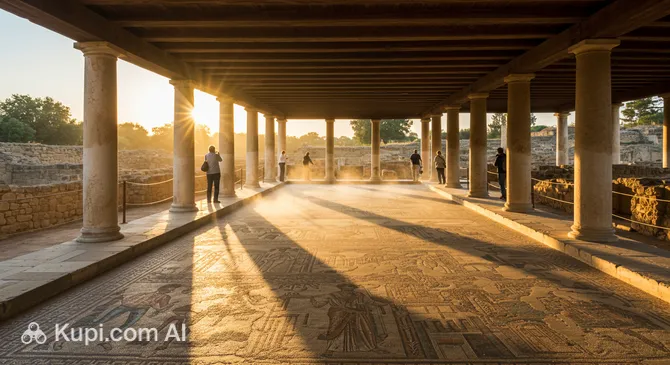
Imagine a luxurious residence of a Roman nobleman, spanning an impressive 2,000 square meters. This is the scale of the House of Dionysos—one of the most significant archaeological finds preserved in the ancient city of Paphos. This attraction comprises the ruins of a massive residential house that has become a true open-air museum on the island of Cyprus.
House of Dionysus. Illustration.
Source: Kupi.com AI
Traveller photos:
This ancient monument was named after the numerous depictions of Dionysos, the god of wine and revelry, which adorn the superbly preserved mosaic floors. The building is believed to have been constructed in the late 2nd century AD and served as the center of social life for the local aristocracy, impressing guests with its scale and elegant finishes.
The interior layout includes about 40 rooms skillfully arranged around an open central courtyard—the peristyle. The primary value of this site lies in its unique mosaics, which cover more than 550 square meters, transforming an ordinary floor into a canvas of mythological plots and everyday scenes from antiquity.
Contacts
You can contact the administration or clarify visit details using the official information for the Archaeological Park.
The main highlight here is undoubtedly contemplating the ancient mosaics, recognized as some of the finest in the Mediterranean. Visitors can walk along specially designed walkways to view detailed hunting scenes and intricate geometric patterns from above. Be sure to find the mosaic in the central hall depicting the Triumph of Dionysos—it is considered the crown jewel of the entire collection.
While strolling through the ruins, you can observe the architecture of a wealthy Roman house firsthand. Explore the east wing, where the living quarters and baths were once located, and peek into the western part, which served as the formal area with the dining room (triclinium). The preserved layout makes it easy to imagine how life was organized within these walls nearly two thousand years ago.
Don't forget to pay attention to the open spaces surrounding the house. Since the site is located within the Archaeological Park, your tour of the villa can be combined with exploring neighboring monuments while enjoying the tranquility and the sea breeze coming from the harbor.
Getting There
Finding this ancient masterpiece is easy, as it is located in the heart of the tourist zone. The House of Dionysos is situated within the Paphos Archaeological Park, which stretches across the central coastal part of the city. The exact address is QC54+7C8, Paphos 8040, Cyprus.
For those who prefer public transport, a great option is the city buses running to the Kato Paphos harbor. From the main bus station at the port, the entrance to the park is just a few minutes' walk away. If you are coming from remote areas or other cities, it is most convenient to use a taxi or a rental car.
For drivers, the GPS coordinates are: 34.758163°N, 32.4060775°E. There is a spacious parking lot at the entrance to the Archaeological Park where you can leave your car before starting your walk through the ancient ruins.
Nearest city: Paphos
History & Facts
This luxurious building owes its existence to the city's prosperity in the 2nd century AD. Interestingly, the villa was not built on an empty plot: archaeologists discovered the foundations of earlier Flavian-era structures beneath it. Even older layers concealed a sanctuary carved directly into the rock, where a rare bone knife handle depicting the god Harpocrates was found.
The golden age of this site ended suddenly and tragically. In the first half of the 4th century AD, a series of powerful earthquakes that leveled most of the ancient cities on the island did not spare this house. The building collapsed, forever burying its magnificent interiors under the rubble—which, paradoxically, helped the mosaics survive to this day in excellent condition.
In subsequent centuries, the ruins served as a sort of "quarry" for local residents: finished stone blocks were extracted from the walls to build new houses in the area. The western part of the structure suffered particularly from this activity. Nevertheless, the surviving fragments of walls and floors today serve as an invaluable source of knowledge about the daily life and aesthetic tastes of the wealthy elite of ancient Paphos.
Time Needed
To leisurely examine every detail of the mythological stories and appreciate the skill of ancient artists, a typical visitor will need between 1 and 2 hours. This is quite enough time to see all 40 rooms and the main mosaic panels.
However, keep in mind that the site is part of the extensive Paphos Archaeological Park. If you plan to see other villas, the fortress, and the lighthouse, it is better to set aside at least 2–3 hours for your visit. Comfortable shoes and a supply of water will make this immersion into history as pleasant as possible.
Working Hours
The doors of this historical complex are open to guests daily, making it easy to include in your sightseeing itinerary. You can visit the ruins from Monday to Saturday, from 8:30 AM to 5:00 PM.
On Sundays, the opening hours are extended, and the attraction can be explored from 8:30 AM to 7:00 PM. Please note that entry to the grounds stops some time before the official closing of the park, so it is advisable to arrive early.
Day
Opening hours
Monday
8:30 – 17:00
Tuesday
8:30 – 17:00
Wednesday
8:30 – 17:00
Thursday
8:30 – 17:00
Friday
8:30 – 17:00
Saturday
8:30 – 17:00
Sunday
8:30 – 19:00
Nearby
A visit to this villa is just one part of a grand journey through time offered by the city's historical district. Exploring the surroundings will allow you to fully experience the scale of the ancient heritage and enjoy the Mediterranean scenery.