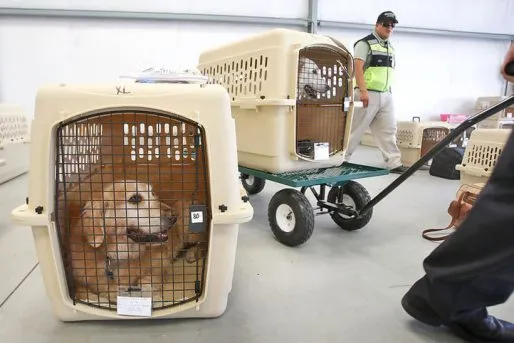
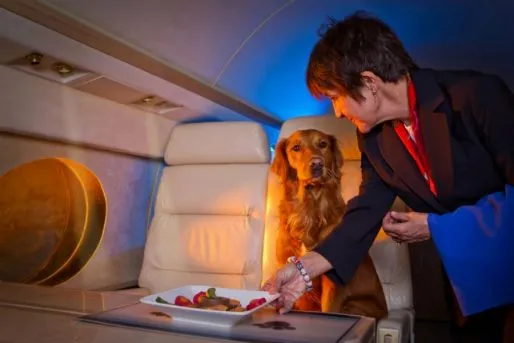
Which dog breeds are not allowed for transport and what difficulties might arise when planning a flight with a pet? We'll tell you how to show the world to your four-legged friend.If you decide to take your dog with you on a trip, you should arrive at the airport in advance, as all necessary formalities can take about an hour. First, at the airport's veterinary control service, you need to exchange the certificate obtained from the district veterinary service for an international one. Then, the new certificate, a European health certificate, a veterinary passport, and the animal itself must be presented at the check-in counter. From this moment, the dog cannot be released from its carrier, even if you are taking it into the cabin. An airport employee will deliver the dog to the aircraft's cargohold, and you will only see your pet again upon arrival. Equip the crate with two empty containers and a water dispenser so that in case of a flight delay, airport staff can feed the animal andgive it water without opening the crate.
What to consider when planning a trip with a dog?
First, you should familiarize yourself with the generalrules for exporting pets from Russia. As for dogs, only those older than three months are allowed for transport, and exclusively with an electronic microchip and a veterinarypassport with arabies vaccination mark. The rabies vaccination must be administered no earlier than 30 days before departure and no later than one year. It is recommended to use an imported vaccine, such as Nobivac, which is recognized worldwide — unknown brands of domestic vaccines may be viewed with suspicion at customs. An electronic microchip, which became an alternative to tattooing in 2008, can be implanted at any veterinary clinic, both private and public. This procedure is absolutely painless for thedog; no special diet or regimen is required before or after microchipping.If the country you are traveling to is not partof the European Union and is not a frequently visited route,only the veterinary service of the airport you are flying to can provide the most complete picture of animal transportation rules.For example, if you are going to Bangkok, several weeks before your flight, find information on the rules for transporting dogs to that country on the official website of Bangkok International Airport, and if it's not available — call the official airport services orwrite them an email.
What are the restrictions for transporting dogs?
Some countries prohibit the import of aggressive dog breeds, such as Pit Bull Terrier, Staffordshire Bull Terrier, American Staffordshire Terrier, Rottweiler, Dogo Argentino, Fila Brasileiro, Tosa Inu, and Akita Inu. If their import is still permitted, the airline will require a muzzle, or particularly strictrequirements will beimposed on the crate.Many countries have their own individual requirements for importing dogs. For example, Panama insists on an animal export certificate obtained directly from the Panamanian consulate in Russia; Israel and Finland require a special test for rabies antibodies, and in Finland, the results of such a test are only accepted from authorized laboratories not located in Russia (this means the sample will have to be sent to the European Union and the result awaited, or the dog imported into Finland via a neighboring country); in theUnited Kingdom, as of January 1, 2012,the six-month quarantine for dogs was abolished, andnow animal import is carried out according to general European rules, but the administration of echinococcus medication is mandatory before entering the United Kingdom. New Zealand, Ireland, Malta, Cyprus, Hong Kong, Sweden, Japan, Singapore, and some other countries have special requirements for importing dogs. There are also other types of restrictions — medical ones. Ifyour dog suffers from heart problems, has had a serious illness or surgery, then due to pressure changes, the flight can be a severe test for it. Some dog breeds with shortened muzzles (bulldogs, pugs) may experience breathing problems on theplane due to anatomical features.
What to consider when transporting a dog on a plane?
Once you have decided to take your dog with you andhave ensured that all requirements for preparing the animal for departure have been met, notify the airline that you intend to fly with a dog, providing its breed, age, carrier dimensions, and the animal's weight along with thecarrier. The airline willinform you whether thedog is allowed in the aircraft cabin or if it needs to be checked as baggage (in which case, staff must check for available space in the heated cargo hold). It's best to clarify this information directly before purchasing your ticket and note that some airlines, such as Emirates, may take several days to respond to a request.Most airlines allow dogs weighing up to 6–7 kg to fly in a soft bag in the cabin; heavier animals must travel only in rigid special carriers and in the cargo hold. The cost of transporting your dog will also depend on its location on the plane. Generally, transporting an animal in the cargo hold is about one and a half times more expensive than in the cabin. A cargo ticket should be booked in advance, as each aircraft only has three spots for animal transport in the heated compartment, and if two of them are occupied by large crates, you might be denied. If the airline offers this option, it's best to pay for the dog's ticket immediately after booking — on their official website or via their helpline.
Have a pleasant journey!
 Which dog breeds are not allowed for transport and what difficulties might arise when planning a flight with a pet? We'll tell you how to show the world to your four-legged friend.
If you decide to take your dog with you on a trip, you should arrive at the airport in advance, as all necessary formalities can take about an hour. First, at the airport's veterinary control service, you need to exchange the certificate obtained from the district veterinary service for an international one. Then, the new certificate, a European health certificate, a veterinary passport, and the animal itself must be presented at the check-in counter. From this moment, the dog cannot be released from its carrier, even if you are taking it into the cabin. An airport employee will deliver the dog to the aircraft's cargo hold, and you will only see your pet again upon arrival. Equip the crate with two empty containers and a water dispenser so that in case of a flight delay, airport staff can feed the animal and give it water without opening the crate.
Which dog breeds are not allowed for transport and what difficulties might arise when planning a flight with a pet? We'll tell you how to show the world to your four-legged friend.
If you decide to take your dog with you on a trip, you should arrive at the airport in advance, as all necessary formalities can take about an hour. First, at the airport's veterinary control service, you need to exchange the certificate obtained from the district veterinary service for an international one. Then, the new certificate, a European health certificate, a veterinary passport, and the animal itself must be presented at the check-in counter. From this moment, the dog cannot be released from its carrier, even if you are taking it into the cabin. An airport employee will deliver the dog to the aircraft's cargo hold, and you will only see your pet again upon arrival. Equip the crate with two empty containers and a water dispenser so that in case of a flight delay, airport staff can feed the animal and give it water without opening the crate.