How to survive a plane crash
Numerous studies suggest that there is almost always a chance to survive a plane crash. However, the likelihood of escaping with just an injury, or even a slight scare, depends not only on the actions of the pilot and flight attendants but also on the passengers themselves. In this article, we will provide several rules that, if followed, can increase your chances in the event of a disaster.

How to reduce potential damage from a plane crash?
- Fasten your seatbelt. It will allow you to stay in your seat and not be thrown out or hit parts of the cabin upon impact. It is not advisable to unfasten your seatbelt throughout the entire flight, even if the "fasten seatbelts"" sign has turned off.
On July 20, 2010, a United Airlines flight encountered severe turbulence. 20 people among the passengers sustained serious injuries, as they were not buckled in. The plane had to make an emergency landing at Denver airport; passengers were provided assistance, and some were hospitalized with fractures and other injuries.
- Brace. This position helps prevent fractures and injuries. In English, the crew's command will be "Brace!". There are at least 2 cases in history where all passengers survived precisely because of this.
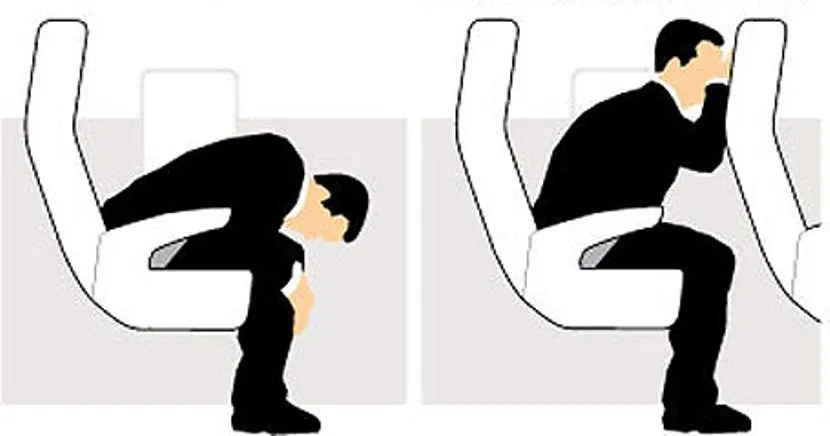
During the crash of SAS flight on December 27, 1991, the plane crashed near the village of Gottröra, breaking into three parts, but none of the 129 people on board died. Later, the investigation of the incident showed that the disaster occurred without casualties thanks to the coordinated work of the crew and passengers, who strictly followed all flight attendants' commands and did not panic.
- Clear your pockets in advance; even an ordinary pen can cause a serious injury upon impact.
- Never sleep during takeoff and landing; statistically, the most unsafe periods are the first 3 minutes after takeoff and during plane acceleration, and the last 8 minutes before landing.
How to survive a water landing?
History records 26 cases of emergency plane water landings; in all but one case, there were survivors. To increase your chances, follow these rules:
- Never inflate your life vest on board; only do so after you have exited the plane, but you should put it on beforehand.
- If you find yourself in the water, try to huddle with other passengers, stay close to each other; this will help you avoid or slightly delay hypothermia. However, be wary of panicking individuals; their uncontrolled movements can endanger not only themselves but also others.
How to survive during evacuation?
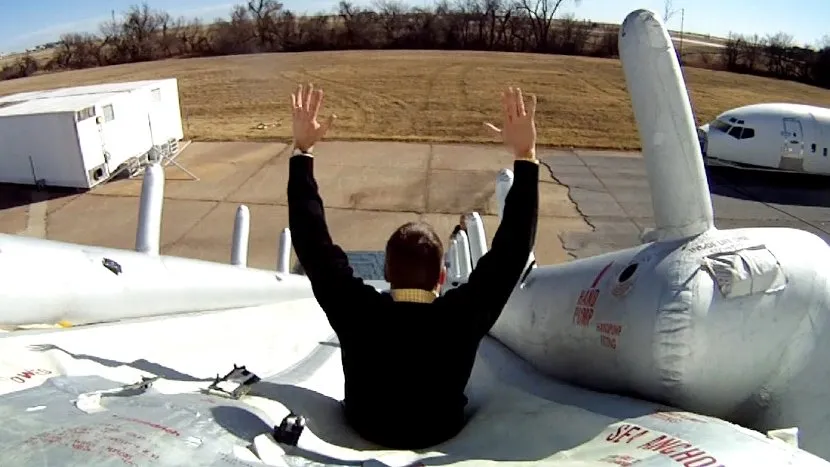
- Study the evacuation routes in advance. Find the nearest emergency exit to you, count how many rows away it is. In case of smoke and poor visibility, this knowledge will save your life. Study the safety rules booklet, which is in the back of every seat, and understand how to open the emergency exit door.
- Fly in appropriate clothing. First and foremost, clothing for the flight should be comfortable and not restrict your movements. The same applies to footwear. Believe me, running out of a burning plane in high heels is quite difficult. Pay attention to the material; most injuries in a disaster are burns. Try to avoid synthetics (they will melt instantly and cause even greater damage) and opt for natural and dense materials.
- Do not consume alcohol on the plane. While it may help some relieve stress and fear of flying, in an emergency situation, it will play a cruel trick on you.
- If the cabin fills with smoke, try to crouch as low as possible and cover your mouth and nose with some material. Smoke is very toxic and can kill much faster than flames. From physics, we know that smoke always rises, so crouch down and move towards the exit on all fours. Most often, in case of smoke, a passenger has no more than 90 seconds to get out alive and avoid carbon monoxide poisoning.
- Do not try to retrieve your belongings, for at least two reasons. Firstly, during an evacuation, literally every second counts; searching for items and attempting to exit the plane with them will steal valuable seconds. Secondly, other passengers will follow your example, and then it will be problematic for everyone to exit. You remember how those who spend a long time trying to gather their belongings and remove them from the overhead bin slow down the exit from the plane, don't you?
Specialists who investigate plane crashes have compiled statistics showing that the chance of survival depends not on which part of the cabin the passenger is in (front, over the wing, or in the rear), but on how far they are from an emergency exit. Studies show that those sitting no more than five rows from an emergency exit have a greater chance.