Support

Palace of Culture and Science

About

The Palace of Culture and Science (Pałac Kultury i Nauki) is one of the most recognizable and monumental buildings not only in Warsaw but in all of Poland. Located in the heart of the city at Parade Square, this skyscraper is an essential part of the capital's skyline and a major tourist attraction. Locals often refer to it as PKiN or colloquially as "Pekin" (a play on its acronym).
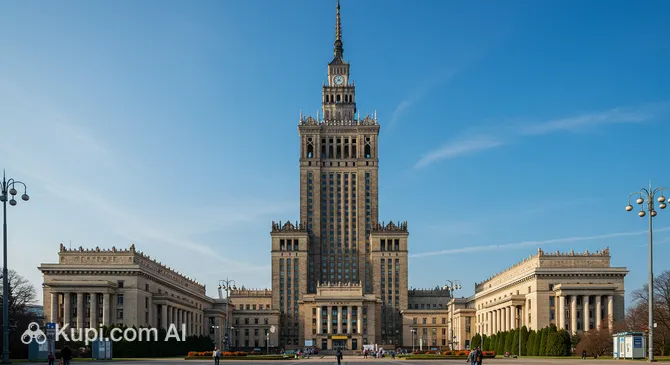
Palace of Culture and Science. Illustration.
Source: Kupi.com AI

Traveller photos:

The building represents a unique blend of Stalinist Neoclassical architecture and Polish Historicism. Its total height, including the spire, reaches nearly 237 meters, with 42 floors inside. At the time of its completion in 1955, the Palace was the second-tallest building in Europe. The scale of the structure is impressive: about 40 million bricks were used for its construction, and the total number of rooms exceeds 3,000.

Today, the Palace of Culture and Science is a multifunctional complex with a vibrant atmosphere. Within its walls are theaters, museums, a cinema, a university, as well as offices for various companies and public institutions. Additionally, it hosts numerous exhibitions, fairs, and conferences. One of the main draws for tourists is the observation deck on the 30th floor, which offers a spectacular panorama of Warsaw.

Contacts

To get the most up-to-date information on opening hours, ticket prices, and current events, we recommend contacting the Palace of Culture and Science directly. All necessary contact details, including the official website, are listed below.

How to contactContact
Addressplac Defilad 1, 00-901 Warszawa, Poland
Phone+48 22 656 76 00
Websitewww.pkin.pl

What to Do

A visit to the Palace of Culture and Science is an opportunity to immerse yourself in a true kaleidoscope of experiences. Life bustles inside this monumental building: it houses numerous museums, such as the Museum of Technology, four theaters, and a multiplex cinema where you can get acquainted with Polish art. Additionally, visitors can enjoy restaurants, bookstores, exhibition spaces, and even a large swimming pool. You can spend time exploring the exhibits, watching a play, or simply soaking in the unique atmosphere of this multifunctional complex.

The main attraction for most tourists is the famous observation deck located on the 30th floor at a height of 114 meters. After ascending in a high-speed elevator, you will be rewarded with a stunning panoramic view of all of Warsaw. It offers a wonderful opportunity to see the city from a bird's-eye view, take impressive photos, and appreciate the scale of the Polish capital. There is also a cafe at the top where you can relax and buy souvenirs. For visitor safety, the deck is equipped with safety mesh, so you can enjoy the views without any worries.

The Palace of Culture and Science also serves as an important center for the city's social and business life. It houses Poland's largest Congress Hall, which can accommodate up to 3,000 people. Its halls regularly host international conferences, concerts by world stars, fairs, and other large-scale events. Therefore, when planning your visit, it's worth checking the schedule—your trip might coincide with an interesting event worth attending.

Getting There

Getting to the Palace of Culture and Science is incredibly easy, as it is located in the very heart of Warsaw, at Parade Square (plac Defilad, 1). Thanks to its central location, the building serves as a key landmark and is easily accessible from any point in the capital of Poland.

The most convenient way to reach it is by public transport. At the foot of the palace lies the Centrum metro station (Line M1), and just a few minutes' walk away is the Świętokrzyska interchange station, where lines M1 and M2 meet. Additionally, numerous bus and tram stops, such as "Centrum" and "Dworzec Centralny," are nearby, served by dozens of routes connecting the city center with all districts.

If you arrive in Warsaw by train, your walk to the attraction will take only a few minutes. The Palace of Culture and Science stands in immediate proximity to the main railway station, Warszawa Centralna. Traveling by taxi or rented car is also straightforward, though it's worth keeping in mind the heavy traffic in the city center and the fact that finding parking may take extra time.

Nearest city: Warsaw

History & Facts

The history of the Palace of Culture and Science dates back to the post-war years when it was decided to erect a monumental building in the center of Warsaw. Construction took place from 1952 to 1955 as a "gift from the Soviet Union to the Polish people." The project was designed by the architect Lev Rudnev, one of the creators of Moscow’s famous "Stalinist skyscrapers." To give the building a national flair, Rudnev specifically studied traditional Polish architecture by visiting historic cities like Krakow and Zamość. Nevertheless, its resemblance to the main building of Moscow State University is still evident today.

The construction of such a massive structure was a grand project. Around 3,500 Soviet workers arrived in Warsaw for the construction. A whole residential district with its own infrastructure—a cinema, canteen, and even a swimming pool—was built for them on the outskirts of the city. About 4,000 Polish specialists were also involved in the project. To clear space for the future giant in the heart of the capital, approximately 170-180 pre-war buildings had to be demolished. Unfortunately, the construction was not without tragedy, as 16 people lost their lives during the three-year project.

The grand opening of the palace took place on July 22, 1955. Initially, the building was named after Stalin—the "Joseph Stalin Palace of Culture and Science"—but after 1956, this part of the name was removed. Conceived as a symbol of Polish-Soviet friendship, the palace was intended to be visible from any point in the city. Its appearance has sparked mixed feelings among Poles over the years, becoming an inseparable, though controversial, part of Warsaw's history and skyline. Over time, the building's originally white facade has darkened, while the structure itself has become steeped in urban legends and deeply integrated into the capital's cultural life.

Time Needed

When planning a visit to the Palace of Culture and Science, it's worth deciding in advance how much time you want to spend, as the leisure options here are diverse. For most tourists, the main goal is the ascent to the famous observation deck on the 30th floor. Such a visit usually takes 1 to 2 hours. This is enough time to wait for the elevator without rushing, enjoy breathtaking panoramic views of Warsaw from a height of 114 meters, take photos, and have a coffee at the local cafe. Most visitors spend about 20-30 minutes on the deck itself, but there is no time limit for staying at the top.

If you want a deeper look at this unique complex, plan to spend significantly more time. For instance, a guided tour of the palace's interiors takes about 1.5 hours. Visiting one of the museums located inside, such as the Museum of Technology or the Museum of Evolution, can also take another 1.5-2 hours. Thus, for a combined visit including both the observation deck and a museum, it's best to set aside half a day (about 3–4 hours). And if your plans include a theater performance or a concert, this will be a separate evening event that offers a completely different experience of this multifaceted symbol of Poland.

Working Hours

The main tourist attraction of the Palace of Culture and Science—the observation deck (Taras Widokowy) on the 30th floor—is open to visitors year-round. Standard opening hours are daily from 10:00 to 20:00. It's worth noting that during certain periods, such as summer and December, opening hours may be extended until late in the evening on Fridays and Saturdays. However, hours may change on public holidays, so it is highly recommended to check current information on the official website before visiting.

Tickets can be purchased at the onsite ticket offices or online, which often helps save time and avoid queues, especially during the summer season. Advance booking for a specific time is usually not required, but purchasing a ticket beforehand guarantees entry. The ticket office closes at the same time as the observation deck, and during periods of high visitor numbers, ticket sales may be temporarily suspended.

10:00 – 20:00

Nearby

A visit to the Palace of Culture and Science is just the beginning of your journey through central Warsaw. Thanks to its location, you find yourself at the epicenter of the city's cultural and social life. A walk through the surrounding area will allow you to discover many other interesting spots, from museums and theaters to cozy cafes and historical monuments, all just steps away.

Exploring nearby attractions will enrich your experience and help you gain a fuller understanding of the multifaceted nature of Poland and its capital. Below is a list of some sites located in the immediate vicinity of the palace that might interest you.

NameDistance
Pianka 24-Hour Restaurant0.4 km
Bibenda0.7 km
NBP Money Centre0.8 km
Norblin Factory1 km
Tomb of the Unknown Soldier1.1 km
National Museum in Warsaw1.2 km
68 Aquarium Shop1.4 km

Reached the bottom of the page?

Looks like you know this route inside out