Source: Kupi.com AI
| Characteristic | Value |
|---|---|
| IATA code | QIT |
| ICAO code | SNIP |
| City | Itapetinga |
| Country | Brazil |
| Time zone | America/Bahia |
| Schedule | Live departures board |
| Characteristic | Value |
|---|---|
| IATA code | QIT |
| ICAO code | SNIP |
| City | Itapetinga |
| Country | Brazil |
| Time zone | America/Bahia |
| Schedule | Live departures board |
Since Itapetinga Airport is a small regional airfield serving primarily private aviation and lacking regular commercial flights, it does not have a standard passenger support service or a dedicated helpline like major international hubs. Management is carried out by the state structures of Bahia and the local administration.
Below are the most current contact and location details available for travel planning:
Thanks to the airport being located just **4 kilometers** from the center of Itapetinga, the journey there will not take much time or effort. The transport infrastructure here is typical for small Brazilian cities: options are limited but reliable and affordable. Since the airport primarily serves private flights, there are no massive transport hubs, yet reaching the terminal is hassle-free.
Below are the main ways to get to the air harbor, as well as recommendations for travelers planning their route.
This is the most convenient and common way to get to the airport. Itapetinga has a well-developed local taxi service. A trip from the central square or major hotels in the city will take just **10–15 minutes**, provided there is no traffic congestion.
The estimated cost of a car trip from the city center is between **20 to 35 Brazilian Reals** (BRL), depending on the time of day.
If you prefer freedom of movement, renting a car is an excellent option. There are rental points for local and regional companies within Itapetinga itself. The road to the airport runs along the avenue Av. Isaí Dutra Amorim.
Important: International rental counters are generally absent inside the airport building or operate only by prior request. It is recommended to rent a car in the city and agree on the return procedure before your flight in advance.
There are no specialized express buses or rail links to the airport. Itapetinga's urban bus network covers major districts, and some routes pass along the avenue near the airport.
However, this method is **not recommended** for tourists with luggage. The stop may be at some distance from the terminal, and the bus schedule does not always align with private flight plans. Public transport here is oriented primarily towards the needs of local residents, not air passengers.
A parking area for vehicles is provided on the airport grounds. Given its status as a regional airfield, the parking is an open-air lot. Typically, there is ample space, and the parking fee is either symbolic or non-existent (free parking), which is a pleasant bonus for those seeing someone off or leaving a car for a short period.
Since Itapetinga Airport does not receive regular commercial flights from major airlines, most tourists fly to neighboring cities and then travel to Itapetinga by ground transport (bus or rental car). The nearest major hub is Vitória da Conquista Airport, located approximately 75 km away. The journey from there takes about 1–1.5 hours.
For those planning to combine their trip with a coastal holiday, convenient options might be Ilhéus/Bahia-Jorge Amado Airport (about 142 km) or the more distant Porto Seguro Airport, famous for its resorts.
If you are flying from abroad, your entry point into the region will likely be Salvador – Deputado Luís Eduardo Magalhães International Airport, from where you can take a domestic flight to Vitória da Conquista or travel by land. For travelers heading to the Chapada Diamantina National Park, Lençóis – Coronel Horácio de Mattos Airport may also be of interest.
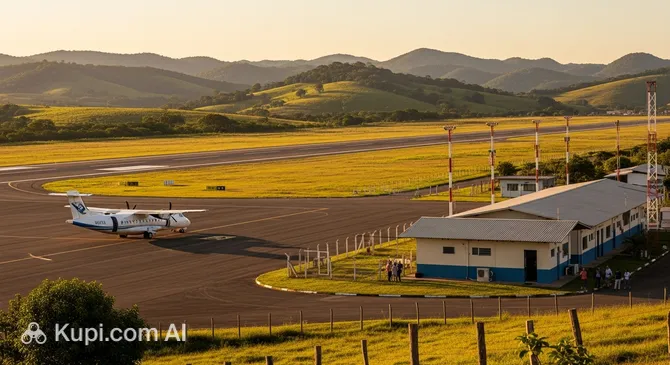
The infrastructure of Itapetinga Airport (QIT) fully corresponds to its status as a small regional aviation hub. There are no confusing mazes of corridors or needs to use trains to move between gates. The terminal complex is designed to ensure maximum speed and simplicity in servicing passengers of private and business aviation.
The airport features **one compact passenger terminal**. It is a single-story building that combines all necessary services for departing and arriving guests.
Due to the lack of separation into domestic and international sectors (the airport accepts only domestic flights), the space is used as efficiently as possible. The main purpose of the terminal is to ensure a short and comfortable transit from the car to the aircraft steps. There is no division into Terminals A, B, or C, so it is impossible to get lost or mistake your destination.
The internal layout of the terminal is characterized by extreme simplicity and intuitive clarity. The terminal scheme includes the following key zones:
Unlike major hubs, in Itapetinga, the departure and arrival zones are virtually combined or located in adjacent rooms of the same building.
Departure Zone: The boarding procedure here is stress-free. After a brief document check (if required), passengers pass through the single exit directly onto the runway to their aircraft. The distance from the terminal door to the steps is minimal.
Arrival Zone: Arriving passengers enter the terminal via the same route. Baggage claim usually takes place either directly at the aircraft side (hand-to-hand) or in the terminal hall, where it is handed over by ground service staff. There are no carousel-type baggage belts here.
One of the main advantages of Itapetinga Airport is time-saving. The absence of regular commercial flights with hundreds of passengers means there are practically **no queues**.
For travelers visiting Itapetinga for the first time, navigation will not be difficult. The entire path from the building entrance to the aircraft seat is visually visible. Airport staff are few but always ready to indicate directions. The main advice is to agree in advance with the greeter or driver on the exact meeting place at the terminal exit, as the parking zone is literally a few steps from the building doors.
The history of Itapetinga Airport is inextricably linked with the economic rise of the city itself, which proudly bears the title of the "Capital of Livestock Farming" of the state of Bahia. The air harbor emerged as a strategic response to the need for rapid connection of this rich agricultural region with the state's administrative center, Salvador, and other major Brazilian cities. In the mid-20th century, when the region's road network was poorly developed, aviation became the driver of growth for local farmers and entrepreneurs.
The airport received active development during the heyday of regional aviation in Brazil. For several decades (especially in the 1970s and 1980s), regular passenger transport was carried out here. Long-time residents remember the times when the legendary **Embraer EMB-110 Bandeirante** aircraft of Nordeste Linhas Aéreas landed on the Itapetinga runway. This period is considered the "golden age" of the airport when it served as a vital bridge for residents of the hinterland.
Like many regional airports in Brazil, Itapetinga experienced periods of decline and revival. With the departure of major regional carriers and the improvement of road quality, passenger flow decreased, and the airport reoriented towards private aviation. However, the importance of the facility was never in doubt, leading to regular upgrades.
One of the key stages of recent history was a large-scale reconstruction initiated by the government of the state of Bahia in the second half of the 2010s and early 2020s. The works included:
The airport played a special role during the city's industrialization period, when large footwear manufacturing facilities opened in Itapetinga (specifically factories of the giant Vulcabras/Azaléia). During this period, the airfield became a crucial logistics hub for top management and investors. The intensity of business aviation flights in those years broke records for cities of similar size, helping Itapetinga secure its place on Brazil's economic map.
Since Itapetinga Airport (QIT) is a small regional node primarily serving private aviation and emergency flights, passengers should not expect the level of service customary for international hubs. The main advantage of this air harbor is its compactness and the speed of all procedures, which minimizes the time spent in the terminal.
Nevertheless, before departure or upon arrival, it is useful to know what amenities you can count on to plan your journey as comfortably as possible.
Public catering infrastructure in the terminal is extremely limited. There are no full-service restaurants or famous coffee chains here. A small retail point or snack bar (lanchonete) may operate in the building, offering a basic selection: coffee, water, soft drinks, and light local snacks.
Shops: Duty-Free zones, souvenir shops, and newsstands are absent. Travelers are strongly advised to purchase everything necessary (food, water, magazines) in the city beforehand. Considering that the center of Itapetinga is just a few minutes' drive away, this will not be difficult.
The airport has no separation into service classes; separate business lounges or rooms for loyalty program members are not provided. The waiting hall is a single small space with seats. However, thanks to the low passenger flow, it is almost always quiet and calm here, creating an atmosphere of privacy without additional costs.
Currency exchange points and bank branches are absent in the terminal. ATMs may also be unavailable or may not service international cards. It is better to withdraw cash in the city center before heading to the airport.
There is no stationary medical center or pharmacy in the terminal building. In case of need, medical assistance will be provided by city emergency response services. An ambulance from the nearest Itapetinga hospital arrives within 5–10 minutes. We recommend carrying a personal first aid kit.
Specialized mother-and-child rooms or play areas are not provided, as the airport is designed for short-term stays. If you are traveling with an infant, it is more convenient to perform all hygiene procedures at your hotel before departure.
The airport terminal is single-story, which significantly simplifies movement for passengers with reduced mobility. The absence of stairs and thresholds allows unimpeded access from the taxi to the waiting hall. However, specialized ambulifts are absent, so boarding the aircraft is done via steps, where assistance from staff or companions may be required.
There are no hotels directly on the airport grounds. However, thanks to the air harbor's location practically within the city limits, passengers can use hotels in the center of Itapetinga (just a 4–5 km journey). This allows for a proper rest even before an early morning flight.
Popular accommodation options in the city:
Conference rooms or business centers are absent in the terminal. For conducting business meetings or working with documents, it is recommended to use the infrastructure of city hotels. The compactness of the city allows you to schedule a meeting in the center and arrive at the airport literally 20 minutes before departure.
Travelers planning a flight from Itapetinga Airport (QIT) should adjust their expectations regarding gastronomic possibilities in advance. Since the airport is a small regional node without regular commercial traffic, there is **no full-scale food court**, fine dining restaurants, or familiar chain coffee shops. Catering infrastructure here is kept to the minimum necessary for a short wait for a private flight.
In the single passenger terminal building, as a rule, one small **snack bar (lanchonete)** or buffet operates. This modest establishment is oriented towards the basic needs of pilots and the few passengers.
Considering that the airport is located just **4 kilometers** from the center of Itapetinga, the best solution for passengers is to have lunch in the city before leaving. In downtown Itapetinga, you will find a much wider selection of establishments and can explore the local cuisine of the state of Bahia.
What to try in the city before departure:
Within the airport itself, opportunities to adhere to special diets are practically non-existent.
Prices in the airport buffet (if open) are usually reasonable and comparable to average prices in the city, without the significant markups typical of large international hubs. A cup of coffee and a snack will cost approximately **10–20 Brazilian Reals (BRL)**.
For the most comfortable journey through Itapetinga Airport, adhere to the rule: **"eat before you go"**. Do not count on the airport as a place for breakfast or lunch. The ideal scenario is to enjoy a meal in one of the city's restaurants and arrive at the terminal full, carrying a bottle of water and a light snack in case the flight is delayed.
Traveling through a regional airport like Itapetinga differs significantly from the experience of flying through major international hubs. A more intimate atmosphere prevails here, and many procedures are simplified. However, the specifics of small and private aviation dictate their own rules, knowledge of which will make your trip comfortable and safe.
Forget the rule of "arriving 3 hours early". In Itapetinga, time flows differently.
If you are flying on a small turboprop plane or business jet, luggage rules here are stricter than in commercial aviation, dictated not by bureaucracy but by flight physics.
At Itapetinga Airport, you will not find kiosks for self-selection of seats or online check-in with a cabin map.
Since Itapetinga does not serve direct long-haul flights, your route will likely include a transfer at a major hub (for example, in Salvador or Vitória da Conquista).
The airport serves exclusively domestic flights. There is no customs or passport control for crossing borders here. However, if you are a foreign national, always carry your passport with a valid visa or entry stamp, as police may check documents at any stage of travel within the country.
Delays in regional airports are most often related to weather conditions. Since there is no entertainment infrastructure in the terminal, waiting can be tiring.
Reached the bottom of the page?
Looks like you know this route inside out
Where travelers fly most — pick a route and check prices