What to see in Volgograd
Do you love short spontaneous trips as much as we do? If so, here's a great idea for a weekend getaway: let's fly to Volgograd. A huge plus of traveling around Russia is that you don't need a visa or a foreign passport. You just need to buy tickets to Volgograd and make a plan for this little travel trip. By the way, we're sharing the latter with you today in this article.

What to visit in Volgograd in one day
The first associations with Volgograd are Mamayev Kurgan and the sculpture "The Motherland Calls!". In fact, many undertake this entire journey just for them. But in the former Stalingrad, there are other great places worth spending a day exploring. It's not that difficult to do: despite Volgograd stretching for 120 kilometers along the Volga, most of its main attractions are clustered in the center. So, there won't be any difficulties in a one-day city tour.
For example, we suggest the following route.
We begin our acquaintance with Volgograd at the railway station. An interesting fact: it was built on the foundation of the old station. Today, it's a huge building in the Stalinist Empire style, meaning it features a vast amount of stucco, bas-reliefs, and, naturally, a tower with a star. If you look inside, be sure to check out the ceiling painting.
Next, we suggest a walk along Kommunisticheskaya Street. There you'll find another historical building — the fire tower of the Tsaritsyn Fire Department. This is an interesting structure made of red and white brick, which stands out from other buildings not only by its color but also by its colorful facade decor with arches and openwork stucco. You can recognize the building from afar by its tall spire-topped tower. Looking at it, you can imagine what pre-revolutionary Tsaritsyn looked like.
A moment of enlightenment: previously, until 1961, Volgograd was called Stalingrad, and even earlier, until 1925, it was Tsaritsyn.
The building of the Tsaritsyn Fire Department that we see today is a reconstruction. But it perfectly replicates the exterior of the structure built at the end of the 19th century and destroyed either in the 1930s or during the war (data varies here). Currently, there's an observation deck there, so you can see Volgograd from the height of an eight-story building from the fire tower.
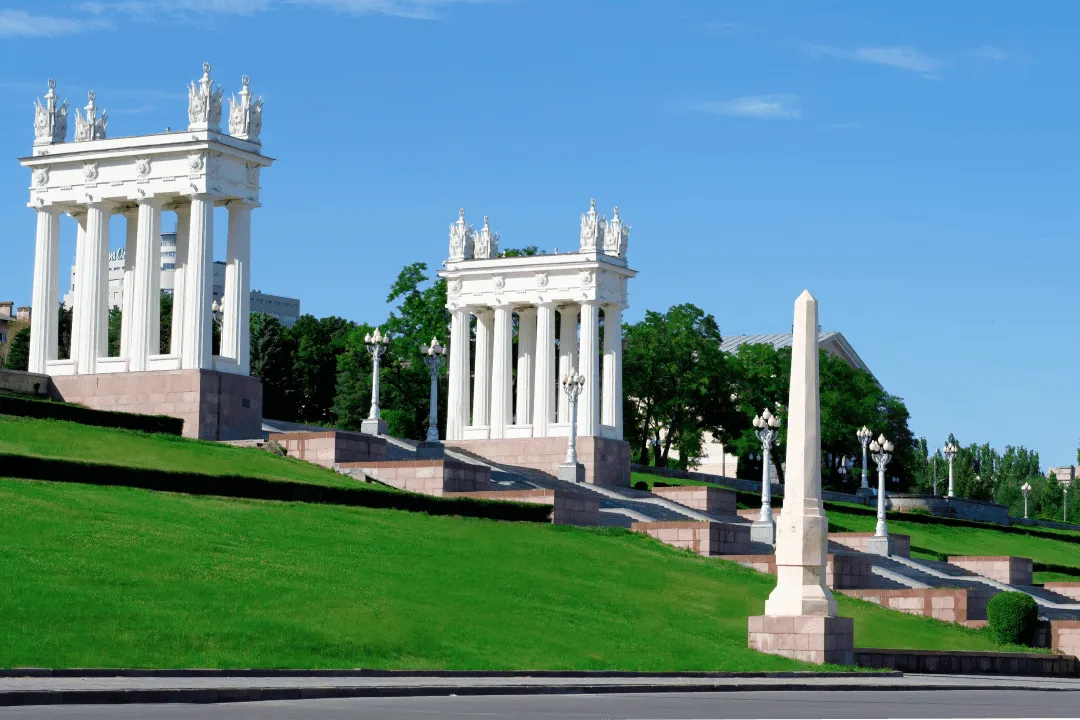
After admiring the city panorama, you can move on to the 62nd Army Embankment. A central staircase leads to the water, connecting the upper and lower terraces. From them, a magnificent view of the Volga opens up. The propylea with eight columns at the top of the staircase are called the Parade Gates in Volgograd. They have long become one of the city's hallmarks. The gates look especially cool in the evening when they are illuminated. Near the propylea is the light and music fountain "Art". It is a sculptural composition of three figures of girls in folk costumes. Unusual, but true: the creators of the fountain were inspired by the Beryozka folk dance ensemble.
After a stroll along the embankment, we walk about five kilometers to Mamayev Kurgan. It's not as far as it seems. Plus, the route is very picturesque: you can walk along the embankment along the Volga, and at the same time see the Volgograd Bridge and the new Volgograd Arena stadium. There's also an easy option: take Volgograd's high-speed tram (metrotram) and reach the city's most famous landmark in 15 minutes.
You can end the day with a river cruise along the Volga. For this, you either need to return to the embankment or get to the river port. The latter is located not far from the 62nd Army Embankment. In fact, you can embark on a river cruise from there.
Historical and Architectural Monuments
It's worth starting with Volgograd's most famous historical monument — Mamayev Kurgan.
Mamayev Kurgan
Yes, we already wrote about it in the previous section, but now let's talk in more detail. The memorial is known to everyone primarily thanks to Evgeny Vuchetich's sculpture "The Motherland Calls!". Its height is 85 meters. A staircase of 200 steps leads to the monument — corresponding to the number of days the Battle of Stalingrad lasted. In addition to the sculpture "The Motherland Calls!", the complex includes compositions "Memory of Generations", "Stand to the Death", Heroes' Square, the Ruined Walls, the Hall of Military Glory, and the Square of Sorrow.
Volgograd Railway Station
Another building we've already mentioned is the Volgograd railway station. Its facade is clad with granite and Crimean stone, and its walls with marble. Inside, the station is also interesting: all around are artistic paintings and canvases dedicated to special periods in the region's life.
Gerhardt's Mill
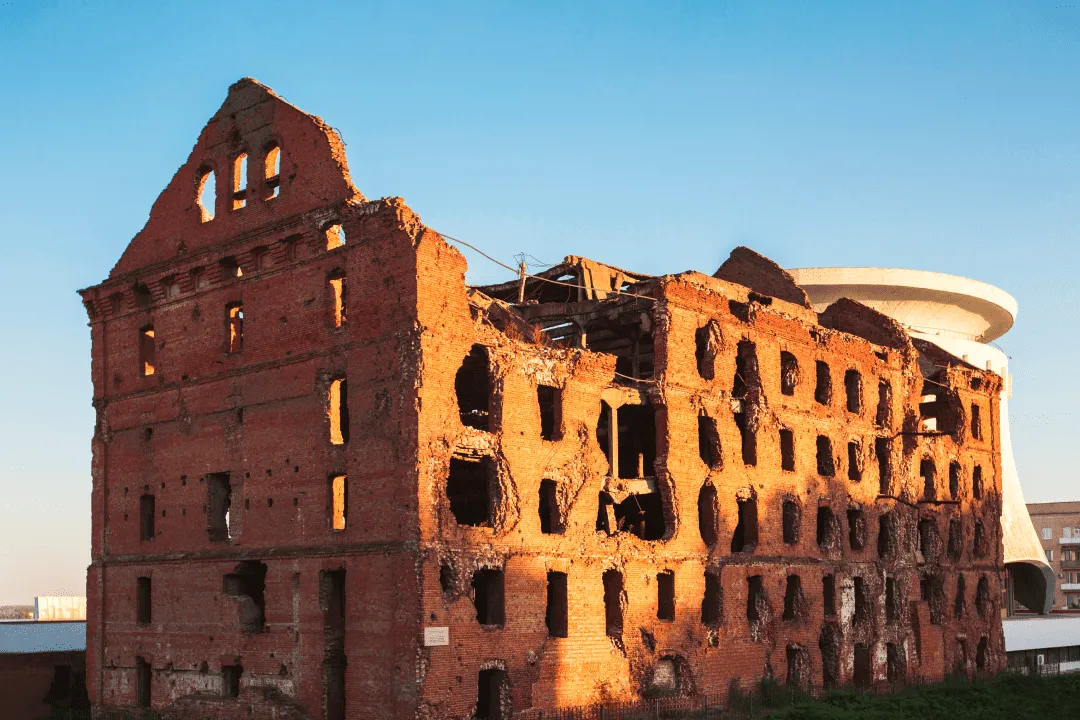
It's also worth visiting the historical reserve — the ruins of Grudinin's Mill. Its other name is Gerhardt's Mill. It was built at the beginning of the 20th century and had its own electric generator and boiler room. Today, the inscription "Gerhardtъ" is preserved on its end. This is, in fact, the surname of the owner — Alexander Gerhardt, a Volga German.
Volgograd Conservatory
We recommend visiting the P. A. Serebryakov Volgograd Conservatory. Previously, this building on Mira Street, 5A, housed the Tsaritsyn Music College. Later, it was the Stalingrad Music College, and from 1963 to 1989, the Volgograd College of Arts. And now we've reached the present day — the conservatory. For some time, the building was in decline. It was only restored in 1958 according to the design of architect Efim Levitan. And what does that mean? Correct, the conservatory is executed in the Stalinist architecture style.
Museums and Theaters
Walked around the city? It's time to put together a cultural and educational program.
Memorial and Historical Museum
For example, you can visit the Memorial and Historical Museum on Gogol Street, 10. It is located in the former mansion of the Tsaritsyn merchants and philanthropists Repnikovs, which was built in 1903. The building itself is considered an architectural monument of regional significance. Inside, you can find exhibitions on historical themes.
Regional Museum of Local Lore
Perhaps there is no city in Russia that doesn't have a local history museum. Volgograd is no exception. The local Regional Museum of Local Lore is housed in two buildings: the former Tsaritsyn Zemstvo Administration and the former Volga-Kama Commercial Bank. These, for a moment, are also considered architectural monuments of regional significance from the late 19th — early 20th century, built in an eclectic style with Art Nouveau elements. The museum can be found at: Lenin Avenue, 5A and Lenin Avenue, 7. Currently, the museum features permanent exhibitions: "Nature of Volgograd Region", "Archaeology. From the Stone Age to the Middle Ages", "Historical Past of the Region", "Golden Horde. Secrets of a Vanished Civilization", "This Land is Yours and Mine", "As Beyond the Don, Beyond the River...". Temporary thematic exhibitions, regional and international conferences are also held here.
Museum-Reserve "Old Sarepta"
If you have time, you can drive to the "Old Sarepta" Museum-Reserve. It has been operating since 1989 in the Krasnoarmeysky district of Volgograd. At the center of the architectural ensemble of 26 buildings is a real, active German church, where an organ plays during mass, just as it did in the 18th century. In general, at "Old Sarepta", you can learn about the traditions, history, and culture of the Volga Germans. So, we recommend it.
Theaters
We've covered the educational program, now let's move on to the cultural one. Volgograd has youth, experimental, and musical-drama Cossack theaters. There's also the Tsaritsyn Opera, the Youth Theater (TYuZ), and a puppet theater. In short, there's a wide selection. For example, you can go to the puppet theater with a child, see unusual productions at the experimental theater, or listen to operettas at the musical theater.
Volgograd Churches, Temples, and Cathedrals
Kazan Cathedral
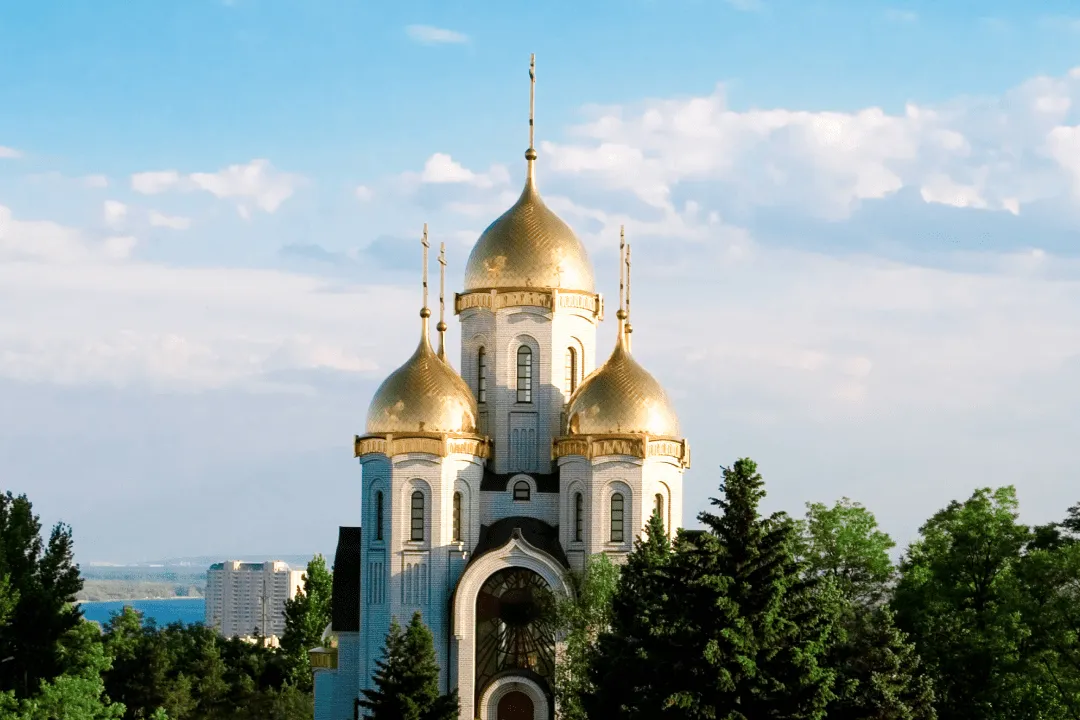
There are several large churches in Volgograd. The largest of them is the Kazan Cathedral. It was built in 1885. At that time, it looked impressive: several domes with golden cupolas, semicircular arches, and an abundance of symmetrical decorations. However, it did not last long in that form: a fire occurred. The modern building of the church was built in the 1890s. Moreover, the architect who designed the Kazan Cathedral is still unknown.
Church of St. John of Kronstadt
While walking around the city, you can also approach the small brick Church of St. John of Kronstadt on Tumanyan Street. It looks like a beautiful building of light stone in the Old Russian style, crowned with a rounded dome. The church was built in Volgograd not so long ago, in the mid-1990s, but is already considered an integral part of the city's architecture.
Ust-Medveditsky Transfiguration Monastery
There is another interesting church in the Volgograd region — the Ust-Medveditsky Transfiguration Monastery. It got its name from the Cossack village next to which it is located. More precisely, it used to be a village, but now in its place is the city of Serafimovich. Even if you are indifferent to religious matters, it's worth visiting here. The place is very picturesque: the church is built on a high bank of the Don, and the river itself stretches below. The buildings are also interesting. They say the Church of the Transfiguration of the Lord with 33 domes (you can count them if you get a chance) was built without a single nail.
Where to go with a child
Travelers with children will find plenty to do in Volgograd. There are interesting parks, a zoo, a planetarium, and a circus. And in the evening, little tourists will enjoy river cruises along the Volga. But first things first.
Arlekino Circus
If you have a free evening, you can go to the Arlekino Circus. Clowns, acrobats, and jugglers — circus performers' acts are sure to interest children. And if you buy cotton candy, the little travelers are guaranteed to be happy.
Star House
There's also an option for educational leisure, for example, a visit to the Volgograd Planetarium — the Star House. There you can touch the mysteries of the Universe, learn more about space, celestial bodies, and constellations. Moreover, it will be interesting not only for children but also for adults.
Museum of Entertaining Sciences
Also, visit the Museum of Entertaining Sciences. The local exhibition reveals the essence of physical and chemical phenomena that make up our world in an easy-to-understand way. The main advantage for curious young visitors is that all museum exhibits can be touched. Children can perform interesting experiments under the guidance of a mentor. So, time will fly by unnoticed and beneficially.
Oceanarium
Little travelers will also enjoy the oceanarium. There you can see bright tropical fish and leisurely turtles, as well as dangerous predators — sharks, piranhas, moray eels. By the way, the Volgograd Oceanarium also houses penguins, otters, and seals.
If you go to Volgograd in the summer, you can visit the attractions in the Central Park and the embankment. In spring and summer, it's very lively there: many strolling couples, families with children, and tourists just like you.
Parks, Gardens, and Squares
In the very center of Volgograd, there are several picturesque and colorful park areas where you can take a walk and relax a bit from rushing through the city's main attractions.
Komsomol Garden
Right behind the building of the New Experimental Theater is the Komsomol Garden. Earlier — back in the days when Volgograd was called Tsaritsyn — this place was a large Skorbyshchenskaya Square. The name is not at all positive, but quite explainable. Once there was a church here in honor of the icon of the Mother of God "Joy of All Who Sorrow". That's where the square got its name. Fast forward to our time. Today, Komsomol Garden is one of the favorite places for residents and guests of Volgograd. There are beautiful paths with flowerbeds, children's attractions, and benches in shady alleys. In short, everything is designed for a great rest.
Central Park of Culture and Leisure
Another park worth visiting is the Central Park of Culture and Leisure. We already wrote about it above. But a good place can be mentioned twice. The park is suitable not only for walks but also for sports and creativity. Recently, many interesting venues have opened here. For example, the sports zone features a European-level skate park — Volga Training Park. This is an entire complex designed for cycling, skateboarding, and rollerblading. Also, in the Central Park of Culture and Leisure, you have the opportunity to see the city from above. For this, take a ride on the Ferris wheel. You can save this attraction for the evening to see Volgograd in the rays of the setting sun.
Volgograd — Baku Friendship Park
Interesting fact: about a third of the Central Park of Culture and Leisure is occupied by the "Volgograd — Baku" Park. A park within a park — quite original, wouldn't you agree? It's like the Vatican in Rome, but in park equivalent. The thing is, there's no actual boundary between the parks, but the "Baku" part is designed in an oriental style (it even has a miniature replica of the Maiden Tower), while the rest of the territory is occupied by a modern park with attractions, a pond, and that very Ferris wheel. A part of the "Volgograd — Baku" Park was opened in 2013, and initially, it was planned to simply name it after the capital of Azerbaijan. But the locals weren't very keen on this idea, so a compromise solution was adopted for the naming: Volgograd — Baku Friendship Park.
Where to stay in Volgograd
In fact, the choice here is huge. You can find apartments, hostels, and family hotels.
Sobranie Hotel offers an excellent combination of price and quality. The rooms are pleasant, and everything you need is inside. Price per night starts from 3,700 ₽.
Hotel "Volgograd" is a more expensive option. Well, why not? It's the city's most famous hotel. It's also suitable for travelers with children, by the way. You can choose one of 157 rooms of various classes and price categories. The most affordable option costs 5,300 ₽ per night.
Apart-hotel "Yuzhny" is an option for those who like to cook their own breakfasts. Here you can rent a studio with an equipped kitchen. Such pleasure will cost from 5,500 ₽ per night.
There is an option to rent apartments in the city. Specifically an apartment, not a hotel. This is an excellent choice for a group of friends. A good one-bedroom apartment can be rented for around 2,500 — 3,000 ₽ per night.
Where to go in the surroundings of Volgograd
Walked around Volgograd, seen all the sights, and still have a free day left? Then head out of town. The Volgograd region is rich in beautiful and unique natural monuments.
Donskoy Park
One of the closest natural parks to Volgograd. "Donskoy" is located in the Ilovlinsky district, about 85 km northwest of Volgograd. The natural park stretches on both sides of the Don River. Interesting white cliffs hang over one of its tributaries — the Ilovlya River. They are also called the Chalk Mountains. They were formed from accumulations of prehistoric mollusk shells. Their height reaches 100 meters. The highest peaks — Ventsy Plateau, Trapezium Cliff, and Kobylya Golova Mountain — are ideal for trekking. If you visit the park between late April and mid-June, you can catch the season of blooming tulips, wild apple trees, and irises.
Ilovlinsky Museum of Cossack Life
Not far from Donskoy Park is the Ilovlinsky Museum of Cossack Life (here's the address: Zheleznodorozhnaya Street, 2V). It houses exhibits that accurately recreate a late 19th-century Cossack estate with all its accompanying objects: a kuren house, a pottery workshop, stables, and outbuildings. To immerse visitors in the atmosphere, museum guides conduct programs in traditional Cossack costumes.
You can get from Volgograd to this place by car, driving to Ilovlya. Then you need to turn towards Kachalin village. And that's where the park territory begins. The approximate travel time is one to one and a half hours. There is also an option to take a bus: they run from Volgograd's central bus station to Trekhostrovskaya stanitsa. The journey takes approximately two to two and a half hours.
So, this is the travel idea we came up with.
So, if you have a free weekend, go for it: fly, discover the world, and keep new places and impressions in your heart.