Journey to Tibet: Traveling Through the Sky
High mountains hide one of the most mysterious places on the planet under their cover – authentic Tibet. Throughout the country's history, it has been extremely difficult for a foreigner to get there. The reason for this is not only hard-to-pass mountain passes and harsh climate, but also the political situation.
 Tibetans feared that strangers might wage war on their wild lands, which is why outsiders are still treated with caution here. This position is well-founded: since the beginning of the 20th century, Tibet has been a coveted prize for the British Empire.
America and Russia were also not averse to starting a redivision, but, in the end, in the 50s, China's colonial appetite flared up seriously, and it finally threw its communist blanket over a people with enlightened consciousness. The last 14th Dalai Lama emigrated to India, and his place in the main temple of Lhasa was taken by a Chinese protégé from the Communist Party. A comical sight.
Since the beginning of the 20th century, only rare scientists or military personnel had the opportunity to visit Tibet. The Russian family of researchers, the Roerichs, embarked on a Tibetan expedition in 1923, but even they, with all official permits and American support, were denied entry to Lhasa.

Austrian alpinist and writer Heinrich Harrer was much luckier. On the eve of World War II, Heinrich had the opportunity to visit Tibet as an alpinist, provided he showed some loyalty to the fascist dictatorship. He joined the SS and packed his bags. The group of climbers was detained by the British authorities in India and all were placed in a prisoner-of-war camp. Only four years later, several prisoners managed to escape. Harrer was among them.

Although formally listed as an SS officer, the young man was in fact a convinced pacifist, so he decided to wait out the world's upheavals on the run. For over a year, he wandered through the endless Himalayas until mountain trails finally led him to Lhasa. There, Heinrich lived for seven years, becoming a close friend of the Dalai Lama. After the region's occupation by Chinese troops, Harrer returned home, where he wrote the book «Seven Years in Tibet», and in 1997, a film of the same name by director Jean-Jacques Annaud was released, with the ubiquitous Brad Pitt in the lead role.
The Chinese government opened Tibet to foreigners only in 1984. A rare tourist could travel by train from Beijing to Xining, a settlement in Qinghai province. Then, those wishing to penetrate the heart of the country would get behind the wheel and, risking their lives, spend two weeks winding along narrow serpentine roads until they reached their destination. This lasted for over 20 years, but time moves on, and the new century has sown the seeds of civilization even in the wildest soils.
The Sky Train
The number of people wishing to experience Tibetan culture grew every year. And in 2006, the construction of the world's highest railway — the Qinghai-Tibet Railway, connecting bustling Beijing and serene Lhasa — was finally completed. Construction was carried out under unbearable conditions: pressure drops, extremely low temperatures, permafrost, and seasonal animal migration required workers to combine the dexterity of a Chinese seamstress and the patience of a Buddhist monk. But now, the 4064-kilometer journey takes only two days.
 A railway journey to the capital of Eastern wisdom is in itself a dizzying (in the literal sense of the word) adventure. A small section of the road near Tanggula province rises 5072 meters above sea level, where the air temperature reaches minus 45oC. Therefore, before boarding the train, everyone must sign a special document acknowledging the travel risks.
Despite the harsh climate outside the window, passengers feel comfortable and safe inside the carriage; moreover, people acclimatize during the journey, which a plane flight does not provide. A special heating system and oxygen masks minimize the likelihood of an accident, and built-in power outlets allow you to always stay connected.
Snow-capped mountain peaks give way to agricultural plateaus with yaks grazing on them. The rhythmic clatter of wheels induces a trance and creates an atmosphere of universal anticipation. Here's how Australian traveler Lewis Southerden describes his intercontinental trip:
«It didn't take long to realize: this train, with its soft sleeping cars, is a United Nations in miniature. My neighbors turned out to be four Israeli women, a group of Australians heading to a sports camp on Everest, two Indian couples from Singapore, and a pair of French newlyweds.
It turns out we are all making this journey for the first time. The train will arrive at its destination at 9:30, exactly on schedule. While it's unknown what will happen next, everyone is exchanging jokes, but only one thought truly occupies everyone: «we are on our way to the roof of the world».
The cost of travel on the sky train ranges from 35 to 115 euros and depends on the chosen seat. The softer the seat, the higher the price.
Admission Requirements
Unfortunately, it is impossible to enter the sacred mecca without an accompanying document. Ordinary people do not possess the knowledge of Tibetan monks, so instead of meditating and walking through their inner empire, they have to endure the scrutinizing gaze of border guards.
In the 21st century, only a truly desperate fanatic would risk entering Tibet through the back door. The modern world offers the opportunity to get a key to the front door. In this case, it is a permit—a special authorization for foreigners to enter Tibet. Obtaining this document from the Chinese authorities can only be compared in difficulty to finding a job in London.

Since 2008, permits have been mandatory for all foreign citizens. Entry conditions change with surprising frequency. As of October 2012, the issuance of permits was suspended, and only on March 26 of this year was Tibet reopened for visits. However, the main mountaineering camp is still not operating.
Just a year ago, obtaining an individual permit seemed like something fantastic. Permits were issued only to groups of five people, in which at least two had to have the same citizenship. That is, if the husband was German and the wife was Russian, their path was blocked. Today, the situation has changed for the better.
Now permits are available to:
- solo tourists
- groups of five people with different nationalities
- people with no more than two nationalities on one permit
For residents of Japan, the Philippines, and Norway, permits are not needed at all, but Russians will still have to sweat quite a bit to get the coveted document. It makes no sense to contact the Moscow embassy. There, of course, you can get the appropriate permit, but there's a 90% chance it will be annulled at the border. Therefore, in Moscow, it's better to open a regular Chinese visa, and then request the permit directly in Mao's homeland.
You can familiarize yourself with the permit application procedure on the website www.xzta.gov.cn. Experienced travelers advise contacting the Beijing travel agency Leo Hostel 15-20 days before departure and arranging a «Tibetan pass» through them. There's no point in submitting documents earlier, as the employees of this travel agency tend to drag their feet. If your request has fallen into oblivion, feel free to call and explain the matter to the English-speaking staff.
Careless travelers head to the capital of the PRC at random, hoping to obtain an entry permit to Tibet on the spot. As a result, they get stuck in Beijing for a couple of months until they receive the long-awaited «YES». After all, in this matter, it's better to prepare in advance.
What if… or a few tips for illegal infiltrators
The penalty for illegal entry into a “special control” region varies from quiet expulsion from the country to a diplomatic scandal. Everything depends on the violator's luck and the mood of the border services. Very rarely, people in uniform might politely advise you to leave and calmly go for coffee while the illegal is walking around the forbidden territory. Several such cases have indeed occurred. There are still people who tempt fate against common sense, and if such daredevils stumble upon this article, may the following tips help them:
- Do not travel to the country during national holidays and ceremonial events. On red-letter days, foreigners receive increased attention.
- Qinghai-Tibet Railway employees sometimes do not ask for a special permit when selling tickets. If the expected question does arise, you can ask a person with a Chinese passport for assistance.
- Without a permit, it's easier to enter Tibet via India or Nepal; compared to the PRC, the authorities of these countries are more lenient towards illegal tourists.
- If a confrontation with border guards occurs, the only correct option is to “play dumb” and feign unquestioning obedience and willingness to comply with their terms.
What are people looking for in Tibet?
Rarely does anyone go to Tibet out of idle curiosity. Since this place is difficult to access, people come here with a specific purpose or a question. The name of the Tibetan capital, Lhasa, translates as “place of gods”. Every year, thousands of souls flock to Lhasa, eager to enter into dialogue with higher powers in the Potala Palace, where His Holiness the Dalai Lama lived. However, getting into the palace-museum is not so easy. Excursions are conducted by prior arrangement with the group leader, and tickets are sold one day before the visit.
Some pilgrims flock to the western part of the Tibetan plateau, to the legendary Mount Kailash. Its four ribs symbolize the cardinal directions. This place is sacred not only to Buddhists. Jains believe that here, Saint Rishabhanatha attained Moksha (enlightenment), freeing himself from death and suffering, while Hindus are convinced that the almighty Shiva resides on Kailash. Tibetan teaching states: “one who circumambulates the mountain once will be forgiven all sins; one who does it 108 times will achieve complete enlightenment”. The ritual is called Kora. One “circumambulation” takes an average person 3 days, while locals manage it in a day.
 Performing Kora is not within everyone's power, but it is not the only way to achieve enlightened consciousness and expanded perception of reality. Since the 1960s, Tibet has become the cherished dream of all those who chose a psychedelic way of penetrating Buddhist teachings.
Based on the content of “The Tibetan Book of the Dead,” Timothy Leary wrote a guide for those experimenting with psychotropic substances. Since then, many psychonauts have visited the “roof of the world.” They surrendered to the power of mind-altering substances and observed the Shaman Festival, held in Eastern Tibet in the sixth month of the lunar calendar (August).
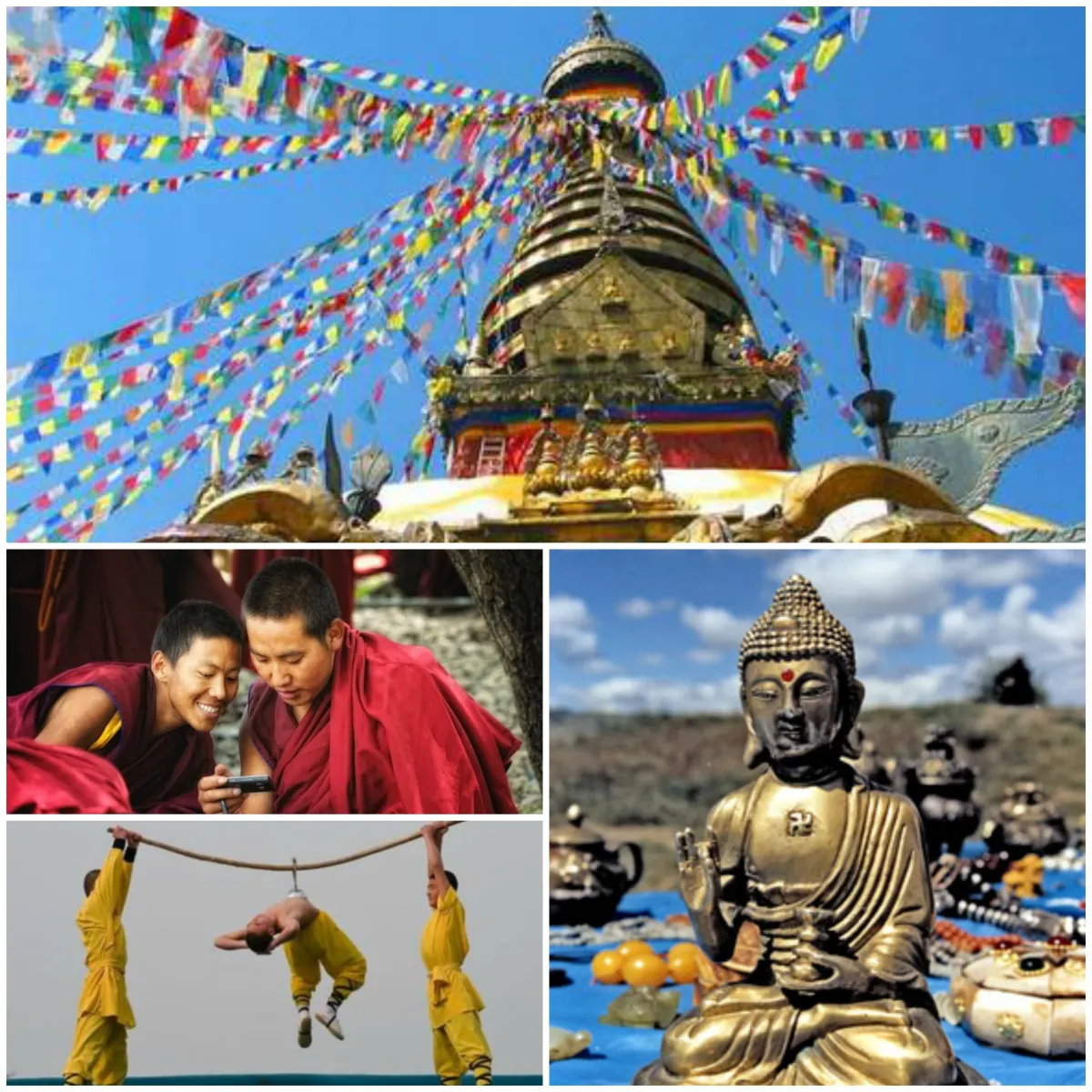
Many representatives of the “beat generation” literally “infected” Europe and America with Buddhism, giving lectures and publishing their impressions of the trip. Some never returned home, preferring peace and meditation to a bustling life.
“The Celestial Empire” does not fully reveal its secrets to anyone, and even when in the very center of Lhasa, every traveler deep down dreams of something more. Ancient legend says that somewhere in the vicinity of Tibet there is a lost kingdom – Shambhala, the center of the universe and the birthplace of all existence.
For many years, researchers have been searching for the mythical source of life, sometimes in the Himalayas, sometimes in the nearby regions of Syria, sometimes in the Gobi Desert, but all in vain. And I inadvertently begin to suspect that the magical country is much closer…


