Traveling with children by plane
First time traveling with a child by plane? It's not as scary as it might seem. Passengers with children enjoy many privileges: a seat in the first row with much more legroom, more attentive staff, and no queues.
Air ticket prices for children
Almost all airlines worldwide divide their fares into three age categories:
- adults;
- children (Child) – from 2 to 12 years old;
- infants (Infant) – from 0 to 2 years old.
For all groups, their own fares and discounts have been developed. For example, a child's plane ticket for a child under two years old will cost only 10% of the regular price (without a separate seat), and on some flights, children travel for free. For older passengers (2-12 years old), the amount will be approximately 50% of the adult ticket price. But note that often the discount applies to the fare, while additional fees remain in full.
If your child is already 12 years old, no discounts are provided for them. The price of a child's air ticket also depends on whether they are flying with or without an escort.
How to send a child by plane? Some airlines accept children flying alone. As a rule, the minimum age for unaccompanied flights is 12-14 years, but there are carriers who have lowered this threshold to 2-4 years. Some have even developed a special program for young travelers.
For example, the Dutch airline KLM offers the Junior Jet service. Parents hand over the child to an airline employee, who bypasses the queue for passport control and check-in with them, and then escorts them onto the plane. Throughout the flight, a senior flight attendant looks after the child, and to keep the little one entertained, the airline provides a play kit. At the arrival airport, the child is handed over personally to the greeter.
Please note that the ticket price for an unaccompanied child does not include discounts and is equal to the air ticket price for an adult passenger.
Check-in and baggage
Passengers with children under two years old can check in without queuing. If your child is a little older, don't worry: airline staff, and even other passengers, often let parents with children go first. But it's still worth arriving at the airport in advance to not miss the most convenient seats.
As for baggage, the policy of most airlines is uniform here. Children over two years old can take as much baggage as adult passengers. If you are flying with a baby under two years old, you can only take hand luggage up to 5 kg, a stroller, and up to 10 kg of checked baggage for free. Car seats and strollers are not considered additional baggage, so their weight is not taken into account.
Many airlines on medium- and long-haul routes (over 6,000 km) provide young passengers with a bassinet and a seat with more space between seats (usually in the first row of economy class).
However, passengers with children cannot be seated near emergency exits: this is prohibited by the safety rules of all airlines. But once on the plane, you can ask the flight attendants to move you to empty seats, if available. As a rule, passengers with small children will be accommodated.
Some carriers go even further and, if necessary, will provide you with baby food, diapers, wet wipes, etc. However, all this must be ordered in advance. Call the airline two or three days before departure and ask what additional services they provide to passengers with children. Unfortunately, on short routes (up to three hours), there are no special amenities for children :(
Airport
After check-in, you must go through security screening. Here, too, you can bypass the queue, especially if you have an infant in your arms.
You don't have to check your stroller as baggage. Umbrella strollers, as a rule, are allowed to be taken with you up to the aircraft steps. If you don't need it at the airport or on the plane, you can check it in with the rest of your luggage. To do this, you need to register the stroller at the airport counter and get a baggage tag, without which it will not be accepted anywhere. A stroller is considered oversized baggage, so it's quite likely that you'll have to wait longer than usual for it at baggage claim. Read more about transporting strollers on a plane here.
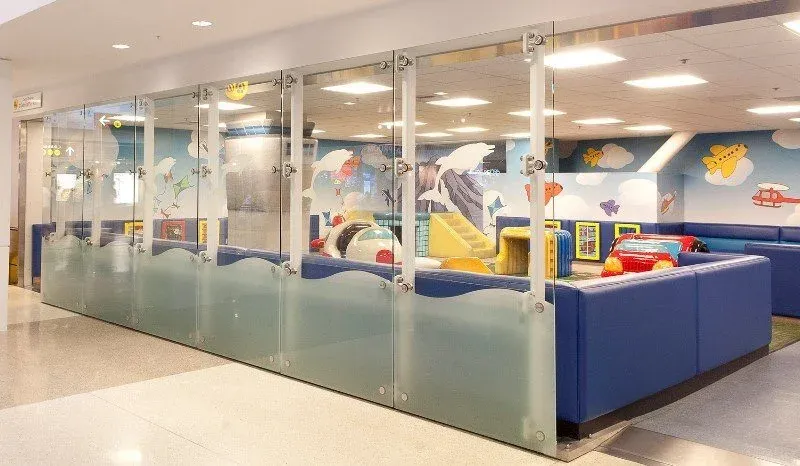
Many airports have a mother and child room. There you can relax a bit, entertain the child with games, and feed them. In large airports, children might be entertained by animators, but this is not common, and they don't work around the clock.
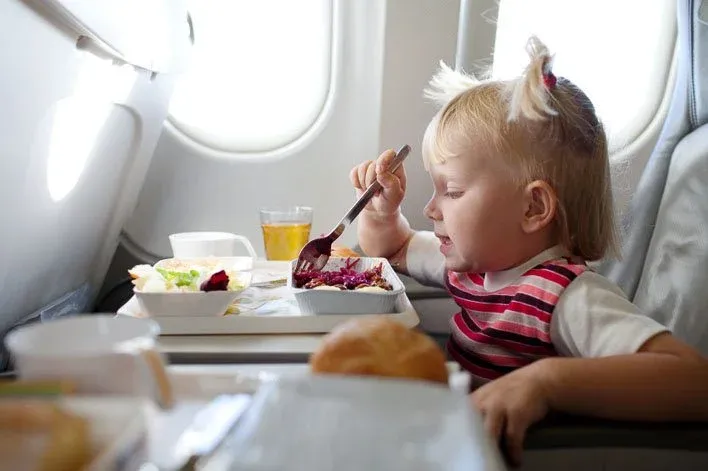
How to feed a child on a plane?
Most airlines offer special children's menu, but it must be ordered in advance. If the flight is long, you shouldn't rely solely on the airline's provisions. What to take on a trip with a child? Snacks, cookies, sandwiches, etc. You can also ask the flight attendants to warm up food for the child on board.
For children under two years old, you can bring baby food, including liquid. However, in hand luggage, limit yourself to only the amount needed during the flight. Put everything in one bag so you don't have to search for cookies or juice for a long time, and send anything extra to checked baggage. Be prepared that during security control, you may be asked to open food jars and taste them.
Airline rules include the well-known 100 ml rule for all liquids. But parents with children are sometimes given concessions: airport staff may allow a bottle or thermos with a larger volume of water on board if it is intended for a child. They will also ask you to taste it. This is a small privilege for parents traveling with a baby.
What to do on the plane?
Passengers with children also go first here. Boarding usually begins with business class passengers and passengers with children. However, this rule is not always followed.
During takeoff, give the young passenger a caramel, a lollipop, or something to drink from a bottle: swallowing movements relieve pain from pressure changes in the ears. For breastfed infants, feeding during takeoff and landing will likely solve the problem.
To keep the little one from getting bored, bring books, coloring books, pencils, and toys. Avoid bringing toys with small parts, as it's very difficult to retrieve them from under the seat. To distract the child, bring a computer, tablet, or DVD player with pre-loaded cartoons.
All children are different and get tired differently. Therefore, it makes sense to apologize immediately if the child has kicked the seat in front and/or is being noisy.
If it's the child's nap time according to their routine when you're flying, they might be anxious due to the new environment and sounds. You can bring a small toy and offer it to the child: 'This is a hippo, it's flying for the first time and is very worried, please help it go to sleep, calm it down, pet it.' This will help the child process their fear and calm down themselves.
Read more about how to entertain a child on a plane here.