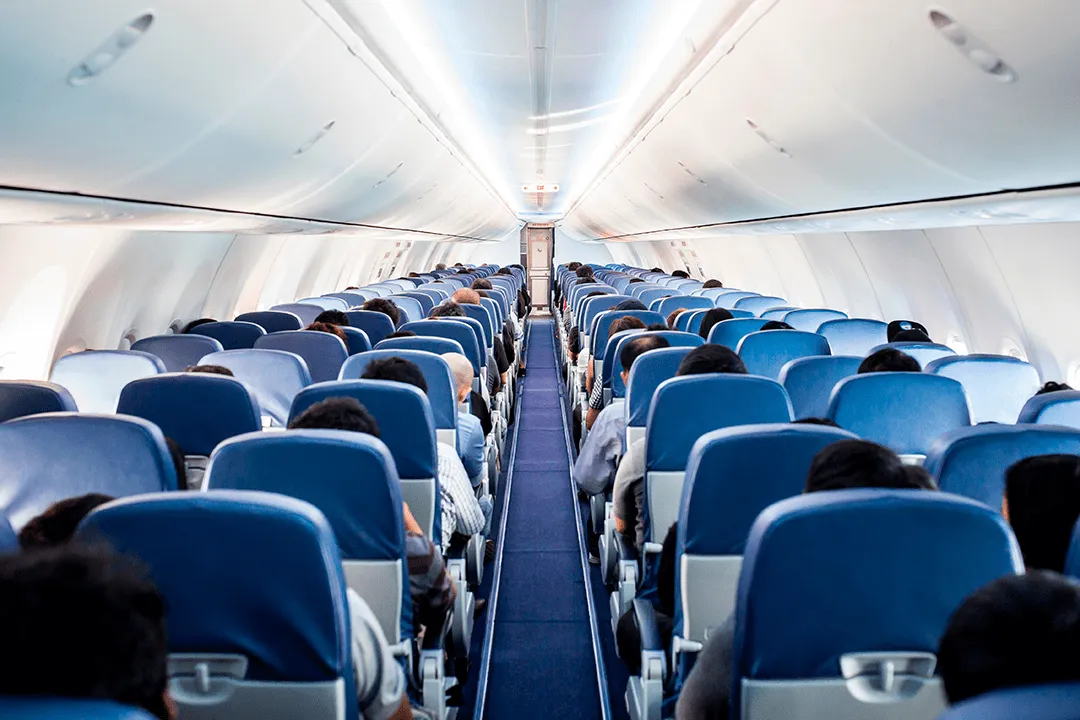
Transporting animals on a plane
In this article, we will tell you what rules for transporting animals on a plane exist, and how to make the flight comfortable for all participants in the process.
Transporting animals in the airplane cabin
Not all airlines allow pets in the cabin. Requirements vary — you need to consult the carrier's website in advance. Most often, you can take small animals that, along with their carrier, weigh no more than 8 kg. Major carriers adhere to this condition — for example, Aeroflot. On one flight, you can take three animals older than 6 months. There are two options:
- Take 1 animal in a carrier into the cabin for passengers. Total weight — no more than 8 kg. The remaining 2 pets will be kept in the compartment for luggage.
- Take 2 animals in a carrier into the cabin for passengers. Total weight — no more than 8 kg. 1 pet will be in the compartment for luggage.
For all passengers to be comfortable, the carrier must be waterproof. In addition, a special pad or wipes should be placed at the bottom. According to the rules, the animal must remain inside the carrier throughout the entire journey, so check the container's lock before the flight. Yes, unfortunately, sticking out its snout or tail is not allowed.

Choose a carrier size that allows your pet to lie down, stand up fully, and turn 360 degrees. This will allow it to stretch as desired and get enough rest. Ensuring good ventilation and access to fresh air is also important — the animal will definitely feel uncomfortable in the narrow space of the carrier, amidst unfamiliar smells and noises, and will panic greatly. We do not recommend giving sedatives without a veterinarian's prescription if you haven't tested them on your pet yet. No one can say for sure whether it will suit them or not, and no one is immune to allergies or poor health due to an unfamiliar medication.
Where the animal will fly: in the cabin or in the baggage compartment
If your pet, along with its carrier, weighs up to 8 kg — most likely, you can take it into the cabin. If it's more, they will offer to transport it in the airplane's baggage compartment. Then the preparation for the trip will be slightly different — here's how.
Transporting large animals weighing over 8 kg on a plane.
Your pet will fly in the baggage compartment if its weight along with its crate is more than 8 kg. You should approach the preparation responsibly, as it will be separated from you for several hours. Don't be afraid of scary stories, but make sure the journey is comfortable: after all, you are responsible for your pet.
A regular soft carrier for transport in the baggage compartment will not be suitable. You will need to buy a container that meets the international IATA requirement. This can be done before the flight at a pet store, although some airports also sell such carriers. Make sure the container is sturdy and stable: after all, a trip in the baggage compartment is a big stress.
If you are worried, check with the airline about what temperature and conditions will await your pet in the baggage compartment. As a rule, a comfortable climate is maintained in the compartments: the area is ventilated and heated.
It happens that pets are not allowed in either the cabin or the baggage compartment: such are the strict rules. But don't despair, there are companies that transport animals as cargo — both domestically and internationally.
Features of animal transportation by different airlines, how much it costs
Although the rules for transporting animals on a plane are similar across different airlines, some nuances may vary. It's worth paying attention to them — for example, the dimensions of carriers are specific to each carrier.
In the table, we have listed the conditions under which popular Russian airlines offer to transport animals.
|
Weight of the animal if you are carrying it in the cabin |
Up to 8 kg | Up to 23 kg on the seat or Up to 10 kg under the seat |
Up to 8 kg |
Up to 8 kg |
|
Carrier dimensions for the airplane cabin | 44x30x26 cm — rigid containerNo more than 126 cm in sum of three dimensions — soft carrier | 55x40x40 on the seat or55x40x25 under the seat | 46x28x22 cm — rigid containerNo more than 96 cm in sum of three dimensions — soft container | 44x30x26 cm — rigid containerNo more than 126 cm in sum of three dimensions — soft container |
|
Animal weight, if you are carrying it in the baggage compartment | Up to 50 kg;cargo transportation possible | Up to 50 kg;cargo transportation possible |
Transportation in baggage is prohibited | Up to 50 kg |
Flight with a guide dog
A guide dog is a trained animal that helps its owner with visual impairments navigate space. As a rule, such dogs are friendly: they know how to behave well, do not bark, and do not lunge at people. Unlike standard transportation of pets on a plane, the rules here are different.
A guide dog is considered by airlines as an aid and rehabilitation tool for its owner, so they are allowed into the cabin of the airplane without a container.
What conditions must be observed to travel with a guide dog:
- the dog must wear a muzzle and collar;
- the owner must have a document confirming that the dog has been trained;
- sometimes the owner will also be required to provide a health restriction certificate;
- during the flight the dog is placed at the owner's feet under the seat;
- the dog must not interfere with the flight attendants.
How to book a ticket on Kupi.com for an animal
Before planning your trip, contact the airline and find out how the transportation of pets on a plane occurs according to current rules and how much it will cost you. It's best to do this before booking your flight ticket to have time to prepare documents and get the necessary vaccinations.
In addition, the transportation of the animal must be approved. Airplanes have restrictions on the number of pets that can be transported in the cabin and in the baggage compartment. If other passengers have already booked and approved spots for their animals on the flight you wanted to take — you won't be able to bring your pet.
So, to book a spot, you need to:
- choose a suitable flight;
- call the airline and clarify the rules of carriage, the list of documents that veterinary control staff will require from you, and the availability of space for the animal on the plane;
- pay for your ticket and the cost of transporting your pet.
What documents are required
If flying within Russia
- a veterinary passport with marks indicating that all vaccinations have been done and parasite treatment has been carried out. A valid rabies vaccination is an important condition. Without it, you won't be able to fly to another Russian city or abroad.
In addition, visit the Animal Disease Control Station (SBBZh). This is a state institution that deals with veterinary treatment and prevention. The veterinarian will examine the pet and confirm that everything is fine and it's safe to fly. However, you need to plan your visit in advance, at least 15-14 days before the flight.
If you are flying abroad
Requirements for traveling with animals vary by country and are constantly changing, so you will need to clarify all the details in advance. Here's what you'll need in a standard case:
- an international veterinary passport. To prepare the certificate you can get help at the same Animal Disease Control Station (SBBZh).
- a microchip. A veterinarian will microchip the pet and enter the data into the international Animal-ID database — so, if the pet gets lost, it will be easier to identify. It is absolutely painless for the animal.
- rabies vaccination. It is important that the vaccination is administered after the microchip implantation. If you vaccinated your pet several months ago and had the microchip implanted recently, you will have to get the vaccination again. In addition, you need to be vaccinated at least 21 days before the flight – this is the time required for antibodies to form. Again, each country has its own requirements, so the main rule here is to carefully study all entry conditions and prepare in advance.
- permission if the dog, cat, or bird will fly without its owner.

Important: In a number of countries (United Arab Emirates, Taiwan, Japan, Israel, etc.), in addition to vaccination, the animal is required to undergo a test for the amount of rabies antibodies.
What else to consider:
- Will your animal definitely be allowed into the country? It sounds sad, but there are restrictions. While everyone is loyal to dogs and cats, problems may arise with ferrets or fighting dog breeds (pit bulls, Argentine dogos).
- Will your animal be accepted for transport? Rodents, spiders, and snakes are, unfortunately, not welcome on board: not even in the baggage compartment. Check with the airline if they will take your pet on the plane — and only then start preparing documents.
Preparing your pet for the flight
- Let your dog or cat get used to the carrier in advance. You can put a familiar toy inside so they perceive their temporary home more calmly.
- Feed your pet every time after it has been in the carrier. This will create positive associations for it.
- Take drinking water. It can get stuffy in the crate, and dehydration happens very quickly on a plane.
- A couple of hours before departure, give the animal something light to eat — so as not to overload its digestive system.
- If you are transporting a dog, walk it before the flight.
- Give medication, but only if prescribed by a veterinarian. Do not experiment with unfamiliar medications — undesirable reactions may develop, and it will be difficult to help during the flight.