Support

Goethe House

About

The Goethe House in Weimar is not just a building, but a true house-museum that immerses visitors in the atmosphere of the 18th and 19th centuries. Located on Frauenplan square in Germany, this elegant two-story mansion witnessed nearly half a century of the life of the great German poet and thinker Johann Wolfgang von Goethe. It was here that he lived for 47 years, from 1782 until his death in 1832, creating many of his immortal works.
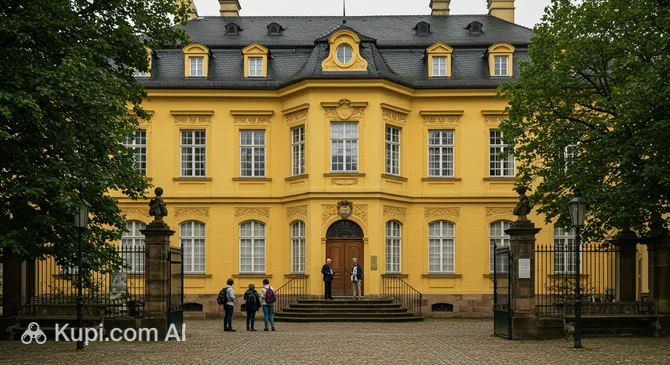
Goethe House. Illustration.
Source: Kupi.com AI

Traveller photos:

Built in 1769, the house is a fine example of Baroque architecture. Initially, Goethe rented an apartment in this building, but in 1794, the Duke of Weimar, Carl August, presented the mansion to him as a gift, handing over the deed of purchase. This generous gift allowed the poet to furnish the house according to his taste, transforming it into a unique space for living, creating, and hosting numerous guests.

Today, the Goethe House is not only a memorial museum where you can see the writer's personal belongings, his library, and art collection, but also a major cultural attraction of global importance. Its historical and cultural value was internationally recognized in 1998 when the Goethe House was included in the UNESCO World Heritage List. Visiting this site is a unique opportunity to touch the era of the Enlightenment and better understand the life and work of one of the greatest figures in German and world literature.

Contacts

To find out current opening hours, ticket prices, and other essential information for visiting the Goethe House, we recommend checking the museum's official website or contacting the tourist information centers in Weimar. There, you can typically find contact phone numbers or an email address. The museum itself is conveniently located in the city center, making it easy to reach on foot or by public transport.

How to contactContact
AddressFrauenplan 1, 99423 Weimar, Germany
Phone+49 3643 545400
Websitewww.klassik-stiftung.de

What to Do

Visiting the Goethe House in Weimar, Germany, is a unique opportunity to touch the life and work of one of the greatest German writers. In this historical building, where Johann Wolfgang von Goethe spent many years, visitors can see the authentic interiors preserved to this day. The museum's exhibition includes the writer's personal items, his furniture, an extensive library, and various collections, allowing for a deep immersion into the atmosphere of his era and daily life.

The various rooms of the house are of particular interest, each holding its own story. You can explore Goethe's famous study, where many of his immortal works were created, as well as the drawing rooms and bedrooms. These spaces offer a vivid insight not only into the creative process but also into the lifestyle, tastes, and habits of the genius, allowing for a better understanding of his personality and surroundings.

The house-museum also reveals the family side of Goethe's life. For example, the attic was expanded in 1817, where the poet's son, August von Goethe, lived after marrying Ottilie von Pogwisch. The ground floor was dedicated to household needs, managed by Goethe's wife, Christiane. The writer's three grandchildren—Walther, Wolfgang, and Alma—also grew up within these walls, adding warmth to the exhibition and telling the story of Goethe not just as a writer, but as the head of a family.

Getting There

Getting to the Goethe House in Weimar is quite simple, as it is one of the city's key landmarks. Weimar has a well-developed public transport system, so you can reach the museum by bus. Look for routes that pass through the city center or have stops near Frauenplan square, where the house-museum is located.

If you prefer a more comfortable way to travel or are carrying luggage, you can always use a taxi. A ride from Weimar Central Station or any other part of the city to the Goethe House won't take long and is reasonably priced. Simply give the driver the address: Frauenplan 1.

For those staying in the central part of Weimar, a walk to the Goethe House can be a pleasant addition to your city exploration. Many historical sites are within walking distance of each other, and the path to the great poet's home allows you to enjoy the architecture and atmosphere of this cultural hub in Germany.

Nearest city: Weimar

History & Facts

The acquisition of the Goethe House on Frauenplan square in 1782 was more than just a change of address for Johann Wolfgang von Goethe; it was the start of an ambitious project to create an ideal space for living, working, and scientific research. The poet personally oversaw the reconstruction and interior design, aiming to realize his ideas of functionality and aesthetics. Interestingly, he designed a significant part of the house specifically to house his extensive collections, which he had begun forming even before moving to Weimar and which reflected his diverse interests.

The house on Frauenplan quickly became one of the most important intellectual centers of its time. Here, Goethe hosted numerous guests, including prominent scientists, writers, and artists, such as Friedrich Schiller, with whom he shared a close friendship and a fruitful creative partnership. The house also stored and continuously expanded Goethe's unique collections: an impressive mineral collection (over 18,000 specimens), artworks, natural science specimens, and a vast library. For Goethe, these collections were not just a source of pride but essential tools for his scientific research and literary work.

Goethe paid special attention to the layout and lighting of the rooms to ensure they best suited his needs. For instance, the famous grand staircase (Treppenhaus) leading to the reception rooms was designed by him and serves as a striking example of his architectural vision. The living quarters, his study, and the library were arranged for maximum convenience. The expansion of the attic in 1817 to accommodate his son August's family was also carried out under the poet's close supervision. Notably, after Goethe's death, his grandchildren made significant efforts to preserve the house and its furnishings in their authentic state, laying a solid foundation for the future museum.

The significance of the Goethe House as an outstanding cultural monument was officially confirmed on an international level in 1998. It was then that, as part of the "Classical Weimar" ensemble, it was included in the prestigious UNESCO World Heritage List. This decision highlighted not only the personal genius of the great poet but also the unique role of Weimar as the cradle of the German Enlightenment and Weimar Classicism, of which the house on Frauenplan was one of the brightest centers.

Time Needed

To get acquainted with the Goethe House in Weimar, a typical visitor should set aside 1.5 to 2 hours. This is generally enough time for a leisurely tour of the great poet's living and working quarters, as well as seeing his personal belongings and the environment where he created for many years. You can immerse yourself in the atmosphere of the time and imagine the life of Johann Wolfgang von Goethe.

It is important to note that the Goethe National Museum is adjacent to the Goethe House, offering a broader exhibition dedicated to the writer's life, work, and era. If you plan to visit the museum section as well, the total visit time may increase by another 1-2 hours. The museum's collection includes manuscripts, paintings, scientific instruments, and other artifacts that provide a deeper understanding of Goethe's multifaceted personality.

Thus, for a full and thorough exploration of both the house itself and the adjacent museum, it is recommended to plan for 3 to 4 hours. This will allow you to study all the exhibits without rushing and get the most out of your visit to this iconic site in Germany, associated with one of the greatest figures in world literature.

Working Hours

To find out the exact opening hours of the Goethe House in Weimar, as well as information regarding any need for advance ticket booking, it is recommended to check the attraction's official website or confirm these details at local tourist information centers. The operating hours of museums and historical sites may vary depending on the season, so it is always best to check for up-to-date information immediately before your planned visit.

Typically, many popular tourist sites, especially ones as significant as the Goethe House, are open to visitors year-round, but may have reduced hours during the winter months or on public holidays. By checking the schedule in advance, you can plan your trip in the best possible way and avoid any potential inconvenience.

DayOpening hours
MondayClosed
Tuesday9:30 – 18:00
Wednesday9:30 – 18:00
Thursday9:30 – 18:00
Friday9:30 – 18:00
Saturday9:30 – 18:00
Sunday9:30 – 18:00

Nearby

A visit to the Goethe House is undoubtedly a highlight, but don't limit yourself to it alone. The surroundings of Weimar hold many interesting places that will help you dive deeper into the city's atmosphere and its rich history. Strolling through the nearby streets and exploring other attractions will make your journey even more fulfilling and memorable.

Exploring what lies near the Goethe House will give you a more complete picture of Weimar's cultural heritage and perhaps lead you to discover something entirely unexpected. Don't miss the chance to broaden your horizons and see more than you originally planned, as every street here breathes history and culture.

NameDistance
Lily's Waffle Bar & Café0 km
Market Square0.2 km
Schiller's House0.2 km
Schiller Museum0.2 km
Weimar House0.2 km
Duchess Anna Amalia Library0.3 km
Goethe–Schiller Monument0.3 km

Reached the bottom of the page?

Looks like you know this route inside out

We use cookies for your convenience.