Support

Bury St Edmunds Abbey

About

Bury St Edmunds Abbey consists of the impressive ruins of what was once one of the wealthiest and most influential Benedictine monasteries in medieval England. This iconic historical site is located in the town of Bury St Edmunds, in the county of Suffolk, in the east of the United Kingdom. Today, it attracts thousands of visitors with its centuries-old history and special atmosphere.
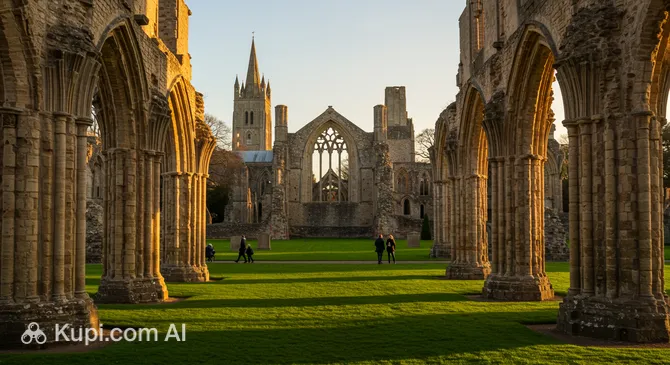
Bury St Edmunds Abbey. Illustration.
Source: Kupi.com AI

Traveller photos:

The history of this sacred site began long before the arrival of the Benedictines. It is believed that the first monastic community was founded here as early as the 7th century, and according to some records, the original settlement, known as Beodericsworth, emerged around 537 AD. However, the key event that defined the fate and name of the abbey was the translation of the remains of Saint Edmund, King of East Anglia and revered as a martyr, to this location in 903 AD. It was after this event that the place became known as Bury St Edmunds — \"St Edmund's town\".

In 1020, the community was transformed into a Benedictine monastery under the leadership of its first abbot, Uvius. Under Benedictine management, the abbey reached an incredible peak of prosperity, becoming a major center for pilgrimage, education, and culture, and owning vast lands. The monastery's greatness continued for centuries until November 1539, when it was closed during the Dissolution of the Monasteries by order of King Henry VIII, and its buildings gradually fell into disrepair.

Today, visitors to Bury St Edmunds Abbey can explore its majestic ruins, including the remains of the massive church and monastic buildings. A walk through the well-maintained Abbey Gardens surrounding the ruins allows you to feel the tranquility of the site and imagine its former glory. This is truly a unique opportunity to touch England's rich history and spend time in an atmosphere of peace and reflection.

Contacts

Since Bury St Edmunds Abbey consists of the ruins of an ancient monastery, it may not have traditional contact details such as a phone number or email address. For up-to-date information on opening hours, available tours, and the best way to reach the abbey, we recommend checking the official tourism resources for the town of Bury St Edmunds or the Suffolk region.

How to contactContact
AddressAngel Hill, Bury St Edmunds, Bury Saint Edmunds IP33 1LS, UK
Phone+44 1284 757490
Websitewww.english-heritage.org.uk

What to Do

When visiting Bury St Edmunds Abbey, you will immerse yourself in the rich history of the site. Although only picturesque ruins of the abbey itself remain today, they are of significant historical interest and stand as silent witnesses to centuries of events. Walking among these ancient stones allows you to feel the atmosphere of the past. Right next to the abbey ruins is the majestic St Edmundsbury Cathedral, which is also a major attraction. Its history dates back to the 11th century, and its impressive architecture is sure to move any admirer of antiquity.

One of the best ways to get to know the abbey and its surroundings is through walking tours. From April to October, fascinating guided tours are held daily at 11:00 am, lasting about 90 minutes and suitable for people of all ages and fitness levels. Experienced guides will tell you about the 1,000-year history of Bury St Edmunds, including legends of Saint Edmund, the town's connection to the Magna Carta, and, of course, the history of the Abbey itself. These stories bring the ancient stones to life and help you gain a deeper understanding of the site's significance.

For fans of more mysterious tales, special themed tours are offered in the autumn and winter. These focus on the darker pages of Bury St Edmunds' past, telling stories of mysterious murders, executions, and even ghost encounters, adding a unique flavor to a walk through historical sites. If you prefer to explore the sights at your own pace, a self-guided tour is available. It takes about two hours and covers the most interesting aspects of the town, allowing you to spend more time on what interests you most.

Getting There

Reaching Bury St Edmunds Abbey, located in the heart of the town of Bury St Edmunds in Suffolk, England, is quite straightforward. Thanks to its central location, it is easily accessible on foot from many parts of the town, and various modes of transport are also available.

If you are planning to travel by car, Bury St Edmunds is conveniently situated near the A14 trunk road, which connects Cambridge and Ipswich. This makes it easily accessible for those driving from different parts of the United Kingdom. There are several public car parks in the town center where you can leave your vehicle and head out to explore the abbey.

For travelers preferring public transport, Bury St Edmunds has its own railway station. Trains arrive regularly from London (Liverpool Street Station) and Cambridge. From the railway station, the Abbey of Bury St Edmunds is about a 15-20 minute walk, offering a chance to enjoy the town's sights along the way. Alternatively, local bus routes can drop you closer to the site.

Nearest city: Bury St Edmunds

History & Facts

The history of Bury St Edmunds Abbey dates back to the distant past. It all began around 537 AD when Sigeberht, King of the East Angles, founded a monastery at a place then known as Beodericsworth. A landmark event occurred in 903 AD when the remains of Saint Edmund, King and Martyr of East Anglia, were moved to the monastery. This event gave rise to the modern name of the town and the abbey — Bury St Edmunds — which became established from the 11th century. Initially, the shrine was looked after by a community of clerics consisting of four priests and two deacons.

A significant new chapter in the monastery's life began in 1020. Bishop Aelfwine of Elmham decided to transfer it to Benedictine monks. Uvius became the first abbot, leading the abbey from 1020 to 1044. Under his leadership, a stone church was built and consecrated in 1032 in the name of Christ, the Virgin Mary, and Saint Edmund. From its very beginning, the abbey enjoyed significant privileges from England's rulers. For instance, King Canute the Great granted it independence from the local bishop's jurisdiction, highlighting the special status of the abbey.

For several centuries, Bury St Edmunds Abbey flourished, being one of the wealthiest and most influential in England. However, its glorious history was interrupted in November 1539. By order of King Henry VIII, as part of the wide-scale Dissolution of the Monasteries, the abbey was closed. Despite this, the town of Bury St Edmunds, which grew around the monastery walls, continued to exist and develop. Today, picturesque ruins remain from the once-majestic abbey, attracting tourists and researchers alike. Nearby is St Edmundsbury Cathedral, whose history is also closely linked to the abbey: founded as a church in the 11th century, it was significantly rebuilt, served as a parish church, and achieved cathedral status in 1914.

Time Needed

To fully enjoy Bury St Edmunds Abbey and immerse yourself in its rich history, visitors are generally recommended to set aside 2 to 3 hours. This is usually enough time to explore the impressive ruins, walk through the well-kept grounds, and experience the special atmosphere of this historically significant site in Bury St Edmunds.

If you prefer a more structured approach to exploring the site, a standard guided tour of the abbey takes about 90 minutes. Those planning a self-guided tour covering not just the abbey itself but also its surroundings in the town can expect to spend about 2 hours. However, if your plans also include visiting the nearby St Edmundsbury Cathedral and other interesting sights in Bury St Edmunds, it's better to plan for a full day for such an extensive cultural program.

Working Hours

When planning a visit to Bury St Edmunds Abbey, it is important to note that its opening hours may vary depending on the season, the day of the week, and any special events. Since exact schedule information is currently unavailable, it is strongly recommended to visit the abbey's official website or contact the tourist information center in the town of Bury St Edmunds before your trip. You can also check there if advance ticket booking or tour registration is required, which is especially relevant during peak tourist season or for group visits.

Typically, such historical complexes are open to visitors year-round, but opening hours can differ significantly between summer and winter periods. Some parts of the abbey or specific exhibitions may only be accessible during certain seasons. Checking for up-to-date information in advance will allow you to plan your visit optimally and avoid any potential inconvenience, so you can fully enjoy this significant historical site in the United Kingdom.

DayOpening hours
Monday7:30 – 18:00
Tuesday7:30 – 18:00
Wednesday7:30 – 18:00
Thursday7:30 – 18:00
Friday7:30 – 18:00
Saturday7:30 – 18:00
Sunday9:00 – 18:00

Nearby

Visiting Bury St Edmunds Abbey is undoubtedly an immersion into rich history and architectural splendor. However, to make your trip to Bury St Edmunds truly complete and unforgettable, it is worth paying attention to its immediate surroundings. Often, it is small walks to nearby sites that reveal new facets of the town, allowing you to better feel its atmosphere and see what might be hidden from the eyes of a hurried tourist.

Exploring nearby attractions will not only broaden your horizons but also provide a more holistic understanding of the cultural and historical context of this amazing place. You can discover charming corners, enjoy local cuisine, or simply relax in picturesque parks, complementing the impressions from the main destination of your trip.

NameDistance
Abbey Gardens0.1 km
St Edmundsbury Cathedral0.1 km
Giggling Squid0.3 km
The Nutshell0.4 km
Verve Bar & Restaurant0.5 km
arc Shopping Centre0.6 km
Hardwick Heath1.6 km

Reached the bottom of the page?

Looks like you know this route inside out