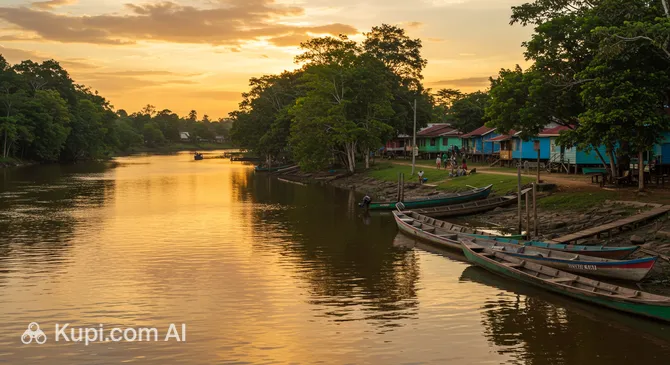
Moengo is a vibrant and authentic town located in the eastern part of Suriname, in the Marowijne District. Surrounded by lush tropical forests and nestled on the banks of the river, this settlement offers travelers a unique atmosphere of tranquility and a deep connection with nature. For those seeking an authentic experience away from bustling metropolises, Moengo is an ideal place where time seems to slow down.
Moengo. Illustration.
Source: Kupi.com AI
Geographically, the town holds a strategic position in the region, serving as the largest center of the district with a population of approximately 8,252 people. The climate here is classically equatorial, ensuring a riot of greenery and abundant local waterways. For a long time, the town's development was inextricably linked to industry, specifically bauxite mining, which has left a significant mark on its appearance and the historical heritage of the region.
Today, Moengo attracts ecotourism enthusiasts with its picturesque river landscapes and the opportunity to get acquainted with the multifaceted culture of Suriname, where indigenous traditions and the colonial past are intertwined. Fishing remains the primary occupation of the local residents, giving the town the special charm of a cozy river port. We invite you to visit this quiet corner of Marowijne to see the untouched beauty of the South American rainforest with your own eyes and enjoy the hospitality of the locals.
Weather Overview
Moengo is characterized by a typical tropical equatorial climate, meaning consistent warmth and high humidity throughout the year. The average air temperature fluctuates between +25°C... +32°C, with almost no change from month to month. This weather promotes the rapid growth of tropical vegetation, making the town's surroundings incredibly green and lush.
Precipitation in the region is abundant, but its distribution depends on the season. Traditionally, there are two wet periods: from April to August and a short rainy season in December–January. During these times, frequent but usually short-lived downpours are expected, after which the sun comes out again. If you are planning a visit, the best time is the dry season from August to November, when rain is least frequent.
Given the proximity to the river, the air humidity in the town feels more intense, so clothing made from light, natural fabrics is the best choice. To better plan your wardrobe and activities, we recommend checking the detailed city's climate in advance, so that no whims of nature catch you off guard during your jungle expeditions.
Average monthly temperature
Average monthly precipitation
Interesting Facts
Immerse yourself in the atmosphere of this amazing region through a few curious facts that reveal the character and history of the town.
Moengo is officially recognized as the largest settlement in the Marowijne District, serving as the region's main administrative and cultural center.
In the past, the town was a true industrial giant of Suriname: it was home to key facilities for the mining and storage of bauxite, which was exported worldwide.
The town's life is inextricably linked to the river, which is not only a transportation artery but also the main source of food; fishing here is both a job and the main hobby of the townspeople.
Despite its significance, Moengo remains a cozy and compact place: according to the 2012 census, just over eight thousand people live here.
The town is an important link between the country's capital and the eastern borders, maintaining a unique balance between its industrial past and natural serenity.
How to Get There
The transportation accessibility of Moengo allows tourists to choose the most suitable way to travel based on comfort and time preferences. Despite its distance from the capital, the town remains an important transport hub for the eastern direction of Suriname. To ensure a smooth trip, we recommend checking the route options to Moengo in advance.
The most common way to reach the town is by car from Paramaribo. The trip along the East-West Verbinding highway takes about 2–3 hours, covering a distance of approximately 100 kilometers. The road passes through picturesque rural areas and tropical landscapes, offering a great opportunity to see the country's daily life from the window of a bus or a rented car.
For those looking for a more exotic path, it is possible to reach Moengo by water. Boats and launches run from the capital, and such a journey takes between 4 and 6 hours. This is a slower but incredibly beautiful route, allowing you to fully enjoy the majesty of Surinamese nature. There is also a small Moengo Airport (IATA: MOJ) in town, which occasionally receives domestic flights, though flight schedules depend heavily on local airlines and current demand.
Railway communication in this region is currently not operational for passenger transport, so the main focus should be on roads and river routes.
Main Attractions
The main natural treasure and center of town life is the majestic river, which offers travelers many opportunities for active recreation. Here, you can rent a boat for a leisurely trip along banks overgrown with thick jungle or head out for a real tropical fishing trip. Observing exotic birds and wildlife in their natural habitat makes every water excursion an unforgettable adventure.
One of the most unusual features of the Moengo landscape is the former bauxite quarries. Over time, they have filled with water, turning into deep and incredibly photogenic lakes. These man-made reservoirs, surrounded by recovering nature, create surreal landscapes that are perfect for ecotourism enthusiasts and professional photographers seeking rare shots of an industrial past being reclaimed by the forest.
For those who prefer hiking, the town's surroundings offer trails through the tropical forests. Under the guidance of local guides, you can venture into the thicket to discover the unique flora and fauna of the region. The proximity to wildlife allows you to step right from the town into a world dominated by ancient trees and the sounds of the living jungle, making Moengo an essential point on the map for any explorer of Suriname.
Local Cuisine
A gastronomic journey in Moengo is, first and foremost, an introduction to the gifts of the local rivers. The town's cuisine is deeply rooted in fishing traditions, so fresh fish in various forms is the basis of almost any menu. The general character of the local gastro-scene can be described as homemade, hearty, and exotic, with a bright influence from the country's multicultural heritage.
One of the key dishes worth trying is pepera—traditional rice cakes served with fish or meat under a thick and aromatic sauce. It is also impossible to imagine a local meal without pom. This is a festive dish, which is a casserole made from cassava root (or pomtajer), having a unique sweet and sour taste and a juicy texture.
The food culture in town centers around small home-style cafes and street stalls. There is also a strong Indonesian and Indian influence felt here: the menu often features roti with spicy curry and aromatic fried rice. It is best to wash down all this variety with fresh juices from tropical fruits or the legendary local beer Parbo, which is perfectly refreshing in the hot equatorial climate.
Travel Tips
A trip to Moengo is a step towards true adventure, and to make your visit comfortable and safe, we have prepared a list of important practical tips.
Clothing and gear: Due to the high humidity and heat, choose clothing made from light, natural fabrics. Be sure to bring insect repellent and sunscreen. For walks in the surrounding areas, you will need closed and comfortable shoes.
Transport: Plan your transfer from Paramaribo in advance, as it's better to book seats in boats and buses a day before departure. Within the town, the best way to move around is on foot.
Finance: Bring enough cash in the local currency. ATMs in town may not work with international cards, and card payments are almost impossible in shops and cafes.
Health: Drink only bottled water. There are pharmacies in town, but if you take specific medications regularly, it is better to bring them with you.
Communication: The main language is Dutch, but many people understand English and the local language, Sranan Tongo. Learn a couple of greeting phrases in the local dialect—it is very much appreciated by the residents.
Local etiquette: Surinamese value politeness and calmness. Always greet people when entering a shop or cafe. Before taking photos of local residents, be sure to ask for permission.
What to avoid: You should not swim in the river in unfamiliar places without local advice. Also, avoid discussing political topics and show respect for environmental rules in forest zones.
Best time: Try to plan your trip during the dry season (August to November) so that rains do not interfere with your walks and river excursions.
Following these simple rules will help you fully immerse yourself in the atmosphere of this amazing region and bring home only the warmest memories!
Entertainment & Nightlife
Entertainment in Moengo is predominantly quiet and contemplative, aimed at lovers of nature and peace. Most activity is concentrated near the waterfront, where locals and a few tourists gather during the sunset hours to relax. This is the best time to enjoy the cool air by the water, have a small picnic, or simply watch the river turn golden in the light of the fading day.
The town lacks a classic nightlife in the form of noisy clubs or bars with loud music. Moengo is a place for those who want to escape the city bustle and spend an evening in a cozy, almost home-like setting. However, life here does not stand completely still: occasionally, local cultural festivals are held in the central squares. These events are accompanied by traditional Surinamese dancing and live music, allowing guests to dive deeper into local folklore.
During the day, entertainment boils down to water activities—trips in canoes or boats—and visits to the surrounding forests. Safety in the town is high and residents are friendly, but for traveling between distant points after dark, it is better to pre-arrange a ride with one of the local drivers, as official taxi services are not represented here in the usual way.
Parks & Museums
Due to its small size and industrial past, Moengo does not have classic urban parks with manicured alleys or large state museums. However, the role of the main "park" is successfully played by nature itself. The coastal zones of the Suriname River and the adjacent areas of tropical forest are natural recreation zones where locals and visitors spend time in the fresh air, enjoying the peace and quiet.
For those interested in industrial history, the territories of former bauxite mines serve as a kind of open-air museum. Although not an official exhibition, the sight of abandoned quarries and the remains of industrial machinery provides a clear picture of the town's economic past, when it was the "bauxite capital" of the region. These locations are popular among fans of industrial tourism and unusual landscapes.
If you are looking for traditional museum collections with artifacts and historical documents, you should head to nearby Paramaribo. The capital houses the country's main cultural institutions, including the famous Fort Zeelandia. Nevertheless, Moengo itself is a living monument to history, where every bend of the river and old production buildings tell their own unique story of survival and development in the heart of the jungle.
Getting Around
The transport system in Moengo is simple and focused on the needs of local residents. Due to the compact size of the town, the main way to get around is by walking or cycling—this allows you to quickly reach any point while enjoying the views of the river coast. Public transport as such is mostly represented by intercity routes.
Buses and small minibuses connect Moengo with Paramaribo and Albina. Often, there is no exact schedule: transport departs as it fills up with passengers, so tourists should factor in extra time for waiting. The main gathering point for passengers is in the town's central square. Fares are paid in cash to the driver, and prices remain very affordable.
Water transport plays an important role in the life of the town. Wooden boats and motor launches are used to transport people and goods along the river, which often proves to be faster and more convenient than land roads, especially if you need to reach remote forest settlements. If you need a taxi to get around town, it is best to ask for help from the staff at your guesthouse—they will help you call a trusted local driver, as mobile ride-hailing apps do not work here.
Accommodation
The choice of accommodation in Moengo is limited, emphasizing its status as a quiet and non-touristy destination. You won't find large hotel chains or luxury resorts here. The bulk of the accommodation consists of small family guesthouses and modest lodges located near the river. This lodging is ideal for anglers and ecotourism fans who value proximity to nature and home comfort over five-star service.
Most available accommodation options are concentrated along the waterfront or in the central part of town. Conditions in such places are usually basic: a clean room, a bed, and a fan. It is worth noting that during peak periods or local holidays, rooms may be fully booked, so it is recommended to contact the owners in advance, even though online booking systems are poorly developed here.
For travelers accustomed to high levels of comfort and a wide range of services, staying in hotels in Paramaribo is often the best solution. Due to the relatively short distance, Moengo can easily be visited as part of a day trip, returning to the capital by evening. If you do decide to stay overnight, prepare for a complete immersion into the authentic life of the Surinamese provinces.
Nearby Cities
The town of Moengo is an excellent starting point for those who want to explore the eastern regions of Suriname and even take a peek into neighboring countries. Its convenient location on the main transport highway allows for interesting excursions to the border or to historical settlements in the region.
Just 37 kilometers to the east is the town of Albina. This is an important border settlement on the Maroni River, offering stunning views of the water and serving as the starting point for many river expeditions. From here, you can easily cross to the other side to visit Saint-Laurent-du-Maroni—a town in French Guiana known for its colonial architecture and history as a former penal colony.
If you head towards the capital, it is worth paying attention to Nieuw Amsterdam, located at the confluence of the Suriname and Commewijne rivers. This town attracts tourists with its open-air museum situated in an old fort. Each of these directions will provide you with new impressions of the diversity of cultures and landscapes of this amazing land.
City
Population
Distance
Albina
5,247
37 km
Saint Laurent du Maroni
44,000
43 km
Nieuw Amsterdam
5,650
81 km
Meerzorg
12,405
83 km
Onverwacht
2,223
88 km
Exploring the surroundings of Moengo will help you better understand the multifaceted history of the region and enjoy the beauty of the wild nature that surrounds each of these settlements.
Shopping & Souvenirs
Shopping in Moengo is primarily about visiting the local markets, which are the heart of town life. You won't find global brand boutiques or huge shopping centers here, but you can immerse yourself in the atmosphere of genuine Surinamese trade. The main activity is concentrated in the markets by the river, where fishermen bring their morning catch and farmers bring fresh tropical fruits and vegetables.
For tourists, handmade goods are of the greatest interest. Local artisans are famous for making unique wooden items decorated with traditional carvings, as well as jewelry made from shells and forest plant seeds. Such souvenirs will be a great reminder of your trip to this remote corner of the world. It is also worth paying attention to local spices and sauces, which will give your home-cooked dishes a unique Surinamese flavor.
Shops in town usually open early in the morning and stay open until evening, with a siesta break during the hottest hours. Payment is made primarily in cash in the local currency (Surinamese dollars), as card terminals are extremely rare. Tax Free is not available in Moengo, so the prices you see on the tags (if any) or those mentioned by the seller are final. Do not hesitate to politely haggle at the markets—it is part of the local communication culture.