Support

Walls of Ávila

About

The Walls of Avila are not just a landmark, but a true symbol of the city of Avila and one of the most impressive monuments of medieval architecture in all of Spain. These powerful fortifications, completely encircling the old part of the city, create a unique atmosphere and transport travelers back many centuries. Built between the 11th and 14th centuries to protect against enemy raids, today they are a UNESCO World Heritage site and attract tourists from all over the world.

The walls are approximately 2.5 kilometers long and reach a height of 12 meters. The monumental structure is adorned with 88 semi-circular towers and has 9 gates through which you can enter the heart of the historic center. The thickness of the walls, reaching up to three meters, testifies to the former defensive significance of this fortress. At night, the entire perimeter is illuminated, turning the walls into the largest fully lit monument in the world.
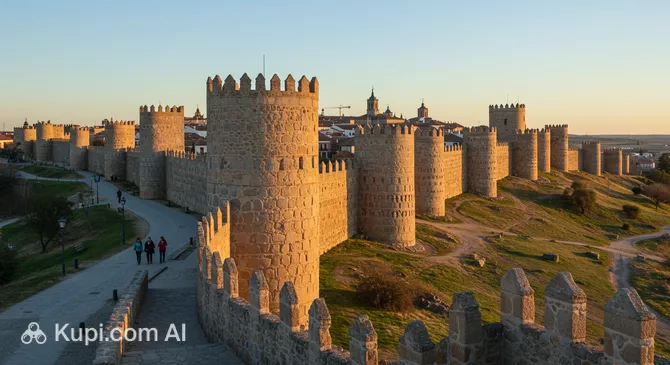
Walls of Ávila. Illustration.
Source: Kupi.com AI

Traveller photos:

The main pleasure for visitors is the opportunity to walk along a significant portion of the wall. Once at the top, you can enjoy breathtaking panoramic views of the tiled roofs of the old city, the Gothic cathedral that is part of the defensive system, and the picturesque surroundings. Such a walk allows you not only to appreciate the scale and grandeur of the structure but also to feel like a guard peering into the distance from ancient towers.

Visiting the Walls of Avila is a unique opportunity to touch living history. This is not just a stone fence, but a complete architectural ensemble that has been perfectly preserved to this day and continues to define the city's character. A walk along the walls will be one of the most vivid impressions of a trip to this amazing Castilian city.

Contacts

To plan your visit and check current information regarding opening hours, ticket prices, and accessible sections, it is recommended to consult official sources. All necessary information is usually published on the city's tourism portal and the attraction's own website.

How to contactContact
AddressC. Conde Don Ramón, 15, 05001 Ávila, Spain
Phone+34 920 35 40 05
Websitemuralladeavila.com

What to Do

Visiting the Walls of Avila offers several exciting activities, the main one being a walk along the fortifications themselves. About half of the total length of the walls—approximately 1,700 meters, divided into two main sections—is open to visitors. Climbing to the top, you can feel like a medieval guard and enjoy breathtaking views of the old city with its labyrinth of cobbled streets, tiled roofs, and church spires. This is a unique opportunity to see the city from a completely different perspective and appreciate its layout and beauty.

During your walk along the walls, pay attention to the key points. The route allows you to see several of the nine gates, the most famous of which are the Alcazar Gate (Puerta del Alcázar) and the Gate of San Vicente (Puerta de San Vicente). Special attention should be paid to the view of the Cathedral's apse, which is part of the defensive system and literally built into the wall. From the height, panoramas open up not only of the historic center but also of the surrounding landscapes, including views of the Sierra de Gredos mountains in the distance.

In addition to a daytime stroll, it is worth considering other options. For example, visiting the walls at sunset will provide unforgettable impressions and wonderful photographs. As darkness falls, the illumination is turned on, transforming the walls into the world's largest fully lit monument, creating a magical and almost cinematic atmosphere. For those who want to delve deeper into history, there is a tourist center at the Meat Market Gate (Puerta de Carnicerías) where you can purchase tickets and get additional information. In summer, dramatized performances and tours are sometimes held here, adding historical color to the visit.

Getting There

Getting to Avila, where the famous walls are located, is quite easy from many large cities in Spain, but it is most convenient to do so from Madrid. Regular trains and buses depart throughout the day, and the journey takes an average of 1.5 to 2 hours. This makes Avila an excellent choice for a day trip, allowing you to explore the city's main attraction without rushing.

Upon arrival in Avila, whether at the railway station (Estación de Ávila) or the bus station (Estación de Autobuses), you will find yourself very close to your destination. You can reach the walls surrounding the Old Town on foot—a pleasant walk will take no more than 15–20 minutes. Alternatively, you can take a taxi or one of the city buses, which will quickly take you to one of the entrances to the historic center.

Since the walls surround the entire historical center, you will effectively reach them as soon as you enter the old part of the city. To climb up for a walk, you need to find one of several official entrances. The main access points for visitors are the House of the Butchers (Casa de las Carnicerías), where the main visitor center is located, and the Alcazar Gate (Puerta del Alcázar). Navigating is easy as the entrances are well-marked, and the walls themselves serve as the city's primary landmark.

Nearest city: Avila

History & Facts

The history of the Walls of Avila is closely linked to the era of the Reconquista—the reclaiming of lands on the Iberian Peninsula by Christian kingdoms. After King Alfonso VI recaptured Avila from the Moors, he ordered the construction of powerful fortifications in 1090 to protect the city and secure the new frontier. The construction was overseen by his son-in-law, Raymond of Burgundy. According to legend, the walls were built in record time—just nine years—which speaks to the colossal effort and strategic importance of the project. The construction used not only granite blocks but also materials from ruined Roman and Visigothic structures, fragments of which can still be seen in the masonry today.

One of the most striking features of the walls is their fusion with sacred architecture. The apse (altar part) of the Avila Cathedral is built directly into the wall, forming the strongest tower in the eastern part of the fortifications, known as the "cimorro." Thus, the cathedral served a dual function: it was not only the city's main temple but also its most vital bastion. In the Middle Ages, the walls also served as a social barrier: the nobility and clergy lived inside, while the peasants lived outside. At the same time, noble knights bore personal and financial responsibility for defending the gates closest to their palaces.

The walls hold many legends, one of which earned the city the nickname "Avila of the King" (Ávila del Rey). It tells of the rescue of the young Infante Alfonso, the future King Alfonso VII, whom loyal residents hid behind the walls from his hostile stepfather. The fate of the fortifications could have been tragic: in the 19th century, there were plans to demolish them to expand the city, but fortunately, an economic crisis prevented these plans. In 1884, the walls were declared a National Monument of Spain, forever protecting them from destruction and preserving this unique example of medieval fortification for future generations.

Time Needed

When planning a visit to the Walls of Avila, it is worth setting aside 1.5 to 2 hours for exploration. This time will be sufficient to leisurely walk along the entire 1,700-meter section accessible to tourists. During this time, you can enjoy the views, take photos, and feel the medieval atmosphere while slowly moving from one tower to another. Walking along the walls is the main highlight for which people come here, and it allows you to see the historic center of Avila from the best possible vantage point.

If you want to dive deeper into the history and not limit yourself to just the walk on top, plan to spend about 3–4 hours or even half a day. Additional time will be needed to visit the information center, study the architectural details at the various gates, and, importantly, walk around the exterior of the walls. It is from the outer perimeter, for example, from the Los Cuatro Postes viewpoint, that the most iconic and breathtaking view of the entire monumental structure opens up. This approach will allow you to fully appreciate the scale and grandeur of this unique monument in Spain.

Working Hours

The Walls of Avila are open to visitors year-round, but the opening hours change depending on the season. During the summer period, usually from April to October, you can climb the walls from 10:00 to 20:00. During the winter months, from November to March, the schedule is reduced—from 10:00 to 18:00. It is worth noting that during the winter period, Monday may be a closing day, except for public holidays. The last admission to the wall is approximately 45 minutes before closing, so plan your visit with some time to spare.

Advance ticket booking for a regular walk along the walls is generally not required; however, tickets can be purchased online to avoid queues at the ticket office. If you plan to visit Avila during the height of the tourist season or on public holidays, it is recommended to check for the latest information and possible changes to the schedule on the city's official tourism portal or on the attraction's website. This is also important because opening hours may be adjusted due to weather conditions or special events.

10:00 – 20:00

Nearby

Exploring the majestic Walls of Avila is just the beginning of your acquaintance with this amazing city. To truly feel its atmosphere, it is worth strolling through the streets adjacent to the fortress. The Old Town, fully enclosed by the walls, is so compact that exploring its treasures becomes a pleasant walking tour where a new discovery awaits you around every corner.

Many iconic sites are literally just a few steps from the walls, making it easy to combine visits. From ancient basilicas and the Gothic cathedral, whose altar is part of the defensive system, to cozy squares and museums—all this creates a complete picture of Avila's rich history and culture. Below is a list of nearby attractions that will enrich your journey.

NameDistance
Basilica of San Vicente0.1 km
Museum of Ávila0.2 km
Avila Cathedral0.2 km
Mercado Chico Square0.3 km
Alcázar Gate0.3 km
Los Candiles0.3 km
Bococo Restaurant0.3 km

Reached the bottom of the page?

Looks like you know this route inside out