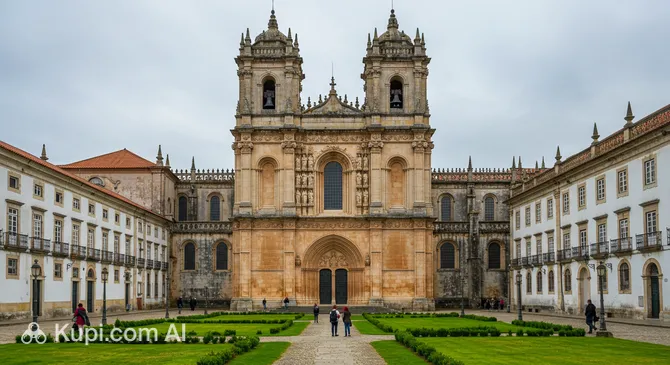
In the heart of Portugal, in the cozy town of Alcobaça, lies one of the country's most majestic architectural treasures — the Monastery of Santa Maria de Alcobaça (Mosteiro de Santa Maria de Alcobaça). This outstanding monument of Gothic art is not only one of Portugal's major assets but also a UNESCO World Heritage site. The monastery impresses with its scale and harmonious austerity, representing the first example of fully Gothic architecture on Portuguese soil.
Founded in 1153 by the first King of Portugal, Afonso Henriques, the monastery was granted to the Cistercian Order and served as a royal pantheon for two centuries. Its history is closely intertwined with the founding of the state itself. Although the cathedral's facade was rebuilt in the Baroque style in the 18th century, the interior retains the impressive simplicity and grandeur of early Gothic, characteristic of Cistercian buildings. The central nave, reaching over 100 meters in length, makes this church the largest in Portugal.
Traveller photos:
Visiting the Alcobaça Monastery is an opportunity to touch centuries-old history, feel the power of medieval architecture, and see the famous tombs of King Pedro I and his beloved Inês de Castro, the protagonists of one of Europe's most tragic love stories. The complex includes not only the church but also several cloisters, a kitchen, and a refectory, allowing for a deeper immersion into the life of the monks who once inhabited these walls. It is a place that leaves a lasting impression due to its monumentality and spiritual atmosphere.