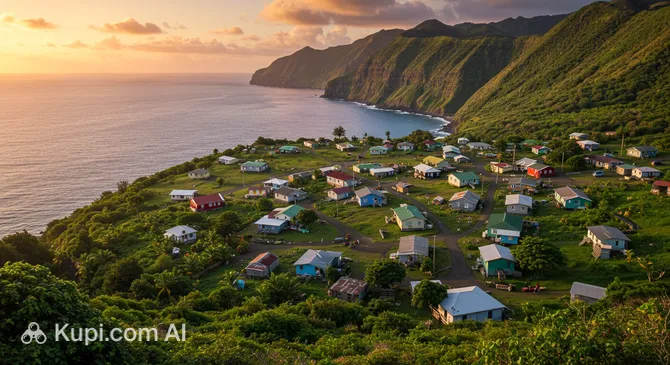
Adamstown is a unique and one of the most isolated settlements on our planet, serving as the capital of the British Overseas Territory of the Pitcairn Islands. Located in the vast expanses of the South Pacific, this tiny village is steeped in an atmosphere of seclusion and the spirit of adventure that once brought its first inhabitants here.
Adamstown. Illustration.
Source: Kupi.com AI
Geographically, the settlement occupies a small elevation above Bounty Bay, reached by the famous steep road known as the "Hill of Difficulty." A major milestone in Adamstown's history occurred in the late 18th century, when mutineers from the ship HMS Bounty settled here along with Tahitians. Today, the population barely reaches 50 people, making it the smallest capital in the world by population.
Tourists will find a truly "village-like" and tight-knit atmosphere here, where every resident knows one another. The main features of the town are the unique cultural heritage of the sailors' descendants and the incredible nature of the island, which covers less than five square kilometers. If you are looking for a place where time seems to have stood still, Adamstown will be a true discovery and a challenge to your traveler skills.
Weather Overview
The climate in Adamstown is characterized as subtropical marine, providing mild and stable weather conditions throughout the year. Thanks to the distance from continents and the complete absence of industry, the air here is strikingly clean, and constant ocean breezes help to better tolerate high humidity. Weather in Adamstown rarely brings temperature surprises, remaining comfortable for exploring the island's hilly terrain.
The typical temperature range fluctuates from +20°C in the winter months (August-October) to +26°C at the height of summer (January-February). Precipitation is distributed unevenly throughout the seasons: March, October, and December are considered the rainiest, when intense tropical downpours are possible. At other times of the year, rains are periodic, quickly giving way to bright sunshine, which is typical for remote oceanic islands at this latitude.
Interesting Facts
Adamstown is a place full of amazing paradoxes and stories hidden from most travelers' eyes. Here are some impressive facts about this tiny dot on the map:
The World's Smallest Capital: Only about 35–40 people live here, officially making the town the least populated administrative center on the planet.
Descendants of the Bounty Mutineers: Almost all modern residents of the village are direct descendants of the sailors from the legendary ship and their Tahitian companions, preserving ancestral surnames such as Christian, Warren, or Young.
Extreme Isolation: The nearest major administrative center for the territory is in Auckland, 5,300 kilometers away, confirming the town's status as one of the most remote inhabited points on Earth.
Digital Independence: Despite its small size and lack of banks, the territory has its own international ISO code (PN) and national top-level domain .pn.
Unique Access: The settlement can only be reached from the sea through the single port at Bounty Bay, after which one must conquer the famous and very steep "Hill of Difficulty" climb.
How to Get There
Getting to Adamstown is an exceptionally difficult task, as the island completely lacks airports and runways. The primary and only way is via the ocean, turning the journey into a full-scale multi-day expedition. All ways to get to Adamstown require careful planning several months in advance due to the rarity of sea voyages and strict visiting regulations.
The nearest transport hub for travelers is the islands of French Polynesia (most often Mangareva), from where cargo-passenger ships periodically depart for Pitcairn. The journey by sea takes several days. Rare cruise liners also visit the island; however, due to the lack of a deep-water harbor, passenger landings in Bounty Bay always depend on current weather conditions and wave height.
There is no rail service on the island, nor is there a public transport system. Upon arrival at the port, guests are usually met by boats, after which they must navigate the famous steep road to the settlement itself. A small number of local vehicles and quad bikes fully meet the needs of the residents, and traffic jams are non-existent due to the small population.
Main Attractions
In Adamstown, you won't find traditional urban ensembles, wide squares, or shopping malls, as the town's main attractions are inextricably linked to its dramatic history and rugged island nature. The central point of interest for tourists is the Pitcairn Island Museum. This small but very informative museum houses priceless artifacts from the sunken HMS Bounty, antique books, and everyday items of the first settlers, offering a glimpse into the island's unique past.
While strolling through the village itself, it is worth visiting the local church and the cemetery where the community's founders are buried. The architecture here is simple and functional, but every building—from the post office to administrative offices—tells its own story of survival in total isolation. A special place is held by Bounty Bay—the island's only port, which serves as its "front door" and offers breathtaking views of rocky cliffs and azure ocean waters.
For lovers of active leisure, there are numerous trails leading to viewpoints on the hilltops. These spots offer panoramic views of the endless Pacific Ocean and the residents' farming plots. Despite its modest size, Adamstown surprises with its authenticity and the rare opportunity to see the inner life of one of the world's most secluded and smallest communities.
Local Cuisine
The gastronomic scene in Adamstown is devoid of restaurants or chain cafes in the traditional sense due to the extremely small population and occasional flow of guests. The food culture is built around home-cooked meals using local products and items delivered by rare cargo ships from the mainland. The basis of the residents' diet consists of freshly caught fish, tropical fruits, and vegetables grown in their own gardens.
The local cuisine is an interesting symbiosis of British colonial traditions and Polynesian influence. Dishes are often prepared with seafood using breadfruit, sweet potatoes, and coconuts. Special treats for tourists are usually organized right in private homes or community spaces, creating a warm and authentic atmosphere during communal meals.
As for drinks, natural fruit juices from local produce are highly valued on the island. It is important to remember that supplies of many common goods are limited, so gastronomy in Adamstown teaches one to appreciate the simplicity and naturalness of flavors. Joint dinners are an important part of the community's social life, highlighting the unity of this small world in the middle of the ocean.
Travel Tips
A trip to such a remote place as Adamstown requires serious preparation, so we have prepared some tips to help make your visit as comfortable and safe as possible.
Clothing and Belongings: Choose light clothing made of natural fabrics for the subtropics and be sure to have sturdy shoes with good grip for walking on steep hills. Don't forget a personal first-aid kit and a supply of necessary medications, as local medical facilities are limited.
Transport: Be prepared to do a lot of walking. There are no taxis or buses on the island, and the main motorized means of transport are private quad bikes.
Finance: The official currency is the New Zealand Dollar. Carry a sufficient supply of cash; there are no ATMs here, and international cards are rarely accepted.
Health and Safety: The crime rate here is zero, but the main danger is the natural conditions. Take out insurance that covers emergency medical evacuation by sea, as there is no major hospital on the island.
Communication: The main language is English, but locals communicate with each other in the unique Pitkern dialect. Wi-Fi access is available in public places, but the connection can be slow.
Local Etiquette: Pitcairners are a very close-knit and friendly community. Always greet passersby and respect the residents' privacy by asking permission before photographing their homes.
What to Avoid: Do not plan trips with a rigid return schedule, as sea transport is heavily dependent on the whims of the weather in the Pacific Ocean. Avoid hiking alone along dangerous rocky cliffs.
Resources: Be mindful of fresh water and electricity consumption—these resources are extremely limited and valuable on the island.
Despite all the logistical challenges, the hospitality of the locals and the primal silence of the ocean will make your stay in this corner of the world a truly unique experience.
Entertainment & Nightlife
Classic urban entertainment and nightlife, such as clubs, bars, or cinemas, do not exist in Adamstown. The size of the community and the infrequent influx of guests do not create a demand for such facilities. Life in the town follows a calm natural rhythm, and residents prefer to spend their evenings with family or at community gatherings. The main hub of social life is the local church and community spaces, where joint dinners and festive events are occasionally held.
Locals and the few guests spend their free time outdoors, fishing, hiking the trails, or gardening. If more diverse entertainment is needed, residents may travel to the mainland, but such trips are extremely rare and require complex logistics. There is no regular "going out on the town" in the traditional sense here due to the vast distances to the nearest civilized centers.
Safety in Adamstown is at the highest level, so walking at any time of day poses no threat. It is only important to remember the rugged terrain and the lack of artificial lighting in many areas, which requires caution when moving around at dusk. When a cruise ship approaches the island, the atmosphere livens up: residents board the vessel to give lectures and trade souvenirs, which becomes the main entertainment event of the month.
Parks & Museums
In Adamstown, there are no man-made urban parks with alleys and fountains, as the entire island is one continuous natural landscape. Almost the entire settlement consists of houses harmoniously integrated into the natural vegetation on the steep slopes. Any trail leading beyond the residential zone goes into picturesque forest areas or to rocky cliffs where one can enjoy the silence and untouched beauty of an oceanic island.
The main cultural site is the Pitcairn Island Museum, located in the very center of Adamstown. This place is a must-visit for every traveler wishing to understand the roots of the local community. The museum's exhibition includes unique relics from HMS Bounty, such as hull fragments and navigational instruments, as well as items illustrating the challenging history of colonization and life in isolation.
In addition to the museum, public buildings, including the church with its memorial plaques, serve as cultural centers. In a broader sense, the entire archipelago can be considered a natural "park," including the uninhabited Henderson Island, which is recognized as a UNESCO World Heritage site. A visit to Adamstown provides a rare opportunity to see how history and nature merge into one in one of the most remote corners of the planet.
Getting Around
Public transport in the usual urban sense—buses, trams, or subways—is absent in Adamstown. The settlement is so compact that most movement is done on foot. The island is small, about 3.2 km long, allowing one to cross it independently while admiring the spectacular ocean panoramas along the way.
To transport goods and quickly overcome steep climbs, locals use quad bikes and small off-road vehicles. The road network consists of narrow lanes, the most famous of which is the "Hill of Difficulty"—a steep road connecting Bounty Bay with the village. Travelers should note that the walk up from the landing stage requires good physical fitness and comfortable shoes.
The fare system and transit passes are not relevant here, as there are no commercial transport services on the island. Sometimes locals may offer a guest a ride on their vehicle as a gesture of hospitality. The main advice for those arriving in Adamstown is to plan your movements according to daylight hours and be prepared for the fact that this is a town meant for walking surrounded by wild nature.
Accommodation
In Adamstown, you won't find multi-story hotels, chain properties, or luxury resorts. The accommodation market here is represented exclusively by guest houses and homestay options with local families. This format allows tourists to fully immerse themselves in the unique daily life of the community and feel like part of this small isolated world, where every guest is an important event.
All available housing options are concentrated directly within the settlement itself, as it is the only inhabited area on the island. Living conditions are usually simple and rural but cozy, often including home-cooked meals made from local products. Bookings should be made long before the trip, as the number of guest spots is extremely limited, and the visit must be pre-approved by the Island Council.
The price range may seem high compared to mainland hotels due to the difficulty of delivering resources; however, this is compensated for by the uniqueness of the experience and the hospitality of the hosts. Solutions for long-term visits by specialists or experienced travelers prevail. Adamstown offers a rare opportunity to take a break from the hustle and bustle of civilization in a setting where there is no room for mass tourism.
Nearby Cities
Adamstown is in such deep seclusion that the concept of "nearby cities" virtually does not exist for it. There are no other settlements within a radius of hundreds or even thousands of kilometers, making this place a unique example of absolute geographic isolation. The nearest uninhabited islands of the Pitcairn archipelago, such as Henderson, are UNESCO World Heritage sites, but they can only be reached as part of specially organized maritime expeditions.
For residents and guests of the island, the main landmarks in the outside world are the distant centers of French Polynesia (such as the islands of Tahiti or Mangareva) and New Zealand, where the territory's administrative structures are located. However, traveling there takes several days by ship and requires significant resources, so classic day trips to neighboring cities are physically impossible here.
Despite the lack of neighboring cities, the region around Adamstown offers incredible opportunities for exploring the sea and untouched nature. Every venture out to sea beyond the island turns into a full-scale exploration, allowing one to feel the true scale of the Pacific Ocean and the fragility of this tiny inhabited oasis.
Shopping & Souvenirs
Shopping centers, supermarkets, and traditional markets are completely absent in Adamstown. Consumer goods are largely imported by sea, and residents maintain a semi-autonomous household, relying on their gardens and community resource distribution. However, for tourists, the town offers unique opportunities to purchase items that cannot be found anywhere else in the world.
The main "shopping" attractions on the island are folk handicrafts. Local craftsmen are famous for their skillful wood carving (especially prized are figures of sharks and models of HMS Bounty), woven baskets, and bone carvings. Pitcairn postage stamps hold immense value for collectors—philately has traditionally played an important role in the island's economy, and local stamps are considered some of the rarest and most beautiful in the world.
Trade usually picks up on days when cruise ships visit, as residents set up improvised souvenir fairs. At other times, purchases are made through small local shops or directly from artisans. Payment is primarily made in cash using New Zealand dollars, and the lack of a Tax-Free system is compensated for by the uniqueness and manual labor invested in every souvenir from Adamstown.
Reached the bottom of the page?
Looks like you know this route inside out
Popular routes
Where travelers fly most — pick a route and check prices