Support

Jerash Archaeological Site

About

The Jerash Archaeological Site is a unique monument of antiquity located in the city of Jerash in northern Jordan. This site is often called the "Pompeii of the East" due to its magnificent state of preservation. Jerash is considered one of the largest and most complete examples of an ancient Roman provincial city in the world, having been hidden under the sands for centuries.

In the vast territory of the complex, covering more than 800,000 square meters, visitors can immerse themselves in history while walking along paved streets lined with majestic colonnades. The ruins of temples, two theaters with stunning acoustics, public baths, fountains, and even a hippodrome where chariot races once took place have been preserved here. The entrance to the ancient city is adorned by the monumental Hadrian’s Arch, built in honor of the Roman emperor's visit.
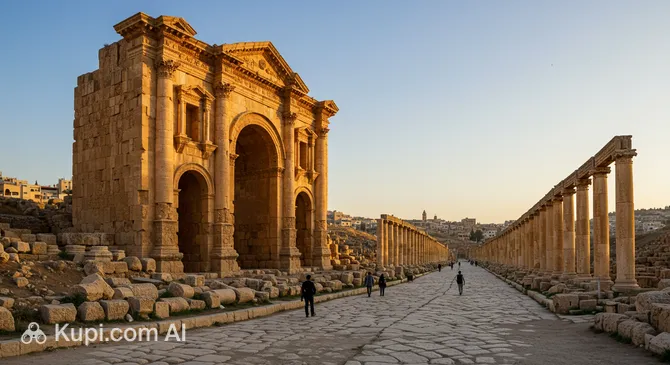
Jerash Archaeological Site. Illustration.
Source: Kupi.com AI

Traveller photos:

A visit to Jerash is a true journey through time, allowing you to see firsthand the grandeur of Roman architecture and urban planning. The preserved details, such as mosaics, stone carvings, and the central Oval Plaza surrounded by Ionic columns, are truly imaginative. This iconic site is a must-see on the itinerary of any traveler interested in Ancient World history and wishing to experience one of Jordan's greatest treasures.

Contacts

To plan your visit to the Jerash Archaeological Site, it is recommended to check current information, such as opening hours and ticket prices, via the phone numbers provided below. The complex does not have an official website, but these contacts will help you obtain the necessary information directly.

How to contactContact
Address7VJR+GJ2, Jerash, Jordan
Phone+962 2 635 4653
Websiteinternational.visitjordan.com

What to Do

Visiting the Jerash Archaeological Site is a total immersion into the atmosphere of an ancient Roman city. Guests can walk along the perfectly preserved streets paved with original stones, where chariot ruts are still visible. The route will lead you through the majestic Oval Plaza with its impressive colonnade, past the ruins of the temples of Zeus and Artemis, two ancient theaters, city gates, and bath complexes. For history enthusiasts, this is a unique opportunity to study the urban layout and architectural solutions of the time in detail.

The local hippodrome is of particular interest, as it regularly hosts colorful historical reenactments. Spectators can watch shows featuring "Roman legionnaires," "gladiator" fights, and chariot races—a spectacle that vividly recreates the spirit of ancient competitions. Furthermore, for a deeper understanding of the region's history, it is worth visiting the Jerash Archaeological Museum. Its collection features artifacts found during excavations, spanning periods from the Neolithic to the Middle Ages.

In the summer, the ancient ruins become the venue for an international arts festival. During this time, open-air concerts, theater performances, and ballet productions take place here, creating an unforgettable atmosphere. The festival program also includes craft fairs and gastronomic events, introducing visitors to local culture and cuisine.

Getting There

The Jerash Archaeological Site is located approximately 50 kilometers north of Amman, the capital of Jordan. A trip by car or taxi usually takes about an hour, depending on traffic conditions. This convenient location makes Jerash a popular destination for a day trip from the country's main city.

There are several ways to reach the complex. The most comfortable option is a rental car or taxi. Additionally, public transportation runs regularly from Amman to Jerash. Intercity buses and minibuses depart from the capital's northern bus station (Tabarbour), taking you directly to the city. Some companies, such as Jett, offer comfortable buses along this route.

The entrance to the archaeological park is situated near the center of the modern city of Jerash. Finding it is easy thanks to numerous tourist signs. For visitors' convenience, there is parking on the adjacent territory, as well as souvenir shops and small cafes where you can rest before or after exploring the ancient ruins.

Nearest city: Jerash

History & Facts

The history of the Jerash Archaeological Site spans more than 6,500 years of continuous habitation. In the Hellenistic era, presumably during the time of Alexander the Great, the city—then known as Gerasa—gained prominence. However, its true golden age began after the Roman conquest by General Pompey in 63 BC, when Gerasa became part of the Decapolis, a league of ten great cities. Its location on busy trade routes contributed to the city's rapid enrichment and growth.

The peak of Jerash's prosperity occurred during the 1st–3rd centuries AD, especially after the visit of Emperor Hadrian in 129 AD, in whose honor a monumental triumphal arch was erected. During this period, the city was actively developed with magnificent structures in the best traditions of Roman urban planning: paved colonnaded streets, majestic temples, theaters, spacious squares, and fountains appeared. The uniqueness of Jerash lies in the exquisite blend of Mediterranean Greco-Roman culture with the ancient traditions of the Arab East, reflected in its architecture and languages.

From the 3rd century onwards, the city began a gradual decline, and a powerful earthquake in 749 AD almost completely destroyed it, after which it was abandoned and hidden for centuries under layers of soil and sand. It was this oblivion that helped preserve the ruins in their unique condition. The city was rediscovered by the German explorer Ulrich Seetzen in 1806, and full-scale archaeological excavations began in the 1920s and continue to this day, constantly revealing new pages of ancient Gerasa's history.

Time Needed

When planning a visit to the Jerash Archaeological Site, it is worth budgeting your time correctly to fully enjoy its scale and atmosphere. For a comprehensive yet dynamic tour of the main attractions—such as the Oval Plaza, temples, theaters, and colonnaded streets—it is recommended to set aside at least 3–4 hours. This will be enough time to visit the key points of the complex without rushing and to form a general impression of the ancient city's grandeur.

If you want to delve deeper into history, take a leisurely stroll through every corner, take beautiful photos, or visit the Jerash Archaeological Museum, it is better to allow half a day for your visit. Those who plan to catch one of the spectacular shows at the hippodrome, such as chariot racing, or visit during an arts festival, should dedicate an entire day to Jerash to unhurriedly combine exploring the ruins with a cultural program.

Working Hours

The Jerash Archaeological Site is open to visitors year-round, although opening hours change depending on the season. During the winter period, it is open from 8:00 AM to 4:00 PM, while in the summer months, visiting hours are extended until 7:00 PM. It is important to note that on Fridays and public holidays, a special, shortened schedule applies: from 10:00 AM to 3:00 PM. During the holy month of Ramadan, hours may also change, so it is recommended to verify them before your visit.

Special booking for individual visits is generally not required—tickets can be purchased at the ticket office at the entrance. For travelers planning to visit several attractions in Jordan, purchasing the "Jordan Pass" can be a cost-effective solution, as it includes entry to Jerash and many other iconic sites in the country. The ticket price for the archaeological site also includes entry to the Jerash Archaeological Museum located on its territory. Since schedules may change, especially during holidays, it is highly recommended to check for current information on official tourism portals before your trip.

DayOpening hours
Monday8:00 – 18:30
Tuesday8:00 – 18:30
Wednesday8:00 – 18:30
Thursday8:00 – 19:00
Friday8:00 – 19:00
Saturday8:00 – 19:00
Sunday8:00 – 19:00

Nearby

A visit to the Jerash Archaeological Site offers an introduction to an entire ancient city consisting of numerous unique monuments. To better plan your route and not miss the highlights, pay attention to the key attractions located within the complex and in its immediate vicinity. Exploring these sites will allow for a deeper dive into the history and culture of ancient Gerasa, one of the treasures of Jordan.

Below is a list of the main monuments inside the complex and interesting places nearby, sorted by distance. It will help you find your way and make the most of your visit to Jerash.

As seen from the list, major historical gems such as the Temple of Artemis and the Oval Plaza are within walking distance of each other, making a stroll through the complex both convenient and enriching. After immersing yourself in history, you can rest and refuel at one of the nearby restaurants, enjoying local cuisine and sharing your impressions of what you've seen.

NameDistance
Temple of Artemis0.1 km
Oval Plaza0.4 km
Temple of Zeus0.6 km
Arch of Hadrian1 km
Zahrat Balqis Mandi Restaurant1.1 km
Lolot Al Rawada Restaurant3.6 km

Reached the bottom of the page?

Looks like you know this route inside out