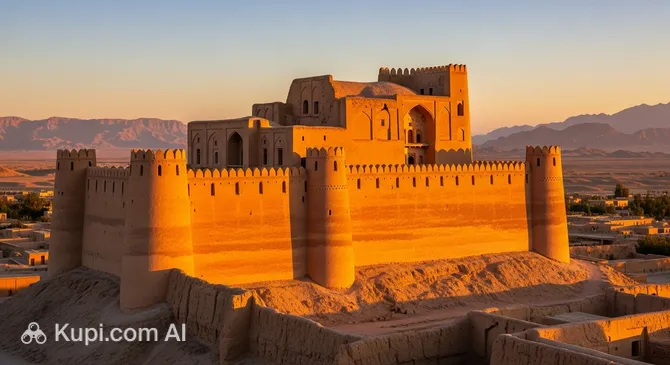
Rayen is a fascinating historical city located in the Kerman Province of southeastern Iran. Nestled on the slopes of the majestic Hazaran Mountains, this city is a true high-altitude oasis where the harshness of the desert meets the lush greenery of gardens. With a population of just over 10,000 people, Rayen maintains an atmosphere of authenticity and tranquility, inviting travelers to truly immerse themselves in the past.
The city's main treasure is its unique historical heritage, embodied in its monumental adobe architecture. For centuries, Rayen served as an important stop on trade routes, and today its streets still preserve the spirit of ancient Persian civilization. The city is famous not only for its antiquities but also for its incredible landscapes: the snow-capped peaks of the Hazaran Mountains contrast beautifully with the terracotta walls of the houses and emerald groves.
Rayen. Illustration.
Source: Kupi.com AI
Visiting Rayen is an opportunity to see the world's second-largest adobe fortress (after Bam) and enjoy the quiet of provincial Iran. Here, you can wander through old quarters, peek into local craftsmen's workshops, and experience the hospitality of the locals, whose lifestyle remains faithful to centuries-old traditions. We invite you to discover this mountain-hidden gem, where every stone breathes history.
Weather Overview
The climate of Rayen is shaped by its high-altitude location at the foot of the Hazaran Mountains. Unlike the scorching plains of Kerman, a milder, semi-arid weather prevails here. Summers in Rayen are warm and dry: in July and August, the average daytime temperature is around 28–30°C, but thanks to the mountain air, the heat is much easier to bear. Winters can be quite harsh for this region—in January, the thermometer often drops to -4°C at night, while staying around 8°C during the day.
Precipitation in the region falls mainly during the winter-spring period, with April considered the wettest month. Snow can remain on the peaks of the surrounding mountains until early summer, creating a picturesque backdrop for walks. To better prepare for your trip and see the current weather forecast for the city, we recommend checking the data before departure.
The best times to visit Rayen are considered spring (April–May) and autumn (September–October). During these periods, the temperature is most comfortable for exploring the fortress and trekking, and local gardens please the eye with bright blossoms or autumn colors. Summer evenings are also very pleasant—the mountain breeze brings long-awaited coolness after a sunny day.
Average monthly temperature
Average monthly precipitation
Interesting Facts
A Mystery Fortress: It is believed that Arg-e Rayen was inhabited until the mid-19th century, making it one of the longest-occupied adobe fortified cities, preserving its structure almost in its original form.
High-Altitude Status: Rayen is located at an altitude of about 2,200 meters above sea level, making it one of the highest cities in the region and providing refreshing coolness even in the height of the Iranian summer.
Blacksmithing Mastery: Historically, the city was famous for its metalworkers. Local blacksmiths produced not only agricultural tools but also exquisite cold weapons, the secrets of which were passed down from generation to generation.
Resilience to the Elements: Despite being built of mud and straw, the fortress has remarkably survived numerous earthquakes that caused much greater damage to other historical sites in Iran.
A Single Entrance: The vast Rayen citadel has only one entrance, located on the eastern side, emphasizing the defensive nature of this unique structure.
How to Get There
Rayen's accessibility largely depends on its proximity to the regional center. Most travelers begin their journey to the city from Kerman, which is located about 100 kilometers to the north. The most convenient and popular way to get there is by official taxi or a rented car. The drive along the scenic mountain highway takes between an hour and a half to two hours and allows you to enjoy the changing landscapes from desert plains to majestic mountain ranges.
If you are planning a trip from Tehran or other major Iranian cities, the most rational choice would be a flight to Kerman International Airport or a train journey to Kerman's central station. Local buses and shared taxis (savari) regularly depart from these transport hubs toward Rayen, making logistics quite simple for independent tourists. To plan your route in advance, it is worth exploring the transportation options in the region.
For those who prefer organized recreation, many travel agencies in Kerman offer day tours to Rayen in comfortable minibuses. These programs usually include a visit to the fortress and a traditional-style lunch, eliminating the need to search for independent transport to get around the area.
Station
Passenger traffic
Distance
Kerman Railway Station
2
82 km
Bandar Abbas Railway Station
2
289 km
Main Attractions
The main and most recognizable landmark of the city is the Rayen Castle (Arg-e Rayen). This grandiose structure, covering about 20,000 square meters, is considered one of the best-preserved adobe citadels in the world. Built during the Sassanid era, it impresses with its massive walls over 10 meters high and numerous watchtowers. Inside the fortress walls, aristocratic houses, temples, and public buildings have been preserved, allowing visitors to imagine how life was organized in a medieval Iranian city.
The city's surroundings are equally impressive and ideal for nature lovers. The Hazaran Mountains, at the foot of which Rayen lies, are among the highest peaks in Iran. The mountain slopes are crisscrossed with picturesque trails leading to waterfalls and hidden gardens. Trekking in this area allows you to enjoy panoramic views of the desert landscape and feel the cool, pure mountain air that makes Rayen a popular retreat during the summer.
Rayen itself is also famous for its fruit orchards, which create a unique oasis microclimate. Walking among the traditional buildings, you will see pomegranate, apricot, and walnut trees. These gardens not only please the eye but also provide the city with fresh produce. The combination of the fortress's rugged architecture and the soft greenery of the oasis creates the unique charm that draws travelers to this corner of Kerman Province.
Local Cuisine
Rayen's culinary traditions are closely intertwined with the gastronomy of Kerman Province, which is famous for its aromatic spices and the use of oasis treasures. The first thing worth trying is the kebabs made from fresh mountain lamb. Special attention should be given to traditional stews, which often combine meat, legumes, and the tanginess of pomegranate juice or dried lemons, creating a unique balance of flavors.
The city is a true paradise for lovers of nuts and dried fruits. Local orchards yield abundant harvests of pistachios and dates, which are served with every meal here. It is also worth trying "Kolompeh"—a traditional cookie filled with date paste, walnuts, and cardamom. This dessert perfectly complements strong Iranian tea brewed with pure mountain water.
The food culture here is centered in small, cozy teahouses and home-style cafes. Locals value a slow pace, so lunch or dinner often turns into a lengthy social ritual. Be sure to try the local saffron rice, served as a side dish to most hot meals—its golden crust and delicate aroma are the hallmark of the Persian table.
Travel Tips
Visiting Rayen will be an unforgettable adventure if you take into account a few practical points characteristic of this high-altitude region of Iran.
Clothing and Essentials: Choose layered clothing, as the altitude in Rayen can make it cool even on a sunny day, and temperatures drop significantly in the evening. Be sure to wear comfortable closed shoes for walking around the adobe fortress and mountain trails. Remember the dress code: women need a headscarf and loose clothing that covers the arms and legs.
Transport: It is best to get around the city on foot. For trips to and from Kerman, use taxis or local "savari." Agree on the fare in advance if the taxi is not equipped with a meter.
Finances: International bank cards are practically not accepted in Rayen. Exchange currency (Euros or Dollars) for Iranian Rials in advance in Kerman or Tehran. Carry enough cash to pay for your hotel, food, and souvenirs.
Health and Safety: The city is very safe, but due to the strong mountain sun, be sure to use sunscreen and wear a hat. Drink only bottled water, although it is usually of high quality in hotels.
Communication: The main language is Persian (Farsi). English is not widely spoken in Rayen, so download an offline translator or learn a few basic phrases: "Salam" (Hello), "Mamnun" (Thank you).
Local Etiquette: When entering a home or a mosque, be sure to remove your shoes. If locals invite you for tea, remember the rules of "Taarof" (traditional politeness)—it is customary to politely refuse a couple of times before accepting the invitation.
What to Avoid: Do not take photos of government buildings, military sites, or local residents without their explicit consent. Avoid public displays of affection, as this is not customary in conservative regions.
When to Visit: Try to get to the Rayen fortress at sunset—in the rays of the setting sun, the adobe walls take on an incredible golden hue, which is perfect for photography.
Following these simple rules will help you fully enjoy the beauty and hospitality of Rayen, making your trip comfortable and pleasant.
Entertainment & Nightlife
Entertainment in Rayen is of a calm and contemplative nature, making it an ideal destination for those seeking solitude and cultural enrichment. Unlike large metropolises, there are no noisy nightclubs or massive concert venues here. Instead, the city offers cozy traditional teahouses where locals gather in the evenings. This is the best place to drink tea with Oriental sweets in a relaxed atmosphere and enjoy the silence under the starry sky.
Daytime leisure in Rayen focuses on exploring historical sites and walking in nature. A visit to the fortress can take several hours, during which you can explore every labyrinth and climb the towers for a better view. For more active tourists, hiking on the slopes of the Hazaran Mountains is an excellent option, where you can find secluded spots for picnics with a view of the valley.
Safety in the city is high, and even evening walks along the lit central streets are perfectly peaceful. If you crave more vibrant experiences or modern infrastructure, a trip to nearby Kerman is always an option, but it is in Rayen that you will find that rare authenticity so valued by experienced travelers.
Parks & Museums
While you won't find huge museum complexes with glass display cases in Rayen, the entire city itself is a living historical museum. The Rayen Castle itself serves as the main exhibition site: it is a grandiose open-air display where you can study the evolution of Persian fortification art. Inside the citadel, the interiors of traditional dwellings and public areas have been recreated, allowing tourists to literally touch the history of the Sassanid and later eras.
Instead of classic city parks, Rayen offers its guests magnificent traditional gardens that encircle the historical center. These green zones, with their "qanats" (irrigation channels) and the thick shade of fruit trees, serve as natural resting places. For locals, these are traditional spots for family picnics, and for tourists, a great opportunity to relax after an excursion while enjoying the view of the fortress.
For those who prefer natural attractions, the slopes of the Hazaran Mountains become a true natural park. Here you can find small waterfalls and cozy valleys that are especially beautiful in spring when wild herbs and trees bloom. Walking along these trails replaces a trip to a local history museum, as it allows you to see the unique flora and fauna of high-altitude Iran in their natural environment.
Getting Around
Given Rayen's compact size, public transport within the city itself is practically non-existent, as there is no need for buses or a metro for most movements. The historical center and the fortress are within walking distance of each other, allowing tourists to enjoy strolls through narrow streets and gardens without depending on a schedule. For travel over longer distances, such as to the foot of the mountains, locals and visitors usually use taxi services.
Connections with other cities are provided through a network of intercity buses and shared taxis ("savari"), which regularly run between Rayen and Kerman. They depart as they fill up, and tickets are very inexpensive. The transport stop is in the city center, and any local will happily tell you exactly where to wait for the right vehicle.
For more comfortable trips around the area or mountain climbing, it is recommended to rent a car with a driver from Kerman for the whole day. This will give you flexibility in your itinerary and allow you to see remote corners of the Hazaran Mountains. Remember that local ride-hailing apps (such as Snapp) are popular in Iran, but in a small town like Rayen, it is easier to negotiate with a driver directly at the central square.
Accommodation
The choice of accommodation directly in Rayen may seem modest, but this adds a special charm to the trip. For those who want to fully immerse themselves in the local flavor, several guesthouses and traditional hotels are open near the fortress. This type of accommodation allows you to wake up with a view of ancient walls and mountains, as well as enjoy homemade breakfasts prepared according to old recipes.
For tourists accustomed to a wider range of services and international standards, the most convenient option would be staying in Kerman. This large city offers hotels of all categories, from budget hostels to luxury five-star hotels. From here, it is very easy to organize a day trip to Rayen and return to the comfort of a city hotel by evening.
When planning a visit, especially in spring during the Nowruz celebrations (Persian New Year), it is highly recommended to book accommodation in advance. During this time, the flow of tourists increases significantly, and the best rooms in Rayen's authentic guesthouses can be fully booked. Payment in small hotels is most often made in cash in the local currency, which should be considered when preparing your budget.
Nearby Cities
Rayen serves as an excellent base for exploring southeastern Iran, offering travelers access to unique cultural and natural sites. Nearby are small settlements, each with its own character. For example, the town of Golbaf charms with its gardens, while Darbebehesht attracts lovers of quiet provincial life.
The main destination for a trip from Rayen is, of course, the city of Kerman. It is a major historical center where you can visit the famous Ganjali Khan complex, walk through one of the country's oldest bazaars, and see unique ice houses—"yakhchals." The journey to Kerman takes about two hours, making it an ideal option for a rich day tour.
Exploring the surroundings of Rayen will allow you to see the diversity of Iranian landscapes—from high mountains to endless deserts. We recommend not limiting yourself to the main attractions and visiting neighboring villages to truly feel the hospitality and richness of this amazing region.
Shopping & Souvenirs
Shopping in Rayen is primarily an introduction to local crafts and the region's agricultural wealth. In the shops located near the fortress, you can find unique wrought-iron products—from decorative knives to traditional kitchen utensils. These handmade items make excellent souvenirs, reminding you of the centuries-old traditions of local blacksmiths.
A special place on the shopping list is occupied by the gifts of the local oases. Rayen and Kerman Province as a whole are famous for their pistachios, which are considered among the best in the world. It is also worth purchasing dried fruits, dried pomegranate, and a variety of Oriental sweets. If you're lucky, you can buy honey collected on the slopes of the Hazaran Mountains, which has a unique taste and medicinal properties.
For more large-scale shopping and the purchase of famous Iranian carpets, tourists usually head to Kerman, but in Rayen itself, you can find charming handmade clay and textile products. Shops here usually take an afternoon break, and payment is mainly accepted in cash in Rials. Don't hesitate to politely haggle at the markets—it is an important part of the local social culture.