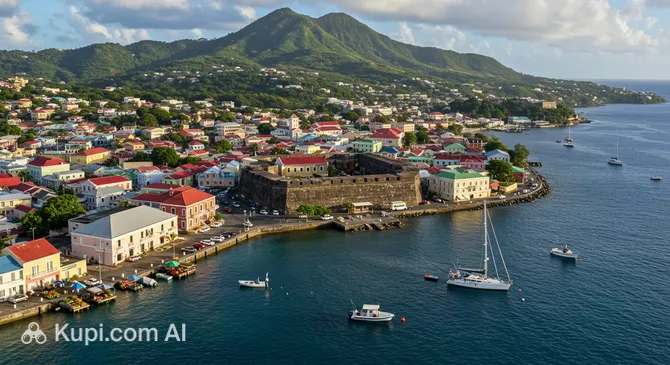
Basse-Terre is not just a city, but the administrative capital of Guadeloupe, having preserved the atmosphere of an authentic Caribbean settlement. Located on the southwest coast of the island of the same name, the city serves as an important commercial and government hub. There is no hustle and bustle of a huge metropolis here; instead, the colonial heritage and a close connection to the ocean are felt in full.
Basse-Terre. Illustration.
Source: Kupi.com AI
The city's geographical location is unique: it is sandwiched between the green slopes of a mountain range and the azure waters of the Caribbean Sea. Despite its small population, Basse-Terre plays a key role in the life of the archipelago. Particular attention should be paid to how carefully the historical heritage of the city is preserved here, reflected in the architecture of the old quarters and fortifications.
For travelers, the city is primarily interesting as a starting point for exploring the southern part of the island. From here, it is easy to reach the majestic La Soufrière volcano and picturesque waterfalls. A visit to the local market and a stroll along the promenade will allow you to feel the true rhythm of life in the Antilles. Basse-Terre invites those who appreciate authenticity, history, and the pristine nature of the tropics.
Weather Overview
The climate in Basse-Terre is classified as tropical humid, which largely determines the appearance of this green city. The temperature regime here is surprisingly stable throughout the year: average daytime figures usually fluctuate between +26...+29°C. However, due to the proximity of the mountain range, Basse-Terre receives more rainfall than the flat Grande-Terre, making the vegetation around the city particularly lush and vibrant.
If you are planning a trip, keep in mind that the weather in Basse-Terre is divided into two main seasons. A relatively dry period lasts from January to May, when rainfall is brief and air humidity is lower. From July to November, the wet season arrives — during this time, showers become more frequent and intense, and tropical winds are possible. September and October are traditionally considered the rainiest months.
The terrain creates its own microclimatic features: in the lowlands near the port, the air can seem denser and more humid, while on the mountain slopes, there is a pleasant coolness. Travelers are recommended to always carry a light raincoat, as a tropical downpour can start suddenly even if the morning was sunny. Despite the humidity, a constant sea breeze helps make the heat more bearable.
Average monthly temperature
Average monthly precipitation
Interesting Facts
Basse-Terre is located on the western side of the archipelago and is separated from its "other half," the island of Grande-Terre, by a narrow sea strait called Rivière Salée (Salt River).
The city is the gateway to the highest point in the Lesser Antilles — the active volcano La Soufrière, whose slopes dominate the region's landscape.
Unlike many Caribbean capitals, in Basse-Terre you can find beaches with unique black volcanic sand, giving the coast a special, dramatic look.
One of the main architectural landmarks of the city is Fort Delgrès, which today houses the Museum of Guadeloupe History.
Despite its status as the capital, Basse-Terre retains the appearance of a compact commune, where the traditional central market still plays a key role in public life.
How to Get There
The transport accessibility of the capital of Guadeloupe has its own specifics that are worth knowing in advance. Since Basse-Terre is not the main aviation hub of the archipelago, most travelers arrive on the island via the international airport on the neighboring territory of Grande-Terre. To plan your route as efficiently as possible, it is recommended to study all the ways to get to Basse-Terre, including transfers and vehicle rentals.
The main path to the city lies through a land corridor connecting the two parts of the island. The road passes through the scenic zone of the Rivière Salée strait. It is important to note that during peak hours, congestion can occur on the only main highway, so plan your movements with a bit of extra time, especially if you need to catch a return flight.
Within Basse-Terre itself and for trips to natural attractions such as waterfalls or the foot of the volcano, it is most convenient to use a rented car. There is no railway service on the island, so buses and taxis remain the only alternatives to private transport for those who do not plan to drive themselves.
Main Attractions
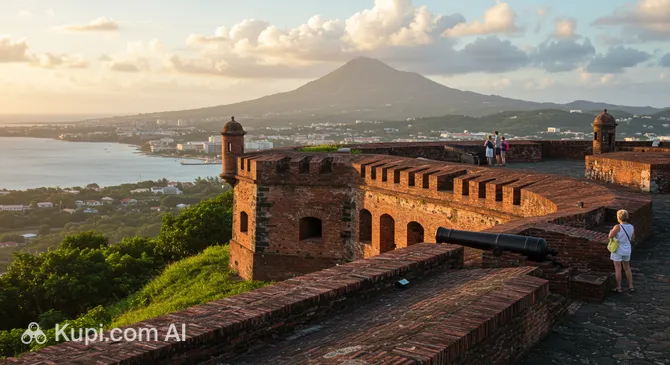
The main attractions of Basse-Terre are a harmonious combination of historical memory and natural grandeur. One of the most significant sites is Fort Delgrès. This powerful 17th-century fortress not only impresses with its architecture but also serves as a reminder of the local residents' heroic struggle for freedom; its walls offer breathtaking views of the sea and the city.
Fort Delgrès. Illustration.
Source: Kupi.com AI
Traveller photos:
In the very heart of the city stands the Cathédrale Notre Dame de Guadeloupe, which stands out with its austere stone facade and is an important spiritual center. It is also impossible to pass by the central market, Marché de Basse-Terre. This lively, noisy place is ideal for getting to know the local flavor, buying exotic fruits, and feeling the true spirit of Caribbean trade.
If you are ready to go beyond the city streets, your attention will surely be drawn to the Grand Cul-de-Sac Marin maritime zone and the majestic slopes of the volcano. Basse-Terre does not strive to surprise tourists with an abundance of modern attractions, offering instead a deep immersion into history and the opportunity to touch the wild, untouched nature of the Guadeloupe archipelago.
Local Cuisine
The gastronomy of Basse-Terre is a bright kaleidoscope of flavors, dominated by traditional Creole cuisine. The basis of local dishes consists of the freshest seafood and fish, delivered to the port every morning. Be sure to try grilled fish with hot spices or the famous goat or chicken curry, supplemented with local root vegetables: yams and cassava.
For fans of unusual snacks, small stalls can always be found on the city streets offering "accras" — crispy cod fritters — and fried plantains. To enjoy food in a more formal setting, it's worth visiting places like Habitation Desmarets, where traditions are combined with a modern approach to serving dishes.
The beverage culture in Basse-Terre is inextricably linked to rum production. Here you will find many variations of the famous "Ti' Punch" cocktail, made with light rum, lime juice, and cane sugar. Refreshing juices from mango, papaya, and passion fruit are also popular. The main place to experience the culinary diversity remains the city market, where the aromas of spices and vanilla create a unique atmosphere of a Caribbean celebration.
Travel Tips
A visit to Basse-Terre will provide you with unforgettable impressions if you prepare for the trip taking local specifics into account. These tips will help you feel confident and comfortable in the administrative capital of Guadeloupe.
Clothing and belongings: Choose light clothing made of natural fabrics, but be sure to bring a raincoat and comfortable closed shoes if you plan to hike to the volcano or waterfalls. For visiting cathedrals and official institutions, a modest dress code (covered shoulders and knees) is recommended.
Transport: The best way to get around is by renting a car. If you decide to take the bus, remember they run less frequently in the afternoon and hardly at all on Sundays.
Finance: The currency is the Euro (€). Cards are accepted in hotels and large stores, but cash is absolutely necessary at the market and in small cafes. Tips are usually included in the bill, but a small reward (5–10%) is welcome for good service.
Health and safety: The city is generally safe, but avoid walking in sparsely populated quarters after dark. Be sure to use sunscreen and mosquito repellent.
Communication: The official language is French. English is not widely spoken, so learn a few phrases: "Bonjour" (hello) and "Merci" (thank you). It is best to buy a SIM card at the airport or communication stores in the center.
Local etiquette: Always say hello when entering a shop or cafe — it is an important politeness norm here. Locals are friendly but value calm and respectful communication.
What to avoid: Do not try to photograph locals or their private property without permission — this can cause dissatisfaction.
Additional tip: Try to visit the market early in the morning (before 9:00 AM) to find the best selection of products and avoid the midday heat.
May your journey to Basse-Terre be filled only with pleasant discoveries and the bright colors of the Caribbean islands!
Entertainment & Nightlife
The nightlife in Basse-Terre is characterized by tranquility and restraint, which is typical for an administrative center. Here you will not find endless rows of noisy nightclubs or neon signs of giant discos. Evening leisure for locals and tourists is most often concentrated in cozy cafes and small bars, where you can enjoy a glass of local rum to the quiet sounds of Caribbean rhythms.
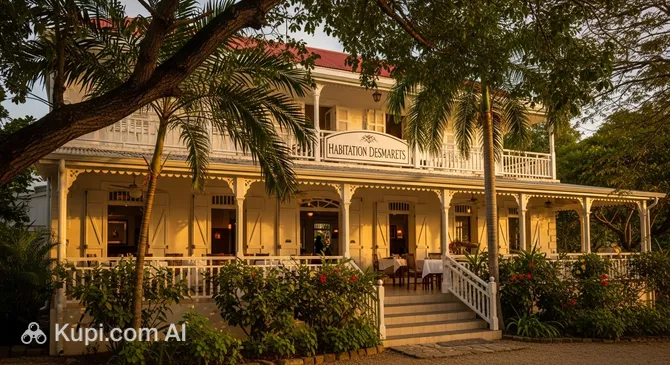
For those looking for gastronomic experiences in a pleasant setting, a visit to places like Habitation Desmarets would be an excellent choice. The atmosphere of such establishments allows you to feel the local charm without unnecessary fuss. Most evening activity is seen around the waterfront and main shopping streets, but the city usually falls asleep by midnight.
Habitation Desmarets. Illustration.
Source: Kupi.com AI
Traveller photos:
If your goal is wild dancing until dawn, you should consider a trip to more resort-oriented areas of the island. Daytime entertainment in the city itself includes visiting historical sites such as Fort Delgrès, walking through the picturesque market, and relaxing by the coastline. Basse-Terre is ideal for those who prefer thoughtful relaxation and value the safety and coziness of a provincial capital.
Parks & Museums
The cultural and natural wealth of Basse-Terre is largely defined by its status as the "green" heart of Guadeloupe. Although there are not many park zones within the city limits themselves, the city is literally surrounded by lush tropical vegetation. The most significant attraction in this regard is the Guadeloupe National Park, whose borders come right up to the city, offering tourists hundreds of kilometers of jungle trails leading to waterfalls and thermal springs.
History buffs should first head to Fort Delgrès. On the grounds of this majestic fortress is the Museum of Guadeloupe History, whose exhibition tells in detail about the colonial past, the era of slavery, and the struggle for independence. This is one of the few places in the region where historical events are presented so clearly and deeply within the context of authentic fortifications.
Another interesting site is Habitation Desmarets — a former estate that offers a glimpse into the past of the island's agricultural culture. The combination of such sites creates a unique city profile: here nature and history are not separated from each other but form a single space for educational leisure. Basse-Terre is perfect for those who prefer open-air museums and walks among ancient forests.
Getting Around
The public transport system in Basse-Terre is mainly represented by bus routes that connect the capital with other communes on the island. The buses here are called "cars," and they are the main way for locals to get around. However, tourists should take into account that schedules may not be strictly followed, and transport service decreases significantly in the evenings and on weekends.
Fares are usually paid in cash to the driver upon boarding. The cost of a trip depends on the distance, so it's better to have small euro denominations with you. For comfortable planning of complex routes or trips to remote natural areas, public transport may not be flexible enough, so many travelers choose alternative options.
Taxis are available in Basse-Terre, but trips can be quite expensive, especially over long distances. The ideal solution for exploring the surroundings remains renting a car — this gives full freedom of movement along mountain serpentines and the opportunity to visit beaches and waterfalls at a convenient time. Bicycle rentals are poorly developed in the city due to the difficult mountainous terrain, so for strolling around the very center, it is best to rely on your own feet.
Accommodation
The choice of accommodation in Basse-Terre reflects its character as a quiet administrative and natural hub. Here, you will find almost no huge chain hotels operating on an "all-inclusive" basis. Instead, the city offers cozy guest houses, small apartments, and private villas that allow you to feel like part of the local community.
The central part of the city and the quarters adjacent to the waterfront are considered the most convenient areas to stay. Staying here gives you quick access to the market, historical Fort Delgrès, and main transport interchanges. Accommodation options on the mountain slopes are also popular, offering magnificent panoramic views of the Caribbean Sea.
Travelers planning a visit during peak season (December to April) should book accommodation in advance, as the number of quality options is limited. If you are looking for something special, pay attention to properties like Habitation Desmarets or similar historical estates converted for guests. Overall, staying in Basse-Terre is geared toward those who appreciate peace, authenticity, and proximity to the island's nature trails.
Nearby Cities
Basse-Terre serves as an excellent starting point for exploring the entire Guadeloupe archipelago. Proximity to the main transport arteries makes it easy to plan day trips to both livelier cities and secluded coastal settlements.
Just a few dozen kilometers away is Pointe-à-Pitre — the economic heart of Guadeloupe, known for its busy port, museums, and wide selection of shops. For those seeking island romance, an interesting destination is Terre-de-Haut, located in the Les Saintes archipelago. This place is famous for its picturesque bays, often compared to Rio de Janeiro's bay, and its cozy European-style streets.
It is also worth paying attention to communes such as Terre-de-Bas and the resort town of Saint-François. Exploring the surroundings of Basse-Terre will give you a complete picture of the region's versatility: from dense tropical forests on mountain slopes to white sandy beaches and colonial towns lost in time.
Shopping & Souvenirs
Shopping in Basse-Terre is primarily about getting to know local crafts and colorful bazaars rather than chasing luxury brands. The main commercial heart of the city is rightfully considered the Marché de Basse-Terre. At this central market, you can find everything from freshly caught fish to rare varieties of vanilla and homemade sauces. It is the best place to buy authentic Caribbean products.
The most common souvenirs brought from Basse-Terre are local rum, famous for its quality, as well as bright fabrics with traditional "madras" patterns. In small shops on the city's central streets, you can find handmade items made from coconut, shells, and wood. For those interested in the history of local production, it will be interesting to visit Habitation Desmarets, where unique products can sometimes be purchased.
Shops in the city usually operate from early morning until evening with a siesta break, and most outlets are closed on Sundays. Card payments are accepted in larger shops and pharmacies, but you should definitely have cash in euros for market purchases. If you need modern shopping centers, it is better to look for them on the way to Pointe-à-Pitre, as Basse-Terre remains faithful to the traditional format of street trading.