Support

Goethe–Schiller Monument

About

The Goethe–Schiller Monument is one of the most recognizable and iconic landmarks not only in Weimar but in all of Germany. This majestic bronze sculpture is dedicated to two titans of German literature and thought—Johann Wolfgang von Goethe and Friedrich Schiller, whose names are inextricably linked to the golden age of German classical literature.
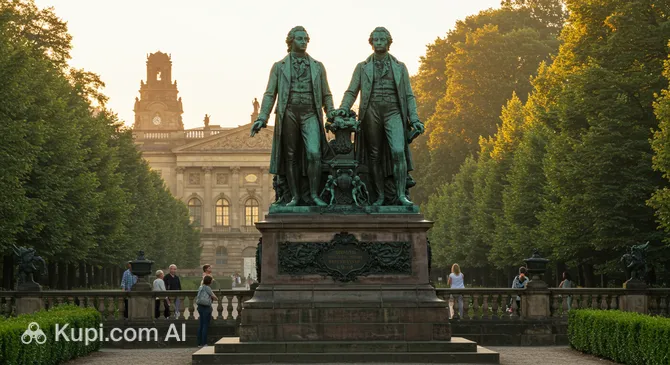
Goethe–Schiller Monument. Illustration.
Source: Kupi.com AI

Traveller photos:

The monument holds a place of honor on Theaterplatz, right in front of the German National Theatre and Staatskapelle Weimar. This location is no coincidence: it emphasizes the colossal contribution of these two geniuses to German culture and their special role in the history of the city, which is rightfully considered the cradle of Weimar Classicism.

The sculpture depicts Goethe and Schiller standing side by side at full height, symbolizing their close friendship and creative partnership. Their right hands hold a shared laurel wreath—a universally recognized symbol of poetic fame and triumph. Goethe’s left hand rests fraternally on Schiller’s shoulder, further highlighting their human and creative bond. In his left hand, Schiller holds a scroll, representing the rich literary legacy they left for posterity. Visiting this monument is an opportunity to touch a great piece of history and culture.

Contacts

The Goethe–Schiller Monument, an iconic landmark in Weimar, is an outdoor site located in front of the German National Theatre and does not have its own direct contact information. For inquiries regarding Theaterplatz or nearby cultural events, you may refer to the theater's contact details below or visit the city's tourist information center.

How to contactContact
AddressTheaterpl., 99423 Weimar, Germany
Phone+49 3643 7450
Websitewww.weimar-lese.de

What to Do

A visit to the Goethe–Schiller Monument in Weimar offers several interesting activities. First and foremost, you can examine the sculptural composition itself in detail—one of the most famous in Germany—and take commemorative photos. The monument is located on Theaterplatz, which is the cultural heart of the city. Here you can simply enjoy the atmosphere, and if you're lucky, catch one of the many city events, concerts, or theatrical performances often held in the square, making the visit especially appealing for art and history lovers.

The German National Theatre is located next to the monument, offering additional opportunities for cultural enrichment. You can attend a play or take a tour of the theater to dive deeper into the history of Weimar Classicism and learn more about the lives and works of the great German poets, Goethe and Schiller. Furthermore, a stroll around Theaterplatz will allow you to discover other historic buildings and landmarks of Weimar as you continue your exploration of this wonderful city.

Getting There

The Goethe–Schiller Monument is located in the heart of Weimar, on Theaterplatz. Thanks to its central location, it is easily accessible for any tourist exploring this charming city in Germany.

Weimar itself is conveniently reached by train from major German cities such as Leipzig, Erfurt, or Berlin. Upon arrival at Weimar Main Station, you can reach the monument on foot – the walk takes approximately 15–20 minutes. If you prefer public transport or have heavy luggage, city buses also run from the station.

Weimar has a well-developed public transport network, including buses and trams that connect all major parts of the city. To reach the Goethe–Schiller Monument directly, look for the stop near the German National Theatre – the monument is located right in front of it, on Theaterplatz.

For those traveling by car, parking spaces are available in the center of Weimar. However, please note that finding a free spot can be difficult during the peak tourist season. Therefore, for more convenient travel around the city and sightseeing, it is recommended to consider using public transport.

Nearest city: Weimar

History & Facts

The Goethe–Schiller Monument in Weimar is one of Germany’s most famous and significant monuments, symbolizing the golden age of German literature. Its grand unveiling took place on September 1, 1857, coinciding with the centennial of the birth of Grand Duke Karl August of Saxe-Weimar-Eisenach. It was during Karl August's reign that Weimar became a cultural capital, attracting geniuses such as Johann Wolfgang von Goethe and Friedrich Schiller.

This bronze masterpiece was created by Dresden sculptor Ernst Rietschel, assisted by Gustav Adolph Kietz. The figures were cast by Ferdinand von Miller in Munich. The names of these masters are immortalized on the monument itself, highlighting their contribution to this symbol of German culture. The monument depicts the two great poets standing side by side, symbolizing their close friendship and collaborative work.

One of the most curious facts about the monument is the depiction of the figures. Although Schiller was significantly taller than Goethe in reality (Schiller was 1.90 m, while Goethe was 1.69 m), the sculptor depicted them as being the same height. This artistic choice was intentional: it emphasizes the equality of their genius and their equivalent contributions to German and world literature. The figures hold a shared laurel wreath, a symbol of fame and recognition, further reinforcing the idea of their creative union and mutual respect.

The significance of the Goethe–Schiller Monument extends far beyond Weimar and Germany. Replicas of this famous monument have been installed in several cities around the world, including San Francisco, Milwaukee, Cleveland, and Shanghai. This bears witness to the international recognition of the two great German poets' contribution to world culture and the enduring value of their legacy.

Time Needed

You won't need much time to see the Goethe–Schiller Monument in Weimar. Usually, 20–30 minutes is enough to see the monument itself—one of the city's symbols—and take a short walk around Theaterplatz, where it is located. During this time, you can take photos, appreciate the sculptor's craftsmanship, and soak in the atmosphere of this iconic spot.

However, if you plan to dive deeper into Weimar’s cultural heritage, it’s worth allocating more time. The German National Theatre is located right next to the monument, along with other interesting sites. If your visit includes a theater performance or exploring nearby attractions, the total time may be 1–2 hours. Thus, the duration of your visit will depend on how thoroughly you wish to explore the area around the monument.

Working Hours

The Goethe–Schiller Monument in Weimar is a sculptural composition located in an open city square. Due to its location, access to the monument is free and available 24/7. This means you can visit and view it at any time convenient for you, day or night, any day of the week.

Since it is a public monument in a square, no tickets or prior booking are required. It is open to everyone year-round, allowing tourists and locals to enjoy this work of art regardless of the season.

Open 24/7

Nearby

A visit to the famous Goethe–Schiller Monument in Weimar is undoubtedly a highlight of any trip to Germany. However, to fully experience this amazing city, we recommend not limiting yourself to a single attraction. Exploring the surrounding area will allow you to dive deeper into the atmosphere of Weimar and discover its hidden treasures.

There are many interesting sites located within walking distance of the Goethe–Schiller Monument. This is a great opportunity to expand your itinerary and see more than you originally planned, enriching your travel experience. Below is a list of some nearby attractions with their distances.

NameDistance
Theater Square0 km
House of the Weimar Republic – Forum for Democracy0 km
Weimar House0.1 km
Schiller's House0.2 km
Schiller Museum0.2 km
36 Pho Co – Vietnamese Bao & Coffee0.2 km
Goethe House0.3 km

Reached the bottom of the page?

Looks like you know this route inside out