Support

Tour Philippe-le-Bel

About

The famous Tower of Philip the Fair (Tour Philippe-le-Bel) is a monumental medieval structure located in the town of Villeneuve-lès-Avignon, directly across from the city of Avignon. This historic site once served as a vital strategic point, controlling the crossing of the Rhône River that connected the Kingdom of France with the Papal territories.
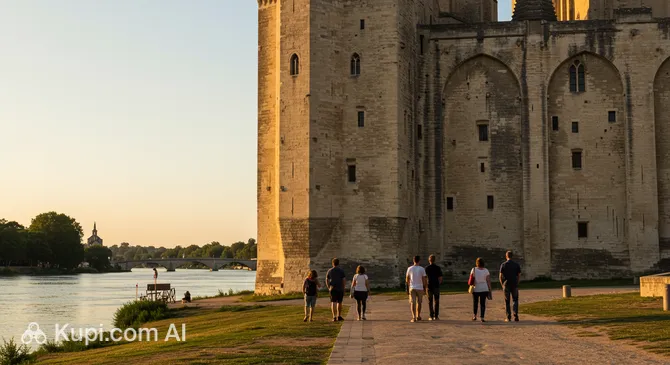
Tour Philippe-le-Bel. Illustration.
Source: Kupi.com AI

Traveler photos:

Erected at the beginning of the 14th century by order of King Philip IV, the tower is the only surviving fragment of a powerful fortress. Today, it is recognized as a historical monument and serves as a unique museum site where the past literally comes to life within its massive stone walls.

Visitors come here to see the magnificently preserved Gothic architecture and learn about the role the tower played in the life of the region during the era of Papal greatness. It is an ideal spot for those who want to combine historical exploration with the contemplation of the beautiful landscapes of the Rhône valley.

Contacts

For those planning a visit to the Tower of Philip the Fair, we have prepared the essential contact information. Having these details on hand will help you easily find your way and clarify any visiting details if necessary.

How to contactContact
AddressRue Mnt de la Tour, 30400 Villeneuve-lès-Avignon, France
Phone+33 4 32 70 08 57

What to Do

A visit to the tower offers guests not only architectural discoveries but also an interactive experience. One of the main activities here is the climb to the top, which provides breathtaking panoramic views of the Rhône valley and the silhouette of the famous Palais des Papes on the opposite bank. The sunset panorama is considered one of the most beautiful in the region.

Inside the tower, you can explore magnificent vaulted halls and visit the permanent exhibition "Mémoires de tour". The exhibit tells the story of medieval bridge building, the personality of King Philip IV, and how these lands have changed over the centuries. Information is presented in both French and English.

Particular attention should be paid to the 3D reconstruction of the Pont d’Avignon. Using modern technology, you can see what this grand engineering project looked like in different eras and how it gradually crumbled under the pressure of time and the elements. This is a unique opportunity to compare today's ruins with their former power.

Getting There

The Tower of Philip the Fair is located in the town of Villeneuve-lès-Avignon at Rue Montée de la Tour, 30400. If you are staying in the central part of Avignon, the easiest way to reach it is on foot. A walk across the Daladier Bridge and Barthelasse Island takes about 20–30 minutes, offering picturesque views of the river along the way.

For those who prefer public transport, city buses run regularly between the towns. This location is also ideal for cycling enthusiasts: the site holds the Accueil Vélo status, which means it offers specialized services and convenient parking for cyclists.

If you are planning a trip by taxi or using a private car with a navigator, use the coordinates 43.9586267, 4.7976332. The drive from the center of Avignon takes no more than 10 minutes, and parking spaces can usually be found near the attraction.

Nearest city: Avignon

History & Facts

The history of this majestic structure began in 1302, when King Philip IV "the Fair" ordered the tower's construction to control the famous Pont Saint-Bénézet. This caused dissatisfaction among the residents of Avignon, but the site's strategic importance was a priority for the French crown. In 1307, the complex was expanded with fortified gates, and in the mid-14th century, a third level was added.

During the period of the Avignon Papacy, the tower witnessed great splendor: cardinals and princes who settled in the luxurious residences of Villeneuve passed through its gates. However, over time, nature took its course—devastating floods gradually put the bridge out of commission, and by 1669, the crossing was finally abandoned, leading to the decline of the fortress.

After the French Revolution, most of the defensive structures were destroyed, and by 1822, only the tower itself remained of its former might. In 1842, the local commune purchased it, preserving this unique example of military architecture for future generations. Today, it is not only a museum but also a symbol of resilience that has survived centuries and the whims of the Rhône.

Time Needed

To fully explore all levels of the tower and see the exhibition, a typical visitor usually needs between 1 and 1.5 hours. This is plenty of time for a leisurely climb up the steps, reading the historical information, and relaxing at the observation deck.

If you are an architectural history enthusiast or plan to study the 3D reconstructions in detail, your visit may last a bit longer. We recommend planning your visit so that you have time left for a stroll through the charming streets of Villeneuve-lès-Avignon after touring the tower.

Working Hours

When planning your visit, it is important to know that the Tower of Philip the Fair welcomes visitors from Tuesday to Sunday. Please note the lunch break, which is typical for many cultural sites in the region: the tower closes in the middle of the day.

The current opening hours are as follows:

  • Monday: Closed
  • Tuesday – Sunday: 10:00 AM – 12:30 PM and 2:00 PM – 6:00 PM
It is recommended to arrive no later than 45 minutes before closing time to ensure you have enough time to explore the exhibition and climb to the observation deck.

DayWorking hours
MondayClosed
Tuesday10:00 – 12:30, 2:00 – 18:00
Wednesday10:00 – 12:30, 2:00 – 18:00
Thursday10:00 – 12:30, 2:00 – 18:00
Friday10:00 – 12:30, 2:00 – 18:00
Saturday10:00 – 12:30, 2:00 – 18:00
Sunday10:00 – 12:30, 2:00 – 18:00

Nearby

Exploring the surroundings of the Tower of Philip the Fair will allow you to immerse yourself deeper in the atmosphere of Provence and see the rich history of this region. Many iconic sites are within walking distance or a short drive away.

A stroll along the right and left banks of the Rhône will reveal majestic palaces, ancient monasteries, and modern amusement parks. Below are the most interesting sites located nearby:

NameDistance
Pont d'Avignon0.8 km
La Chartreuse – National Center for Performing Arts Writing0.8 km
Fort Saint-André0.8 km
Rocher des Doms Garden1 km
Palace of the Popes1.2 km
Le Carré du Palais1.2 km
Léo Léa1.2 km

Reached the end of the page?

That means the route is fully explored