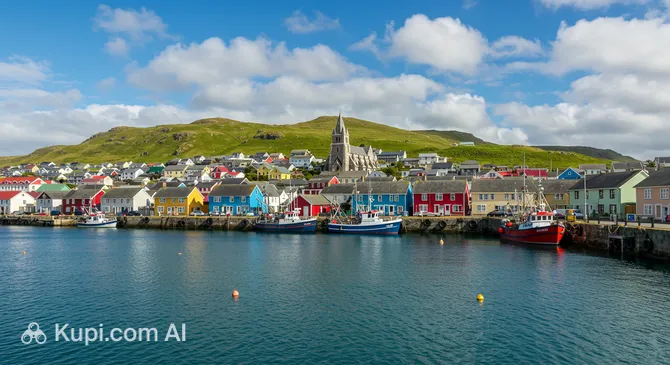
Stanley is the surprising and distinctive capital of the Falkland Islands, located on the east coast of East Falkland island. It is the southernmost administrative center in the world, maintaining the atmosphere of a cozy British town lost in the vast expanses of the South Atlantic. The city stretches along a picturesque natural harbor, and its bright, multi-colored roofs create a unique contrast with the archipelago's rugged but majestic landscapes.
The city's geographical position defines its unique character: it is the logistical and cultural heart of the islands. The population of Stanley is just over 2,200 people, making it one of the most compact capitals on the planet. Here, everyone knows each other by sight, and the hospitality of the locals and the measured pace of life instantly immerse travelers into a state of peace and tranquility.
Stanley. Illustration.
Source: Kupi.com AI
The city's rich historical heritage, inextricably linked with seafaring and Antarctic exploration, is of particular interest to tourists. Key attractions include Christ Church Cathedral with its famous whalebone arch and the waterfront, where a stroll allows you to fully feel the breath of the ocean. Stanley is an ideal starting point for those who dream of seeing penguin colonies and untouched wildlife in its pristine form.
A visit to this remote corner of the Earth will be a true adventure for lovers of ecotourism and history. We invite you to discover Stanley — a place where familiar civilization ends and the magic of the Southern Ocean begins.
Weather Overview
Stanley is dominated by a cool oceanic climate characterized by frequent winds and rapid changes in weather conditions. Expect moderately cool summers with daytime temperatures around +13...+15°C and bracing winters when the thermometer hovers around +2...+5°C. Precipitation is evenly distributed throughout the year, so a raincoat or windbreaker will be useful in any season.
Geographical location in the South Atlantic plays a special role: the proximity of cold currents means that even on the sunniest day, a sharp wind can suddenly blow in. Typical weather in Stanley is an alternation of sun, clouds, and brief rain showers within just a few hours, which locals call "four seasons in one day."
The best time to visit is considered to be the period from November to March, when the local summer arrives. During this time, the days are longest and nature comes alive: it is the ideal period for observing penguins and sea lions. Despite the absence of extreme frosts, high humidity and constant winds make the air feel colder than the numbers on the thermometer suggest, so quality wind protection is the key to a comfortable vacation.
Average monthly temperature
Average monthly precipitation
Interesting Facts
Stanley is one of the least populous capital cities in the world, with just over two thousand residents, which accounts for about 75% of the entire population of the archipelago.
The city is famous for its bright roofs: the tradition of painting them red, blue, or green helps maintain a positive mood on cloudy days and makes the capital's appearance recognizable from the air.
It is home to the southernmost Anglican cathedral in the world — Christ Church Cathedral, which was consecrated in 1892.
In Stanley Harbour, you can still see the remains of old wooden vessels that failed to round Cape Horn in the 19th century and found their final resting place here, turning into unique historical monuments.
Despite its remoteness, Stanley is a very modern city in terms of ecology: most of the electricity on the islands is generated by wind turbines, which are visible on the hills above the city.
How to Get There
The transport accessibility of Stanley is a separate part of the adventure, as the city is located in one of the most remote regions of the planet. The main links to the outside world are air and sea connections. To plan your trip, tourists should study all ways to get to Stanley in advance, taking into account the specifics of local flights and cruise ship schedules.
The city is served by the small Port Stanley Airport (IATA: PSY), which is mainly used for domestic flights around the archipelago and occasional international charters. However, most international travelers arrive via the larger Mount Pleasant airbase, located about an hour's drive away. From there, the capital's center can be reached by special transfer buses or pre-booked taxis.
There is currently no railway service in Stanley or anywhere in the Falkland Islands. Historically, a small narrow-gauge railway existed, but today it is non-functional and remains only in the memories of old-timers and as museum exhibits. The main ground transportation within the city remains private cars and taxis.
The sea route is the most popular way for tourists to visit the city. During the Antarctic navigation period (from November to March), Stanley Harbour becomes an important port of call for dozens of expedition and cruise ships. For many travelers, their introduction to the city begins right at the pier located in the very center, from where all the main attractions are within walking distance.
Main Attractions
Despite its modest size, Stanley offers travelers a range of unique sites that allow for a deep immersion into the atmosphere of the South Atlantic. The Falkland Islands Museum is rightfully considered the city's main cultural center. Its exhibits cover everything from natural history and paleontology to the lives of early settlers and naval battles. Visitors note the high standard of the exhibitions, which make learning about the archipelago lively and engaging.
Another iconic landmark is Christ Church Cathedral — the southernmost Anglican cathedral in the world. Next to it stands the famous Whalebone Arch, erected in 1933 to commemorate a century of British administration. Created from the jaws of two enormous blue whales, this monument serves as a vivid reminder of the region's whaling past and is the most photographed object in the capital.
The walking area along the Ross Road waterfront connects the main administrative buildings, monuments, and cozy houses with bright roofs. It offers a beautiful view of the harbor, where both fishing vessels and luxury cruise ships can often be seen. The waterfront is an excellent spot for birdwatching and simply soaking in the sea air that permeates every meter of this amazing city.
For those seeking closer contact with nature, short trips are organized from Stanley to Gypsy Cove. This is a picturesque bay with white sand, located just a few kilometers from the center, where Magellanic penguins can be seen in their natural habitat. The combination of historical monuments within the city and wild natural beauty in its immediate surroundings makes Stanley a truly alluring destination.
Local Cuisine
The gastronomy of Stanley is an interesting blend of British culinary traditions and the freshest local products provided by the archipelago's sea and land. The menu in most establishments is based on lamb and seafood dishes. Falkland lamb is famous for its quality because the sheep graze on clean pastures blown by the ocean breeze, giving the meat a special tender flavor.
You should definitely try local delicacies such as pink salmon steak or the famous "Fish and Chips" in its local version. Seafood lovers will appreciate the fresh crabs and squid that abound in the coastal waters. Cozy cafes in the city often serve homemade pastries and traditional British afternoon tea with scones and cream — a great way to warm up after a walk in the wind.
The dining culture in Stanley is centered around pubs and hotel restaurants, which serve as the main meeting points. Locals value simple, hearty food and high-quality drinks. Among the beverages, various types of ale and strong tea are popular. Although most products are imported from the mainland, the skill of local chefs allows them to create dishes that are remembered by tourists for their home-style warmth and original taste.
Travel Tips
A trip to Stanley requires preparation, but these efforts will be rewarded with unique experiences. Here are some practical tips to help you feel confident in the southernmost capital of the Atlantic:
Clothing and Items: The weather here is unpredictable, so use the layering principle. Be sure to bring a windproof and waterproof jacket, comfortable shoes for walking on uneven terrain, and sunscreen — the sun at these latitudes is very active even in cool weather.
Transport: Within the city, it's best to move around on foot. For trips into nature, book a 4WD vehicle with a guide in advance, as demand is very high on cruise ship days.
Finance: The official currency is the Falkland pound, which is equal to the British pound. Cards are accepted in most shops and hotels, but a small supply of cash is useful for souvenir stalls in remote areas.
Health and Safety: The city is absolutely safe. A pharmacy can be found in the center, and if serious help is needed, contact the King Edward VII Memorial Hospital.
Communication: The main language is English. Wi-Fi access is available in hotels and some cafes, but the connection can be slow and expensive due to the satellite link.
Local Etiquette: Residents of Stanley are very friendly. It is customary to greet passers-by and maintain a calm, polite tone in communication.
What to Avoid: Never approach penguins or other animals closer than 5-10 meters, and under no circumstances enter fenced areas that may be marked as minefields (a legacy of the 1982 conflict, although most have already been cleared).
Extra Tip: Be sure to send a postcard from the local post office — it is one of the most popular and symbolic souvenirs from Stanley.
Following these simple rules will allow you to fully enjoy Falkland hospitality and bring home only pleasant memories!
Entertainment & Nightlife
Entertainment in Stanley is of a quiet and soulful nature, reflecting the measured pace of life on the archipelago. You won't find noisy nightclubs with neon lights here, but you can fully enjoy the traditional atmosphere of British pubs. The city's evening life is centered in establishments such as the Victory Bar or the pub at the Malvina House Hotel, where locals and tourists gather over a pint to discuss the latest news or share impressions of their expeditions.
During the day, cultural leisure is provided by walks along the waterfront and visits to souvenir shops where you can find unique woolen products and local handicrafts. For fans of more active recreation, boat excursions and 4WD trips to remote farms are offered, where you can watch sheep shearing or have a picnic against the backdrop of rocky shores. Museum exhibits are also open during the day, offering an intellectual dive into the history of the region.
Cruise ship arrivals play a special role in the life of the city. On such days, Stanley noticeably comes alive: additional shops open, and special tastings and short tours are held. This is the best time to feel the tourist pulse of the city. Safety in the capital is at the highest level, so evening walks through the lit streets along the harbor are completely comfortable and allow you to enjoy the silence and the starry sky of the Southern Hemisphere.
Parks & Museums
The cultural and natural wealth of Stanley is compactly concentrated in a few key locations. The city's main pride is the Falkland Islands Museum, located in a historic complex on the waterfront. You can spend several hours here studying the rich collection dedicated to maritime expeditions, Antarctic exploration, and the life of the islanders. Special attention is given to the events of 1982, which left a deep mark on the city's history.
Stanley's urban spaces blend seamlessly into natural landscapes. Although there are no classic parks with manicured alleys, the shorelines and open hills serve as recreation areas. A walk to the Liberation Memorial or a visit to the small but touching garden around the Cathedral allows you to enjoy the silence. The vegetation here consists mainly of low-growing shrubs and grasses, typical of the subantarctic climate.
For those who appreciate open-air natural museums, the ship graveyard in the harbor is a must-visit. This is a unique space where the hulls of old ships, such as the Lady Elizabeth, tell stories of sailors' courage better than any book. The combination of such historical artifacts and the rugged beauty of the surrounding nature creates the atmosphere of a museum spread out against the backdrop of the ocean.
Getting Around
Public transport in Stanley is presented in a very simplified form due to the city's compactness and small population. There is no subway, trams, or regular bus routes that residents of large metropolises are used to. Practically any point in the city can be reached on foot in 15-20 minutes, making walking the main way to get around for tourists.
If you need to get to outlying areas or the airport, it is best to use taxi services. Several private operators work in Stanley, and their cars can be ordered by phone or found at a stand in the center. Payment is made in cash (pounds) or, in some cases, via mobile terminals. Prices are fixed and quite reasonable for such a small city.
For trips outside the capital to penguin colonies or battlefields, tourists usually rent 4WD vehicles with a driver-guide. Roads outside the city are often gravel tracks or simply ruts in the peat, so self-driving without experience in such conditions is not recommended. Stanley's compactness and the lack of transport hustle and bustle make staying here comfortable and allow you to focus entirely on the surrounding beauty.
Accommodation
Accommodation in Stanley is characterized by intimacy and home comfort. There are no massive skyscrapers or noisy hotel chains here; instead, travelers are offered a choice of several high-quality hotels and many cozy Bed & Breakfast guesthouses. Choosing accommodation in the city center ensures you are always within walking distance of the waterfront, the post office, and the main pubs.
One of the most famous places to stay is the Malvina House Hotel, which offers modern comfort and an excellent restaurant. For those who prefer a more authentic experience, small family pensions are ideal, where the hosts are happy to share stories about life on the islands and help organize excursions. Due to the limited number of rooms and high demand during the tourist season, it is strongly recommended to book accommodation several months before your trip.
Accommodation prices in the capital may seem higher than average, due to the region's remoteness and the cost of delivering resources. However, the high level of service and the unique atmosphere fully justify these costs. In addition to classic hotels, short-term rental apartments are also available in Stanley, which is convenient for those planning to stay in the city longer and wanting to feel at home.
Nearby Cities
Although Stanley is the only major settlement on the archipelago, it serves as an excellent starting point for exploring other interesting corners of East Falkland island. The capital's surroundings offer unique opportunities to learn about the region's military history and its untouched nature.
Just 44 kilometers to the west is Mount Pleasant. This is an important strategic and transport hub where the main international airport is located. Although this place is better known as a military base, the road to it passes through picturesque landscapes, allowing you to see endless heather moorlands and the famous "stone runs" — unique geological formations made of piles of boulders.
Trips outside of Stanley usually include visits to remote farms and nature reserves. It is recommended to plan such outings as part of organized 4WD groups, as road surfaces off the main routes can be difficult. Exploring these wild territories will allow you to see the life of the islands as it truly is — rugged, majestic, and incredibly beautiful.
Shopping & Souvenirs
Shopping in Stanley is primarily an opportunity to purchase unique souvenirs that cannot be found anywhere else in the world. The city does not have huge shopping malls, but on central streets like Ross Road, you will find charming specialty shops. The local range is centered on high-quality sheep's wool products: from sweaters and scarves to cozy blankets, which will be an excellent reminder of the trip.
Items with island symbols and images of penguins, which have become the unofficial symbol of the region, are particularly popular. In local shops, you can find beautiful jewelry, bone and wood carvings, as well as unique Falkland Islands postage stamps and coins, which are highly valued by collectors worldwide. Many shops align their hours with the arrival schedule of cruise ships, so they stay open longer on those days.
Shops usually operate from morning until early evening, and many may be closed on Sundays. British pounds sterling and local Falkland pounds (which are equal in value) are widely accepted, as are major international bank cards. A Tax-Free refund system is practically non-existent due to the small scale of trade, but the moderate prices and exclusivity of the goods make shopping in Stanley a pleasant addition to the trip.