Support

Guangji Bridge

About

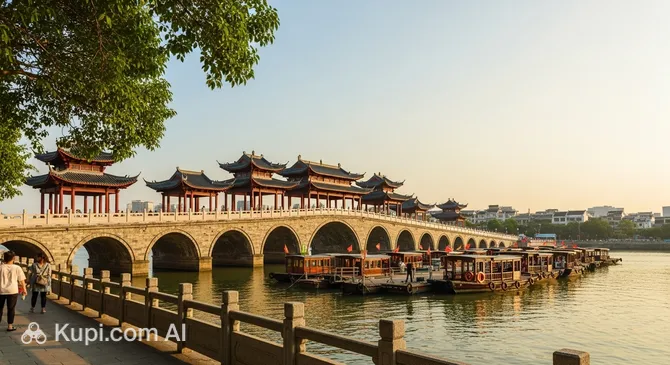
Guangji Bridge is more than just a crossing over the Han River; it is a true engineering marvel located in the ancient city of Chaozhou, China. This unique structure is one of the four famous ancient bridges of China and is striking in its structural complexity. Combining features of beam, arch, and pontoon bridges, Guangji serves as a living monument to the skill of medieval builders.
\n
Guangji Bridge. Illustration.
Source: Kupi.com AI

Traveler photos:

\n

The main feature of this site is its central "separable" section. It consists of 18 wooden boats connected by iron chains. During the day, they form a continuous path for pedestrians, while at night, they are moved aside to allow large vessels to pass. This flexible system not only facilitated navigation but also effectively protected the bridge from destruction during heavy floods.

\n

The architectural ensemble, over half a kilometer long, is decorated with 12 majestic pavilions and 18 gazebos. Travelers planning a trip to Shantou and its surroundings should definitely see this structure, which is rightfully considered the world's first bridge capable of "opening and closing."

Contacts

Before planning a visit to Guangji Bridge, we strongly recommend checking for up-to-date information at a local tourist information center. Since direct contact details for the site are limited in public sources, current access information can be obtained through licensed guides or official Chaozhou tourism services.

How to contactContact
AddressXiangqiao District, Чаочжоу, Китай, 521021

What to Do

Today, Guangji Bridge functions as a pedestrian zone, offering tourists an atmospheric walk over the waters of the Han River. Strolling along its deck, you can admire the details of each pavilion, adorned with traditional carvings and unique couplet inscriptions that reflect the region's rich culture.

\n

In ancient times, this place was known as the "market one li long," as the bridge was a bustling trade center with shops and workshops. That spirit can still be felt today: visitors can examine the ancient stone piers—some of which have survived since antiquity—and enjoy panoramic views of the old city and the river.

\n

For photography enthusiasts, the bridge provides an endless number of angles. The changing light throughout the day and the unique process of connecting the boats in the central section create a dynamic scene that travelers from all over the world strive to capture.

Getting There

The attraction is located in the Xiangqiao District of Chaozhou, on the eastern edge of the historical center. Guangji Bridge crosses the Han River, connecting the old quarters with the opposite bank. The easiest way to get here is on foot if you are already in the city center, heading toward the east gate of the old city wall.

\n

For those traveling from outlying areas, it is most convenient to use a taxi or local public transport. To plan an exact route, we recommend using navigation apps (Baidu Maps or Amap) and entering the address in the Xiangqiao District (postal code 521021). The coordinates for navigation are: 23.663256, 116.652764.

Nearest city: Shantou

History & Facts

The history of Guangji Bridge began in 1171, during the Southern Song Dynasty. On the initiative of an official named Zeng Wang, a pontoon bridge of 86 boats was constructed, originally named Kangji. Over the following decades, builders gradually erected stone piers from the banks, attempting to tame the unruly current of the Han River.

\n

A major transformation occurred in 1435 during the Ming Dynasty. Governor Wang Yuan strengthened the structure and built pavilions and living quarters on it, after which the bridge received its current name—Guangji, which translates to "bringing benefit to all people." By 1530, the structure took on its classic appearance, immortalized in the local saying: "eighteen boats and twenty-four stone islands."

\n

In the modern era, a thorough scientific restoration was carried out between 2003 and 2007. The bridge was restored to its majestic Ming Dynasty appearance, turning it into a unique tourist site that preserves the engineering wisdom of ancient masters.

Time Needed

To leisurely cross Guangji Bridge, study the architectural features of the pavilions, and take memorable photos, travelers usually need between 1.5 and 2 hours. The structure spans 518 meters, and every section with its gazebos and inscriptions deserves individual attention.

\n

If you plan to study the calligraphy on the plaques or the engineering of the ancient piers in detail, your visit may take longer. It is also worth noting that the bridge is especially beautiful at different times of the day as the lighting on the Han River changes.

Working Hours

Currently, the exact operating hours of Guangji Bridge as a pedestrian site are not recorded in a single registry, as access may depend on weather conditions and river water levels. However, the pontoon section of the bridge typically operates during daylight hours.

\n

We strongly recommend checking the current schedule on official provincial tourism portals or at the Chaozhou city information center immediately before your visit to ensure you see the bridge in its assembled state.

Nearby

The area surrounding Guangji Bridge is rich in historical monuments that allow for a deeper dive into the region's unique culture. Just 400 meters away is the majestic Kaiyuan Temple—one of the most significant Buddhist complexes, known for its exquisite architecture and ancient relics.

\n

A stroll through the old town of Chaozhou after visiting the bridge is a logical next step. Exploring the neighborhood, filled with ancient walls and traditional tea shops, will help provide a complete impression of this historical corner of Guangdong Province.

NameDistance
Kaiyuan Temple0.4 km

Reached the end of the page?

That means the route is fully explored