Support

Angkor Wat

About

Angkor Wat is one of the most majestic and significant religious structures in the world, located in Cambodia, near the city of Siem Reap. This giant temple complex, whose name translates from Khmer as "Temple City," was originally dedicated to the Hindu god Vishnu. Built in the 12th century, it represents the pinnacle of classical Khmer architecture and is the country's primary national symbol, with its image adorning the flag and coat of arms of Cambodia since 1863.
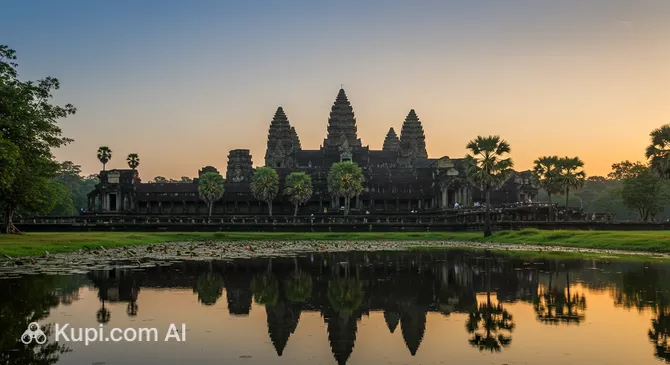
Angkor Wat. Illustration.
Source: Kupi.com AI

Traveller photos:

The architectural design of Angkor Wat is truly grand: it is a stone model of the universe in miniature. The central part of the complex is crowned by five towers arranged in a quincunx, symbolizing the five peaks of the sacred Mount Meru—the home of the gods in Hindu mythology. The entire complex is surrounded by a massive outer wall and a wide moat, symbolizing the mountains at the edge of the world and the endless oceans. The temple's majestic galleries are decorated with thousands of bas-reliefs featuring scenes from ancient epics and Khmer history.

Today, Angkor Wat is part of the vast Angkor Archaeological Park, a UNESCO World Heritage site. Its scale and cultural significance place it alongside world-famous monuments such as the Egyptian pyramids, the Roman Colosseum, and the Taj Mahal. Visiting this ancient temple is not just an excursion, but a true immersion into the history and spiritual world of the great Khmer Empire, which left behind one of the most impressive architectural wonders on the planet.

Contacts

For up-to-date information on the operation of the Angkor Wat complex, ticket prices, and visiting rules, it is recommended to contact the APSARA National Authority (Management of Angkor and the Region of Siem Reap), which is responsible for the entire archaeological park. Below are the organization's primary contacts.

Additional information and advice can also be obtained from tourist information centers in the city of Siem Reap or from local accredited guides.

How to contactContact
AddressKrong Siem Reap, Cambodia

What to Do

Visiting Angkor Wat is a unique opportunity to immerse yourself in the history and culture of the ancient Khmer civilization. The main activity for tourists is exploring the temple complex itself with its impressive architecture. Special attention should be paid to the numerous bas-reliefs decorating the gallery walls. Here, you can examine detailed carvings of Hindu deities, as well as scenes from the ancient epics "Ramayana" and "Mahabharata," which introduce the mythology and religious beliefs of the Khmer people.

While exploring the complex, you can walk through its various parts: from the outer galleries to the central temple with its five famous towers, symbolizing the peaks of the sacred Mount Meru. Do not miss the opportunity to climb to the temple's upper level—it offers a breathtaking panoramic view of the surrounding jungle and the entire complex. In addition to the temple itself, the surviving elements of the complex water system—canals and moats that once served to collect and store water—are also of interest and testify to the high engineering level of the ancient civilization.

Angkor Wat is a true paradise for photographers. Many travelers come here specifically to capture the complex in the rays of the rising or setting sun. The play of light at this time creates a truly unique and mystical atmosphere. Given that Angkor Wat attracts millions of tourists every year, it is worth planning your visit in advance to fully enjoy its beauty and grandeur without unnecessary haste.

Getting There

Getting to Angkor Wat is quite simple, as it is located just 5–6 kilometers north of the city of Siem Reap. The most popular and authentic way to get around is by tuk-tuk, which can be hired almost anywhere in the city. The ride on this motorized rickshaw takes about 15–20 minutes and allows you to enjoy the views along the way. For greater comfort, you can use a taxi service or rent a car with a driver. Many hotels in Siem Reap are also happy to help organize transportation for their guests.

For those who prefer a more active and eco-friendly vacation, renting a bicycle is an excellent option. This allows you to explore the surroundings at your own pace and enjoy the picturesque scenery. However, it is worth remembering the hot and humid climate of Cambodia, so such a trip will require some physical fitness and a sufficient supply of water.

An important point to consider when planning your visit is the purchase of entrance tickets. They are not sold at the temple itself, but at a special ticket center (Angkor Park Pass Ticket Counters) located on the road from Siem Reap to the complex. Tickets are available for one, three, or seven days, allowing you to choose the best option depending on the duration of your stay. Be prepared to have your photo taken when purchasing—your photo will be printed on the ticket to make it personalized.

Nearest city: Siem Reap

History & Facts

The history of Angkor Wat, the jewel of Cambodia, begins in the first half of the 12th century, when construction was started by order of the Khmer King Suryavarman II. Originally, this grand complex, located near Lake Tonle Sap, was planned not just as a temple, but as the future burial place for the monarch himself. It was dedicated to the three main deities of Hinduism—Vishnu, Shiva, and Brahma—which can still be seen today in the numerous bas-reliefs decorating its walls. Although construction began in the 12th century, radiocarbon analysis has shown that people populated this area in large numbers as early as the 11th century.

One of the most amazing features of Angkor Wat is the speed of its construction. By some estimates, the entire complex was built in just 30–35 years, which for a structure of this scale would have been impossible without the unique engineering solutions of the time. A key role in the life of the ancient city was played by a sophisticated system of water structures. A network of canals and reservoirs was designed to collect and store water throughout the year, which was vital for maintaining the complex and ensuring the prosperity of the surrounding population.

For a long time, Angkor (known as Yashodharapura) served as the center of the great Khmer Empire, which existed from the 9th to the 14th century. However, at the end of the 14th century, the once-prosperous city was abandoned by most of its inhabitants. It is believed that the reason for the decline was climate change and the gradual degradation of the very water system that was once the source of its strength. Despite centuries of neglect, the complex is perfectly preserved, and today these 900-year-old ruins with thousands of religious structures are the primary testament to the former greatness of the ancient civilization.

Time Needed

When planning a visit to Angkor Wat, it is important to budget your time correctly to fully enjoy its majesty. For a complete and leisurely tour of the temple itself, it is recommended to set aside at least one full day. This will allow you to walk through all the galleries with their famous bas-reliefs without rushing, climb the central towers, and feel the atmosphere of this ancient place. For those interested in history and photography, it is optimal to dedicate 1–2 days to Angkor Wat to explore it at different times of the day.

It is worth remembering that Angkor Wat is only part of the huge Angkor Archaeological Park. If you plan to visit other iconic temples, such as Bayon with its mysterious faces or Ta Prohm, swallowed by the jungle, then you should allow 3 to 5 days for the entire complex. Many travelers strive to reach Angkor Wat at dawn to see the first rays of the sun color its towers in golden tones—a sight that is definitely worth an early wake-up call and will leave an unforgettable impression.

Working Hours

The Angkor Wat temple complex is open to visitors year-round, allowing you to plan your trip at any convenient time. The doors of the complex open daily at 5:00 AM and close at 5:30 PM. This early start is no coincidence—it gives tourists the unique opportunity to watch the sunrise over the ancient temple towers, which is considered one of the most impressive and memorable sights. Keep in mind that the exact time of sunrise changes depending on the season, so for the perfect photos, it's worth checking this information in advance.

Tickets must be purchased at the official ticket center (Angkor Park Pass Ticket Counters), not at the entrance to the temple itself. Advance online booking is not common, but you can buy your ticket the evening before to save time in the morning. During the peak tourist season, which lasts from November to February, Angkor Wat can be especially crowded. To enjoy the atmosphere in a calmer setting, it is recommended to arrive either at opening time or closer to the evening, when the main flow of tourists has already subsided.

Nearby

Visiting the majestic Angkor Wat is just the beginning of discovering the treasures of the ancient Khmer Empire. The temple is part of the vast Angkor Archaeological Park, spanning about 400 square kilometers. Exploring the surrounding area will allow you to dive deeper into history and see other, equally impressive monuments that together form a grand picture of the place's former greatness.

Many temples and historical sites are located in close proximity to Angkor Wat, making their exploration a convenient and exciting addition to your main route. Each of these attractions possesses its own unique atmosphere and architectural features, telling its own chapter in the history of the ancient city. Below is a list of nearby interesting places that will enrich your journey.

NameDistance
Phnom Bakheng1.7 km
South Gate of Angkor Thom1.9 km
Vimean Sokha Museum3.2 km
Angkor Phokeethra Golf & Spa Resort4.3 km
The Community4.5 km
War Museum Cambodia4.7 km
Angkor National Museum5.2 km

Reached the bottom of the page?

Looks like you know this route inside out