How Aircraft Ventilation Works
 Polina
Air at an altitude of 11,000 meters is an environment where a person cannot survive for even a minute. The temperature there drops to −50°C, the pressure is three times lower than usual, and oxygen is negligible. Nevertheless, inside the airliner, we calmly read a book or sleep in a T-shirt.
Let's understand all the intricacies of the aircraft's environmental control system (ECS). And to test the theory in practice, it's time to buy tickets from Moscow to Sochi or book tickets from St. Petersburg to Mineralnye Vody – on flights of any duration, these systems work with pinpoint accuracy.
Air Bleed
Contrary to popular belief, an aircraft does not carry an oxygen supply in cylinders (these are only for emergency depressurization). All air comes from the atmosphere. But at high altitudes, it is too thin, so it literally needs to be "compressed".
This process occurs in aircraft engines. During the compression stage, blades draw in ambient air and compress it. At this point, physics takes over: with rapid compression, the air heats up to +200°C... +250°C. This flow is called "bleed air" (bleed air). It is important to understand: the bleed occurs before fuel is injected into the combustion chamber, so a sterile, albeit very hot, flow without kerosene impurities enters the system.
Air Conditioning
To prevent passengers from turning into baked potatoes, the superheated air needs to be cooled. For this, it is directed into so-called "PACKs" (PACKs – Pressurization and Air Conditioning Kits), which are usually located in the wing root area.
Heat Exchangers: first, hot air from the engines is cooled by an external icy airflow through metal partitions. These flows never physically mix.
Air Cycle Machines: then the air passes through an air cycle machine (ACM). It rapidly expands, giving energy to the turbine, and instantly cools down to temperatures close to 0°C.
Mixing Chamber: after this, the icy "ambient" air enters a mixer, where it combines with warm cabin air to achieve the ideal temperature (usually +22... +24°C).
Recirculation
The air in an aircraft is a mixture of fresh (from the engines) and recirculated (from the cabin) air in a 50/50 proportion. Many are scared by the word "recirculation," thinking they are breathing their neighbor's exhaled air, but it has a crucial technical function.
At an altitude of 10 km, air humidity is about 1%. If only fresh ambient air were supplied to the cabin, passengers' mucous membranes, eyes, and skin would dry out within half an hour. Recirculation allows using the moisture that people themselves release when breathing, maintaining overall humidity at 10-20%. Before returning to you, this air passes through powerful filters.
HEPA Filtration
Aircraft purification systems are among the most advanced in the world. Airliners are equipped with HEPA filters (High-Efficiency Particulate Air). They are capable of trapping 99.97% of microparticles, including bacteria and viruses as small as 0.3 microns.
The entire volume of air in the cabin is completely replaced with fresh air every 2-3 minutes. For comparison: in modern office buildings, this process takes up to 20 minutes. The air environment in an aircraft is comparable in sterility to an operating room in a good clinic.
Airflow Geometry
Many fear that if someone sneezes in the first row, bacteria will reach the tail. Engineers have accounted for this. Air in an aircraft does not circulate along the fuselage.
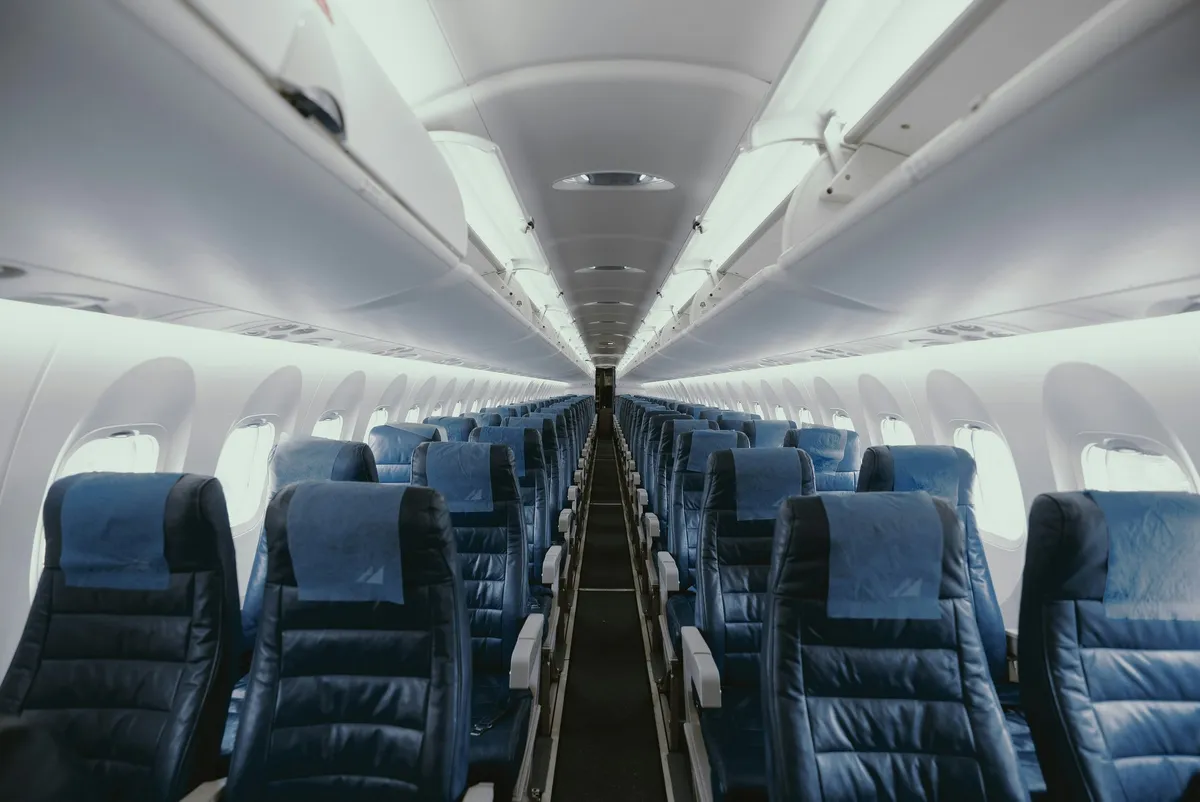
Airflows are supplied from overhead panels and side walls, and extracted through grilles near the floor. Air moves strictly from top to bottom. This creates an invisible "air shield" for each row of seats. An aerosol cloud from a cough or sneeze is immediately carried downwards, under the floor, and enters the filtration system, without having time to spread throughout the cabin.
Pressure
At an altitude of 11,000 meters, a person will lose consciousness within 15-30 seconds due to hypoxia. Therefore, the aircraft is transformed into a sealed capsule, which the engines constantly "inflate" from the inside.
Cabin pressure is maintained at a level equivalent to an altitude of 1,800-2,400 meters above sea level (like at a ski resort). The main player here is the outflow valve (Outflow Valve) in the tail section. It works like a valve in a pressure cooker: if the internal pressure becomes too high, it opens slightly and releases excess air outwards. It is the precise operation of this valve that saves us from sharp ear pain during ascent.
If you feel dryness in your nose, try directing the individual air vent ("duyka") towards yourself. Contrary to myths, it rarely causes a "draft," but it delivers a stream of highly purified and cooled air directly to your face, helping you to better endure a long flight. Have a pleasant journey!