Support

Monasterio de San Juan de Duero

About

On the picturesque banks of the Duero River, in the ancient city of Soria, lies one of the most mysterious and impressive monuments that Spain is famous for. The Monastery of San Juan de Duero is an outstanding architectural complex in the Romanesque style, founded in the 12th century by the Order of the Hospitallers of Saint John of Jerusalem. Today, it stands as a wonderful open-air museum where time seems to have stood still among the ancient stones.
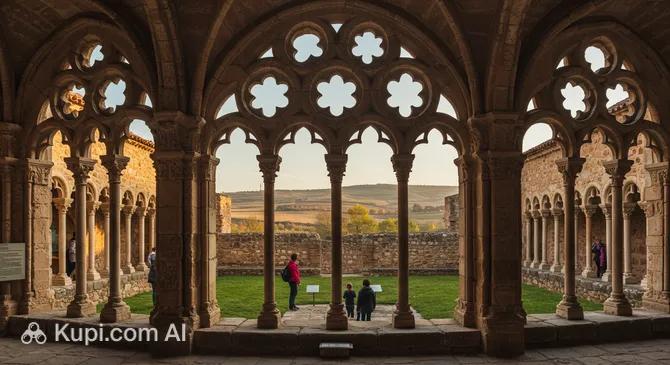
Monastery of San Juan de Duero. Illustration.
Source: Kupi.com AI

Traveler photos:

The main feature of the monastery is its unique cloister — an inner courtyard whose arcades have been preserved in their original form but have lost their roof. This creates a surreal and very photogenic image: rows of elegant double columns under the open sky, decorated with rich carvings. The complex is rightfully considered one of the most original examples of Romanesque architecture on the Iberian Peninsula and has held the status of National Monument since 1882.

In addition to its architectural value, San Juan de Duero attracts visitors with its atmosphere of seclusion. The church, with its simple but noble geometry and semicircular apse, surrounded by a green garden and grove, invites reflection on the history of knightly orders and medieval art. It is a place where every stone holds legends of pilgrims and the mysteries of ancient masters.

Contacts

To clarify information about visiting the monastery or special events, you can use the following contact details:

How to contactContact
AddressCam. Monte de las Ánimas, 42004 Soria, Spain
Phone+34 975 22 13 97
Websitemuseoscastillayleon.jcyl.es

What to Do

The main reason to visit the monastery is to detailedly explore its unique cloister. Be sure to pay attention to the carved capitals of the double columns: here you can see not only floral patterns but also whimsical animal figures and biblical scenes, where the influence of the famous Abbey of Santo Domingo de Silos is felt. The absence of a roof over the arcades allows you to catch an amazing play of light and shadow, making this place perfect for artistic photography.

Inside the church itself, visitors will find the austere forms of Romanesque architecture and ancient canopies (ciboriums). The tour of the museum's exhibition is complemented by reading the information stands, which reveal the secrets of the various construction stages of the complex. Don't forget to look into the southern part, where archaeological remains of structures from the 13th–17th centuries were discovered during excavations.

After immersing yourself in history, be sure to take a walk through the garden and grove surrounding the monastery. Views of the Duero River and the peaceful atmosphere of the countryside allow you to fully relax and feel the spirit of Castile. For those who want to learn more, we recommend using the services of a guide: stories about the architectural mysteries of the Order of Hospitallers will make your visit even more rewarding.

Getting There

Getting to the Monastery of San Juan de Duero is quite simple, as it is located just a few minutes' walk from the historical part of the city. A walk from the center of Soria will take about 15–20 minutes. The route crosses the picturesque stone bridge, Puente de Piedra, after which the entrance to the monastery complex is found on the left bank of the river.

For those who prefer transport, you can use a local taxi — the ride from the city center or the train station will take no more than 5–10 minutes. If you are traveling by car from Madrid, follow the A-2 and A-15 highways. Parking for visitors is available near the attraction in the Monte de las Ánimas area.

Active travelers will enjoy the idea of cycling to the site along the well-maintained promenade of the Duero River. This is a great way to combine visiting an architectural masterpiece with enjoying the natural landscapes of Castile.

Nearest city: Soria

History & Facts

The history of this site began in the first half of the 12th century when, by decree of King Alfonso VII, the lands on the banks of the Duero were granted to the Order of the Hospitallers of Saint John of Jerusalem. The Knights Hospitallers built more than just a temple here; they created an entire complex with a hospital to assist pilgrims and travelers. Documentary evidence from 1152 confirms that the order already owned a church by the "Stone Bridge" at that time.

The monastery acquired its current, somewhat mysterious appearance in the late 12th and early 13th centuries. The unique cloister was built in two phases, which explains the mix of architectural styles: from pure Romanesque to transitional Gothic. However, by the 18th century, the monastery had fallen into decay and was abandoned. During darker times in history, the ancient church was used as a stable, and the exquisite courtyard was turned into a common vegetable garden.

The revival of the monument began in 1882, when it was officially declared a National Monument of Spain. Since 1964, the architectural ensemble has been part of the Numantine Museum, and subsequent archaeological excavations have helped restore the complex's appearance, revealing layers of history from the 13th to the 17th centuries. Today, the monastery is considered one of the most original and photogenic examples of Romanesque architecture in Europe.

Time Needed

To leisurely explore all the corners of the Monastery of San Juan de Duero, a typical tourist needs about 1 to 1.5 hours. This time is quite sufficient to study the architectural details of the church, carefully examine the carved capitals in the cloister, and take striking photographs against the backdrop of the open arcades.

If you plan to complement your visit with a stroll through the adjacent grove or along the banks of the Duero River, it is worth setting aside about half a day. The peaceful atmosphere of this place invites long contemplation, so history and art lovers may want to stay longer to study the information plaques and enjoy the silence.

Working Hours

The Monastery of San Juan de Duero welcomes visitors according to a schedule that includes a midday break. Please note that the attraction is closed on Mondays.

Opening Hours:

  • Tuesday – Saturday: 10:00 AM – 1:45 PM and 4:00 PM – 6:45 PM
  • Sunday: 10:00 AM – 1:45 PM
It is recommended to check the current schedule on the official museum website before your trip, as opening hours may change slightly depending on the tourist season.

DayWorking hours
MondayClosed
Tuesday10:00 – 13:45, 4:00 – 18:45
Wednesday10:00 – 13:45, 4:00 – 18:45
Thursday10:00 – 13:45, 4:00 – 18:45
Friday10:00 – 13:45, 4:00 – 18:45
Saturday10:00 – 13:45, 4:00 – 18:45
Sunday10:00 – 13:45

Nearby

The monastery's location on the banks of the Duero makes it an ideal starting point for exploring other historical treasures of Soria. A walk along the river and through the old streets of the city will allow you to immerse yourself deeper in the atmosphere of medieval Spain and see architectural monuments from different eras.

NameDistance
Albardemax0.9 km
Palace of the Counts of Gómara0.9 km
Castillo Park0.9 km
Plaza Mayor of Soria1 km
Church of Santo Domingo1 km
Baluarte Restaurant1.1 km
San Juan de Rabanera Church1.1 km

Reached the end of the page?

That means the route is fully explored