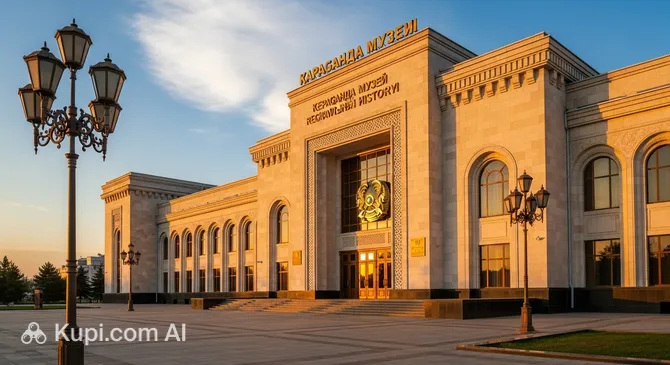
The best place to start exploring the history of the region's coal-mining heart is right here. The Karaganda Regional Museum of Local Lore is one of the oldest and most significant cultural institutions, carefully preserving the chronicles of the city of Karaganda and all of Central Kazakhstan. Located in the very center, it has become a true educational portal for those who want to understand how this land developed.
Karaganda Regional Museum of Local History. Illustration.
Source: Kupi.com AI
Traveller photos:
The main focus of the exhibition is on the formation of the Karaganda Coal Basin. The museum is not just a collection of antiquities, but a detailed account of an industrial feat, captured in scale models of mines, the uniforms of the first miners, and unique geological specimens. While traveling through Kazakhstan, it is hard to find another place where the region's industrial power is presented so vividly and humanely.
The museum's collection contains not only technical relics but also works of art, personal belongings of residents, and rare photographs. This is a place where the spirit of history meets modernity, allowing every visitor to feel the scale of the transformations that turned the steppe region into an industrial giant.
Contacts
To contact the museum staff or clarify information about current exhibitions, you can use the following contact details:
The main draw for visitors is the large-scale exhibition "The Formation of the Karaganda Coal Basin." Here, you can see with your own eyes how the work of miners has changed: from primitive clothing made of coarse fabric to modern equipment. Pay attention to the 30 scale models and archival documents that literally bring the history of coal mining to life.
Be sure to linger in the portrait gallery, which features the works of the famous photographer Nikolay Rybetsky. The faces of participants in the Great Patriotic War and the city's builders create a deep emotional backdrop for the trip. Looking into these portraits, you begin to understand the character of the people who built this city in the harsh conditions of the steppe.
In addition to permanent exhibitions, the museum often serves as a venue for joint projects with local artists. In the halls, you can find sculptures and paintings dedicated to the daily life of miners and the beauty of Karaganda's landscapes. Studying the personal belongings of the city's first residents, such as old spirit lamps and miners' lanterns, will allow you to touch the living history of the region.
Getting There
The museum is located in the heart of the city at 38 Sattar Erubaev Street. Thanks to its central location, it is easy to reach from any part of the city. For navigation, it is convenient to use the coordinates 49.8106681° N, 73.090736° E in any mapping application.
Public transport in Karaganda is very well developed. You can reach the museum via numerous buses and minibuses that pass through the center. The nearest stops are just a few minutes' walk away, making it convenient even for those who do not plan to rent a car.
If you prefer comfort, you can use taxi services. A ride from the central station or major shopping centers will take no more than 10–15 minutes. Drivers easily find the location, as the museum is one of the city's key cultural landmarks.
Nearest city: Karagandy
History & Facts
The history of this cultural institution began on November 7, 1932. Originally, it was not created as a local lore museum, but as a polytechnic museum by order of the People's Commissariat of Coal. The first exhibits—about 80 detailed scale models of mines—arrived directly from Moscow to form the foundation of the future collection.
The museum received its status as the Regional Museum of History and Local Lore in 1938. Its development went hand in hand with the growth of the city itself. When Karaganda officially became a city in 1934, the museum was already actively collecting evidence of how yesterday's mining settlements were transforming into a powerful industrial center with multi-story buildings and a railway.
The museum's funds were replenished in fascinating ways. In the 1960s, unique exhibits, such as an old miner's lamp with the inscription "God be with you" and the first tools used by miners, were donated by Yadviga Fridrikhovna Alalykina, the wife of the city's first doctor. These items became symbols of the era of the coal basin's pioneers.
Time Needed
To leisurely explore the main halls and delve into the details of the exhibitions dedicated to the coal industry and the life of the first settlers, we recommend allowing 1.5 to 2 hours for your visit. This is quite enough time to get acquainted with the key scale models and photo galleries.
If you are a history enthusiast and enjoy studying archival documents in detail or examining every piece in the portrait gallery, your visit may last half a day. The museum offers a high concentration of information that you might want to absorb in smaller portions.
Working Hours
Currently, the exact museum hours are not provided in official sources. To ensure your visit goes smoothly, we strongly recommend checking the current schedule on the institution's official website or verifying the opening hours via the contact phone number before your trip.
Usually, such local lore museums are open to visitors throughout the day, but they may have a day off (often Monday) or designated maintenance hours. A preliminary call will help you plan your route most effectively.
Nearby
After immersing yourself in the history of the region, it is worth taking a stroll around the surrounding area, as the center of Karaganda is rich in interesting monuments and places to relax. Exploring these locations will help you better feel the city's atmosphere and see how history intertwines with modernity.