Support

Palazzo Bo

About

Palazzo Bo is a majestic historic building that has served for centuries as the main headquarters of the University of Padua, one of the oldest and most prestigious educational institutions in the world. Located in the very heart of the city of Padua, it serves as a symbol of academic freedom and scientific progress in Italy.
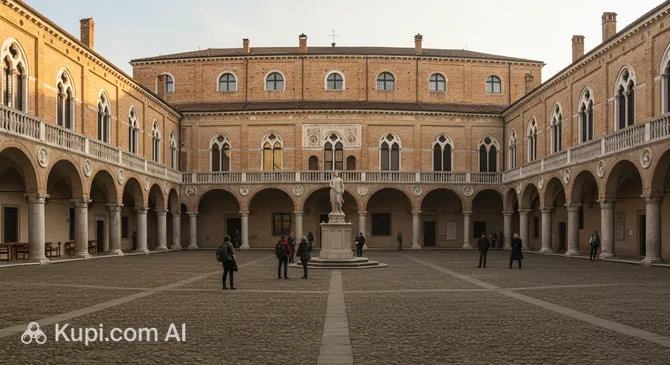
Palazzo Bo. Illustration.
Source: Kupi.com AI

Traveler photos:

The palace's name originates from an ancient inn called Hospitium Bovis ("Inn of the Bull"), on the site of which it was built. The complex is an architectural "labyrinth" where Renaissance loggias stand alongside rationalist elements of the 20th century. One of the palace's primary jewels is the unique 16th-century Anatomical Theatre—the oldest in the world preserved to this day, where revolutionary medical discoveries once took place.

Beyond its historical value, Palazzo Bo is famous for being the place where the great Galileo Galilei taught. Today, visitors can see his podium in the Sala dei Quaranta, as well as admire the numerous coats of arms of students and professors decorating the old courtyard. This site is a must-visit for anyone wishing to experience the living history of European science and culture.

Contacts

To plan your visit to the university's historic building and clarify tour details, we recommend using official communication channels. Please note that visiting the inner halls and the Anatomical Theatre is only possible as part of an organized group with prior booking.

How to contactContact
AddressVia VIII Febbraio, 2, 35122 Padova PD, Italy
Phone+39 049 827 3939
Websitewww.unipd.it

What to Do

The best way to explore Palazzo Bo is by joining an organized tour, as this is the only way to see the university's most secluded corners. Your first impression will be the Ancient Courtyard (Cortile Antico), whose walls are literally "clothed" in thousands of stone coats of arms belonging to the students and scholars who studied here over the centuries. Be sure to find the statue of Elena Cornaro Piscopia—the first woman in the world to receive a doctoral degree.

The highlight of the visit is the legendary Anatomical Theatre. Climbing the narrow stairs, you will find yourself in the wooden funnel of the amphitheater, where foundations of human life were once studied in the dim light of torches. Equally impressive is the Aula Magna (Great Hall), which still hosts solemn academic ceremonies, and the Sala dei Quaranta, where Galileo Galilei's original podium is displayed.

For connoisseurs of 20th-century art and design, the halls designed by Gio Ponti will be a true revelation. Inspect the "Staircase of Knowledge" with its vibrant frescoes and look into the Hall of Medicine, which houses relics of outstanding professors. To conclude your walk, step out into the modern New Courtyard, decorated with works by sculptors Gio Pomodoro and Jannis Kounellis, where you can feel the pulse of Padua's contemporary student life.

Getting There

Palazzo Bo is centrally located in the historic heart of the city at Via VIII Febbraio, 2. Thanks to its position, the building is within walking distance of most key tourist sites. If you are arriving at the main station, Padova Centrale, the walk to the university will take about 20 minutes through the scenic streets of Corso del Popolo and Via del Livello.

For those who prefer public transport, buses No. 3, 12, 18, 22, 24, and 27 run from the station and other areas of the city. You should get off at the "Università" stop, which is just a couple of minutes' walk from the entrance. It is also convenient to take the Sir1 tram line to the Prato della Valle stop, followed by an approximately 10-minute stroll towards the center.

Travelers by car should keep in mind that the palace is located in a limited traffic zone (ZTL), where entry without a special permit is prohibited. The best solution is to leave your car in one of the paid parking lots, such as Parcheggio Piazza Cavour, or use the park-and-ride lots on the outskirts and take the tram to the center.

Nearest city: Padua

History & Facts

The history of this site began not with science, but with trade: in the 13th century, it housed an inn for butchers called Hospitium Bovis ("Inn of the Bull"). In 1405, the building changed hands, and in 1539, the University of Padua finally purchased it, turning the former inn into its official residence. The modern name of the palace—Palazzo Bo—comes from that old title.

At the end of the 16th century, under the direction of architect Andrea Moroni, the complex acquired its Renaissance features. The most outstanding addition of that time was the Anatomical Theatre, built in 1594. This is the world's oldest structure of its kind, where students from all over Europe could observe dissections in a unique funnel-shaped wooden amphitheater.

The university's golden age is inextricably linked with the name of Galileo Galilei. The great scientist taught physics and mathematics here from 1592 to 1610. The Sala dei Quaranta still carefully preserves the wooden podium from which Galileo delivered his lectures. His presence made Padua a center of attraction for the free-thinkers and researchers of the era.

In the 20th century, specifically during the 1930s and 40s, Palazzo Bo underwent a major renovation. Rector Carlo Anti invited the famous architect Gio Ponti, who created the modern "Staircase of Knowledge" and the unique interiors of the rector's apartments. This synthesis of centuries-old history and modernist design transformed the building into a true living museum of academic traditions.

Time Needed

To fully appreciate the architectural grandeur and historical significance of the complex, we recommend setting aside 1.5 to 2 hours for your visit. This will be enough time for a leisurely tour of the inner courtyards, a guided walk through the famous halls, and an introduction to the Anatomical Theatre.

If you are short on time and only plan to see the main symbols, such as the Ancient Courtyard and Galileo’s podium, you can manage in one hour. However, given the tight tour schedule and the popularity of the site, it is better to have an extra 30 minutes in reserve to explore the souvenir shop at your own pace or simply soak in the atmosphere of Italy's oldest university.

Working Hours

Palazzo Bo welcomes visitors daily, following a consistent schedule throughout the week. The complex doors are open from 9:00 AM to 8:00 PM, Monday through Sunday.

It is important to remember that access to the inner historical halls and the Anatomical Theatre is only possible via organized guided tours, which are held according to a specific schedule throughout the day. It is recommended to check for availability and precise tour start times on the university's official website in advance, especially on weekends and public holidays.

9:00 – 20:00

Nearby

Exploring the surroundings of Palazzo Bo allows you to dive deeper into the atmosphere of old Padua, where every alley holds a piece of history. The palace is at the very epicenter of city life, surrounded by famous squares and architectural monuments.

A walk through the nearby quarters will reveal the cozy streets of the old Ghetto and majestic buildings that have stood next to the university for centuries. All the sites listed below are within a comfortable walking distance.

NameDistance
Piazza della Frutta0.1 km
Jewish Ghetto of Padua0.1 km
Pedrocchi Café0.1 km
Otium Bar Restaurant Pizzeria Lunch Café0.2 km
Palazzo della Ragione0.2 km
Palazzo Zabarella0.2 km
All'Ombra Della Piazza0.2 km

Reached the end of the page?

That means the route is fully explored