Support

Equestrian statue of Gattamelata

About

Strolling through the sun-drenched streets for which ancient Padua is famous, it is impossible to pass by one of the greatest treasures of world art. The Equestrian Statue of Gattamelata is a majestic bronze monument created by the genius Donatello in the mid-15th century. It is rightfully considered the first equestrian monument of the Renaissance, reviving the ancient tradition of glorifying heroes in metal.

This masterpiece, located in the heart of Italy, is dedicated to the valiant condottiero Erasmo da Narni. The monument is unique as it was the first civic monument of its time erected in honor of a person for their personal merits and valor rather than by royal birthright. The height of the composition, including the massive pedestal, reaches eleven meters, dominating Piazza del Santo.
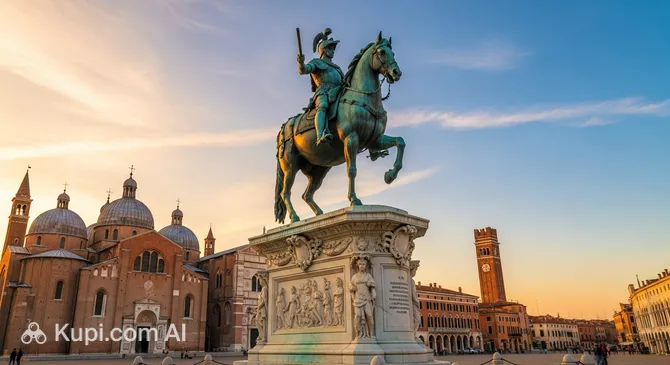
Equestrian Statue of Gattamelata. Illustration.
Source: Kupi.com AI

Traveler photos:

The Statue of Gattamelata is not just a historical site, but a true benchmark of Renaissance sculpture. This monument served as the prototype for most equestrian monuments that later adorned the major cities of Europe. Its austere forms and the psychological depth of the rider's image continue to fascinate travelers and art lovers from around the world.

Contacts

To plan your visit to the monument, the following contact information may be useful. The site is located outdoors, but official details can help you find information about city tours and events on the square.

How to contactContact
AddressPiazza del Santo, 35123 Padova PD, Италия
Phone+39 049 201 0080
Websitewww.padovanet.it

What to Do

The main thing to do at the monument is to carefully observe Donatello's masterful work. Walk around the monument to appreciate how skillfully the horse's anatomy and the rider's calm, confident posture are captured. Pay attention to the details of the armor: the sculptor recreated the elements of military attire with striking precision, combining ancient motifs with features of his own time.

Don't forget to look at the high eight-meter pedestal. It is decorated with symbolic images of doors and putti figures holding Gattamelata's coat of arms and armor. These elements emphasize the memorial's status as an honorary burial site, albeit a symbolic one (a cenotaph).

Since the monument is located on Piazza del Santo, right in front of the entrance to the famous basilica, be sure to combine your viewing of the statue with a visit to the temple. Inside the basilica, you can find the actual tomb of the great commander and continue exploring the religious and artistic heritage of this amazing region.

Getting There

Finding this legendary monument is easy, as it is located on one of the city's most visited squares — Piazza del Santo. The monument stands directly in front of the facade of the Basilica of Saint Anthony, which serves as the primary landmark for all tourists.

If you arrive in the city by train, Padova Centrale railway station will be your starting point. From there, you can reach the square on foot in about 15–20 minutes, walking south through picturesque old streets. City buses and trams also run regularly from the station, taking you to stops near the basilica.

For those who prefer comfort, taxi services are always available from anywhere in the city center. The ride will take only a few minutes, though a stroll will allow you to better experience the atmosphere of ancient Padua.

Nearest city: Padua

History & Facts

At the heart of this masterpiece lies the story of Erasmo da Narni, a famous 15th-century condottiero. He earned his nickname "Gattamelata", which translates as "honeyed cat," for the cunning and diplomacy he combined with incredible bravery on the battlefield. Serving the Republic of Venice, he became the ruler of Padua and earned such respect that the senate decided to immortalize his memory.

The monument was created by Donatello between 1445 and 1453. Interestingly, it was an entirely private project, funded by the commander's widow and son. The sculptor was inspired by ancient models, specifically the equestrian statue of the Roman Emperor Marcus Aurelius, seeking to bring the grandeur and naturalism of the classical era back into art.

The work was revolutionary for its time. Donatello was the first in the Renaissance to depict a rider not as an allegorical figure, but as a real person in contemporary armor, sitting confidently in the saddle. Every detail—from the chasing on the armor to the powerful muscles of the horse—emphasizes the triumph of human will and craftsmanship.

Time Needed

For a thoughtful examination of the statue itself, studying the bas-reliefs on the pedestal, and taking commemorative photos from different angles, 30–45 minutes is usually sufficient. The monument is located in an open space, so the viewing time depends entirely on your interest in the details of Renaissance sculpture.

However, given its proximity to the grand Basilica of Saint Anthony, we recommend allocating at least 2–3 hours for this location. This will allow you not only to appreciate Donatello's work but also to visit the cathedral itself, where Gattamelata is buried, and stroll through the courtyards of the monastery complex.

Working Hours

Since Donatello's masterpiece is located on an open city square, it is available for viewing and photography 24/7 and free of charge. You can admire the play of light on the bronze in the rays of the morning sun as well as under the evening lighting, which gives the rider's image a special monumentality.

Nevertheless, if you plan to visit information centers or nearby museums, it is recommended to check their schedules in advance on the official city portal, as services and access to adjacent buildings may have time restrictions.

Nearby

The area around the Basilica of Saint Anthony is the cultural heart of the city. A stroll through these surroundings will allow you to see many other architectural and historical monuments located just a few minutes' walk away.

Exploring the area around Piazza del Santo will significantly enrich your travel experience, revealing new facets of Italian history and art.

NameDistance
Basilica of Saint Anthony of Padua0.1 km
Prato della Valle0.4 km
Museum of the History of Medicine in Padua0.4 km
Otium Bar Restaurant Pizzeria Lunch Café0.5 km
Palazzo Zabarella0.5 km
Palazzo Bo0.6 km
Jewish Ghetto of Padua0.6 km

Reached the end of the page?

That means the route is fully explored