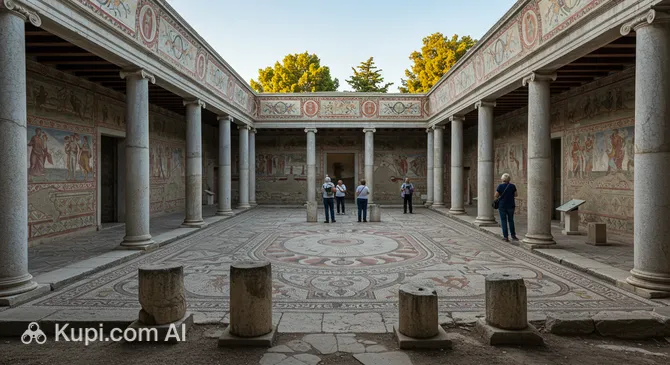
Imagine stepping inside a wealthy Roman home and seeing the daily life of ancient nobility with your own eyes. Casa Romana is a magnificently restored villa in the town of Kos, serving as a living monument to the imperial era in Greece. Dating back to the late 2nd or early 3rd century AD, the building was constructed on the ruins of an even older Hellenistic house.
Casa Romana. Illustration.
Source: Kupi.com AI
Traveller photos:
The architectural complex is striking in its layout, featuring 36 rooms and three open courtyards (atriums). Two of these are designed in the exquisite "Rhodian" style with elegant two-story colonnades. Despite its modest and simple facade, the villa's interior reflects the wealth of its owners, boasting magnificent mosaic floors, sophisticated drainage systems, and water cisterns.
The site's significance lies in its incredible preservation and masterfully executed restoration, which spanned several decades. Casa Romana is more than just an open-air museum; it is a rare opportunity to see authentic mosaics depicting wild beasts and marine life right in the place where they were created centuries ago.
Contacts
For those planning a visit and wanting to check the location in advance, the current contact information is provided below.
Strolling through the villa's halls is a fascinating journey through the labyrinths of ancient architecture. Be sure to linger in the atriums to admire the Rhodian-style peristyles; their slender columns still create a play of light and shadow that evokes memories of past grandeur. One of the highlights of the exhibition is the bathing area, where a stunning mosaic of a leopard is preserved on the floor.
Pay close attention to the interior details: as you examine the mosaic floors, you will discover not only geometric patterns but also detailed scenes of the seabed, figures of gods, and mythical creatures. Experts suggest keeping an eye out for ancient engineering—elements of the original drainage system that provided comfort to residents nearly two thousand years ago are clearly visible here.
Since many statues and valuable finds from this house were moved to the Archaeological Museum of Kos, it is best to complement your visit to the villa with a trip to the museum. Nevertheless, being within the walls of the house itself, reading the information boards, and observing the Hellenistic masonry on the north side will give you a unique feeling of touching living history.
Getting There
Finding this archaeological site among the city streets is quite simple. Casa Romana is located in the heart of Kos Town, in the so-called Western Archaeological Zone. If you are staying in the center or arriving at the port, the walk to the villa will take only 5 to 15 minutes, making it one of the most accessible attractions on the island.
For those who prefer transportation, a bicycle—a popular way to get around the island—or a taxi is an excellent option. Public buses also run through the city, providing quick access to the Leoforos Grigoriou area. Parking spaces are available near the site if you are traveling by rental car.
Entrance to the museum complex is on the east side. Travelers should keep in mind that Kos can be quite hot in the summer months, and a significant part of the tour takes place outdoors or in partially shaded halls, so be sure to bring drinking water and a hat for a comfortable visit.
Nearest city: Kos
History & Facts
The history of this magnificent building began long before it acquired its current form. The original foundation and fragments of masonry on the north side date back to the Hellenistic period (3rd century BC). However, the appearance we see today took shape during the era of Roman rule, when a luxurious Pompeian-style villa was erected on the ruins of the old house.
For a long time, the site remained hidden underground until Italian archaeologists discovered it during large-scale excavations in 1933. The architectural scale of the structure—a total of 36 rooms and three atriums—led scholars to believe the owner was a high-ranking official or a member of a very wealthy family. This was not just a home, but a symbol of status and influence in ancient society.
Remarkably, restoration work on the complex continued for nearly 60 years. Craftsmen and scholars carefully restored the two-story porticos and floors so that, at the beginning of the 21st century, Casa Romana could appear before the public in its historical splendor. Today, it serves as a key link in understanding how the island of Kos transitioned from Greek traditions to a Roman way of life.
Time Needed
To unhurriedly explore all 36 rooms, examine the floor mosaic details, and soak in the atmosphere of the ancient atriums, a typical visitor will need 1 to 2 hours. This is ample time for a thoughtful tour and for taking memorable photos.
If you plan to combine your visit with the nearby Roman Odeon and a tour of the Archaeological Museum, which houses some of the original artifacts, it is better to set aside half a day for such a cultural program. This will allow you to avoid rushing and fully appreciate the scale of the ancient heritage the island is famous for.
Working Hours
When planning your visit, keep in mind that the attraction is open to the public daily except for Tuesdays. On both weekdays and weekends, the museum complex follows a set schedule: from 8:00 AM to 8:00 PM.
Please note that Tuesday is the official day off. It is recommended to visit in the morning or closer to evening when the sun is less intense, and the soft lighting highlights the beauty of the ancient columns and mosaic panels.
Day
Opening hours
Monday
8:00 – 20:00
Tuesday
Closed
Wednesday
8:00 – 20:00
Thursday
8:00 – 20:00
Friday
8:00 – 20:00
Saturday
8:00 – 20:00
Sunday
8:00 – 20:00
Nearby
The villa's location in the heart of the historic center allows tourists to easily combine their visit with other iconic sites. A walk around the neighborhood will help you get a deeper feel for the city's multilayered history and see how monuments from different eras sit side by side.