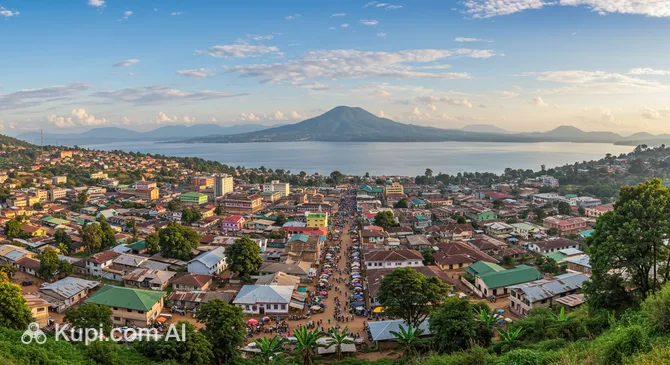
Bukavu is a stunning port city sprawling across the picturesque southern shores of Lake Kivu in Congo (DRC). As the administrative center of the South Kivu province, it draws travelers with its unique atmosphere, where colonial heritage meets the vibrant energy of modern Africa. The city is situated at an altitude of approximately 1,500 meters above sea level, giving it a mild, almost Mediterranean climate rarely found in equatorial latitudes.
Founded in 1901, Bukavu was long a favorite holiday destination for Europeans, which is reflected in its architectural appearance: here you can still see elegant villas and residences nestled in lush green gardens. Today, the city's population exceeds 1.1 million, making it the largest and most important cultural hub of Eastern Congo. Bukavu. Illustration.
Source: Kupi.com AI
The history of this place is no less fascinating than its landscapes. You can learn more about how Bukavu has evolved and changed over the centuries, from the Belgian settlement of Costermansville to a modern metropolis. The main magnets for tourists here are not only old cathedrals and embankments but also the proximity to unique natural sites, such as the Kahuzi-Biega National Park.
Bukavu invites everyone ready to discover the authentic beauty of Africa to enjoy the tranquility of the great lake and touch the living heritage of the region. This is a place where time seems to slow down, allowing you to fully experience the majesty of the surrounding nature.
Weather Overview
Due to its location at an altitude of 1,500 meters above sea level, Bukavu delights visitors with a temperate and mild climate that is significantly more comfortable than in many other tropical regions. Throughout the year, the average air temperature fluctuates within a pleasant 19–20°C. During the day, the thermometer usually rises to 23–25°C, while nights bring a pleasant coolness, dropping to 15–16°C.
The region has distinct rainy and dry seasons. The driest time occurs in June, July, and August, when rainfall is minimal and days are sunny and clear. Conversely, from October to May, rains are frequent, with November, December, and April considered the wettest months. If you are planning a trip, it is worth checking the detailed weather in Bukavu in advance to choose the right wardrobe and plan your excursions.
Lake Kivu plays a key role in shaping local weather conditions, softening temperature fluctuations and creating a stable microclimate. Even during the rainy season, precipitation is often heavy but short-lived, after which the sun comes out again. This mild climate has historically made Bukavu a popular climatic resort, attracting travelers with its freshness and clean air.
Average monthly temperature
Average monthly precipitation
Interesting Facts
Until 1966, the city was named Costermansville in honor of a Belgian governor, and only 65 years after its founding did it receive its indigenous name, Bukavu.
Bukavu is home to the famous Chopo Bridge over the Ruzizi River, which historically connects Lake Kivu and Lake Tanganyika, acting as an important link for the region.
The city is recognized as the main Catholic center of the Democratic Republic of the Congo; it hosts the archbishop's residence and a prestigious Catholic University.
Due to its architecture and location on hills by the lake, during the colonial era, Bukavu was considered the most European city in the region, built up with many modernist villas.
The active volcano Tshibinda is located in close proximity to the city blocks, making the geological setting around Bukavu truly unique.
How to Get There
Bukavu is an important transport hub in eastern Congo (DRC); however, due to its significant distance from the capital—over 2,000 kilometers—traveling here requires prior planning. Air travel remains the main and most reliable way to connect with other regions. If you want to study all routes and logistics options in advance, we recommend checking the section detailing how to get to the city using the most convenient paths.
The city's main air gateway is Bukavu Airport (IATA: BKY), also known as Kavumu. It is located about 30 kilometers from the city center. The airport receives regular domestic flights from Kinshasa and Goma, as well as regional charters. For transfers to the city, tourists usually use taxis or pre-booked hotel transfers, as the journey can take a significant amount of time due to the local terrain.
In addition to aviation, water transport plays a vital role. Lake Kivu has historically served as the region's main "highway." Speedboats and large ferries run between Bukavu and the city of Goma, allowing for a scenic water journey that takes between 3 and 7 hours depending on the type of vessel. There is also the possibility of crossing the border from neighboring Rwanda via land border crossings, which is often used by travelers arriving from Kigali.
Station
Passenger traffic
Distance
Kigoma station
1
275 km
Main Attractions
The main architectural and spiritual landmark of Bukavu is rightfully considered the Cathedral of Our Lady of Peace (Cathédrale Notre-Dame-de-la-Paix). This majestic temple, perched on a hill, is the primary Catholic cathedral in the country and a symbol of the region's deep religious traditions. Its austere yet elegant forms capture the attention of everyone strolling through the city's central streets.
While walking along the embankments, it is worth noting the historic Governor's Residence. This two-story white mansion, surrounded by a well-tended garden, has been preserved from the days of Belgian rule. The building serves as a wonderful example of early 20th-century colonial architecture and serves as a reminder of the period when Bukavu was called "African Switzerland" for its beauty and order.
For those interested in science and nature, a visit to the Lwiro Research Center (CRSN) is a must. Located near the city, this complex is not only an important scientific hub but also boasts a magnificent library and a museum where you can learn about the unique flora and fauna of the Great Lakes region.
The city's natural surroundings are no less impressive: Bukavu serves as the gateway to the famous Kahuzi-Biega National Park. Here, amidst dense tropical forests and in the shadow of the dormant Tshibinda volcano, live the rare Eastern Lowland Gorillas. The picturesque panoramas of Lake Kivu opening up from the city hills complete the list of must-see locations, creating the perfect backdrop for memorable photos.
Local Cuisine
The culinary identity of Bukavu is inextricably linked to the riches of Lake Kivu. The main delicacy that every guest must try is a small fish called sambaza. It is usually fried until crispy and served as an appetizer or a main dish. Tilapia is also popular, masterfully grilled by local chefs with aromatic spices and herbs.
The local diet is based on starchy dishes such as fufu (a thick paste made from cassava or maize flour) and chikwangue. These side dishes perfectly complement rich meat and vegetable stews. Don't forget to try dishes made from cassava leaves, known as sombe, which are slow-simmered with oil and spices to achieve a unique flavor. The city's gastronomic scene is represented by both traditional street stalls and cozy restaurants in the center where you can experience authentic Congolese cuisine.
As for drinks, local beer is popular in Bukavu, as well as fresh tropical fruit juices. Coffee grown on the plantations of South Kivu province has a rich flavor and is considered one of the best in the region. Dining in Bukavu is not just a meal, but an opportunity to feel the rhythm of life in Eastern Congo and enjoy fresh products grown on fertile volcanic soils.
Travel Tips
Bukavu is a city with a special character and a unique location, so a little preparation will make your trip truly comfortable and safe.
Clothing and Essentials: Thanks to the 1,500-meter altitude, it never gets swelteringly hot here. Bring light clothing made of natural fabrics, but be sure to add a warm sweater for cool evenings and a reliable raincoat, as rainfall is frequent. Comfortable closed-toe shoes are a must-have for walking the hilly streets.
Transport: For getting around the city, it is best to use a taxi called through your hotel. Motorcycle taxis are faster but require caution. For trips to Goma, choose speedboats—it's the most scenic route.
Finances: The Congolese franc is in use, but US dollars (new bills without damage) are accepted almost everywhere. Cards only work in large hotels and banks, so always have a sufficient supply of cash with you.
Health and Safety: Be sure to use repellents and drink only bottled water. Check vaccination requirements before your trip (Yellow Fever is mandatory). After dark, move around only by taxi.
Communication: The official language is French, and Swahili is also widely spoken. English is understood by staff at hotels and international organizations. Learn a few phrases in French—it goes a long way with the locals.
Local Etiquette: Greetings are very important. A polite "Bonjour" before asking a question is the key to successful communication. Be patient, as the pace of life here is slower than in Europe.
What to Avoid: Do not photograph strategic sites (bridges, government buildings, police)—this can lead to serious problems with the authorities.
Extra Tip: Try to be on Lake Kivu during the sunset hours. The sight of fishing boats with their lights lit is one of the most beautiful scenes in Bukavu.
Following these simple rules will help you focus on the beauty of the region and ensure your trip to Bukavu leaves you with only the most positive emotions.
Entertainment & Nightlife
Entertainment in Bukavu is characterized by a calm and steady pace, focusing on social interaction and enjoying natural beauty. Local residents and visitors alike prefer to spend their evenings on the shores of Lake Kivu. It is here, in the coastal cafes and restaurants, that life hums: people gather to watch the sunset, enjoying the light breeze and panoramic views of the mirror-like water surface.
The majority of evening venues are concentrated in the city center and along the main transport arteries. Here you can find cozy bars where modern Congolese music—rumba and ndombolo—creates a unique atmosphere. The vibe in such places is friendly and relaxed, with a crowd consisting of local intellectuals, international organization employees, and tourists.
Daytime entertainment in Bukavu is more centered around walking and exploring the cultural landscape. City parks and viewpoints offer opportunities for active outdoor recreation. Although the city lacks massive shopping malls or world-famous noisy nightclubs, the authenticity of local establishments and the hospitality of the residents more than compensate for this, turning every evening into a warm and memorable event.
Parks & Museums
One of the region's main sources of pride is the Kahuzi-Biega National Park, located in close proximity to Bukavu. This UNESCO World Heritage site is one of the few places on the planet where you can see Eastern Lowland Gorillas in their natural habitat. A walk through the park's tropical forests amidst giant ferns and bamboo groves is an unforgettable experience for wildlife lovers.
Within the city and its immediate outskirts, the Lwiro Research Center is worth a visit. This is not just a scientific institution, but a true cultural oasis with magnificent colonial-style architecture. It houses one of the region's largest libraries and a small museum dedicated to Congo's natural wealth. There is also a primate sanctuary at the center, where you can get a closer look at conservation efforts for rare monkey species.
For those who prefer a more relaxed holiday, the Lake Kivu shoreline offers many picturesque spots that function as natural parks. Here you can stroll in the shade of exotic trees while admiring the view of the Tshibinda volcano. The combination of scientific knowledge, historic architecture, and pristine nature makes visiting Bukavu's parks and cultural centers a deep and multifaceted immersion into the life of Central Africa.
Getting Around
The public transport system in Bukavu reflects the dynamic and somewhat chaotic rhythm of an African city. The main mode of travel for most residents and tourists is minibuses, often referred to as "taxibuses". They connect the main residential areas, commercial points, and the administrative center. You can board such a bus at designated stops or simply by waving your hand at the side of the road, though be prepared for the vehicles to often be overcrowded.
For more comfortable and faster trips around the city, taxis are ideal. In Bukavu, both standard cars and motorcycle taxis are available, the latter of which excel at maneuvering through narrow and hilly streets. You should always agree on the fare in advance, as there are no meters in the vehicles. Many tourists prefer to order transport through their hotels, which guarantees a fixed price and a higher level of safety.
Given the city's location on Lake Kivu, water transport also plays an important role. Boats run between various coastal neighborhoods and neighboring towns. This is not only a practical way to avoid traffic jams but also an opportunity to enjoy magnificent views of Bukavu from the water. There is no rail service in the city, so for long-distance travel, either flights or intercity buses departing from central bus stations are used.
Accommodation
A wide range of accommodation options is available for tourists in Bukavu, from classic hotels to private villas. Given the city's history as a colonial resort, many hotels occupy buildings with interesting architecture and feature spacious terraces. In recent years, modern hotels catering to business travelers and international mission staff have also appeared in the city.
The most popular area for staying is along the shores of Lake Kivu. Hotels located on the waterfront offer guests not only comfortable rooms but also magnificent panoramic views of the water and islands. Staying in this area is considered the most prestigious and peaceful, allowing you to enjoy morning breezes and evening sunsets right from your room window.
Budget travelers should look into guesthouses and pensions in the central part of the city. Here, prices are noticeably lower, and the proximity to markets and transport hubs makes moving around Bukavu more convenient. Nevertheless, it is recommended to book accommodation in advance, especially during scientific conferences or major cultural events, as the best value-for-money options fill up quite quickly.
Nearby Cities
Bukavu serves as an ideal starting point for exploring the African Great Lakes region. Thanks to its border location, the city allows for easy trips to neighboring towns, each possessing its own unique character and attractions.
Just a few kilometers across the border is the Rwandan city of Kamembe, which is often visited for shopping or its international airport. Also noteworthy is Rusizi, located in the picturesque valley of the river of the same name. For those interested in thermal springs, an excellent destination is a trip to Bugarama, known for its healing waters and warm hospitality.
Exploring the surroundings of Bukavu will provide you with many impressions: from walking through tea plantations to visiting colorful border markets. The region around the city is rich in natural wonders and small settlements where traditions have remained unchanged for decades, inviting the curious tourist to make real discoveries.
Shopping & Souvenirs
Shopping in Bukavu is primarily an introduction to local color and craft traditions. The city does not abound in massive shopping malls but offers a unique experience of visiting markets and small shops in the central quarters. Here you can find goods that will become truly original souvenirs from the heart of Africa.
The main place for shopping is traditionally the city markets, where life hums from early morning. It is worth looking out for the famous African fabrics with bright prints, known as "vitangi" or pagne. Local craftsmen also offer intricate wood products: masks, figurines, and household items made in the traditional style of the peoples of Eastern Congo. In addition, Bukavu is famous for its woven baskets and copper products.
For fans of gastronomic souvenirs, local coffee and tea grown on fertile highland plantations are an excellent choice. Shops generally operate from morning until early evening, and payment is most often made in cash in local currency or US dollars. Visiting local retail outlets is a great way not only to purchase a unique item but also to interact with the city's residents and learn more about their daily lives and culture.