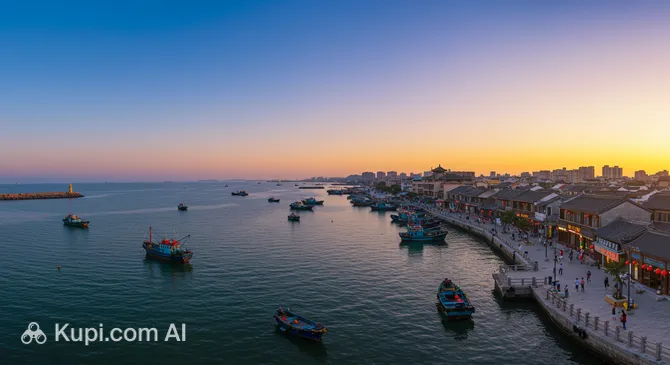
Dongtai is an amazing corner in the eastern part of China, where ancient traditions of the salt trade harmoniously coexist with modern "green" energy technologies. Located on the Yellow Sea coast in Jiangsu Province, this city is rightfully titled the "Salt Capital of the Celestial Empire." Its name, which translates as "Eastern Seashore," perfectly reflects its geographical essence and unique coastal character.
Dongtai. Illustration.
Source: Kupi.com AI
The Dongtai city-level district, with a population of about 990,000 people, attracts travelers with its environmental purity and unique landscapes. Here, you can see a rare combination of vast wetlands, included in the UNESCO heritage list, and dense lowland forests. The city carefully preserves its rich history, dating back to the Tang Dynasty, when sea salt production became the foundation of the region's prosperity.
In addition to historical monuments, Dongtai is famous for its famous watermelons and giant wind turbines towering along the coastline. Visiting this city is an opportunity to immerse yourself in the authentic atmosphere of old China, stroll through the ancient streets of Anfeng, and enjoy the tranquility of the seascapes. We invite you to discover this "green" oasis and feel the hospitality of its residents.
Weather Overview
Dongtai is located in a temperate monsoon climate zone, which is characterized by a clear change of seasons. The coastal location moderates temperature fluctuations, making the weather more predictable. To better plan your visit, we recommend checking the detailed information about the city's climate by month.
Summers in Dongtai are hot and humid: in July and August, the average temperature reaches +28...+30°C, and humidity rises due to monsoon rains. Winters here are cool and dry, with temperatures around +3...+5°C, but the mercury can occasionally drop slightly below zero. Spring (April-May) and autumn (September-October) are considered the best times to visit: during these periods, a comfortable temperature of 15-25°C is established, ideal for walking.
Precipitation is distributed unevenly throughout the year, peaking in the summer months. Travelers should keep in mind that typhoons are possible in July, so it is useful to check current weather reports before traveling during this time. The rest of the time, Dongtai enjoys a moderate number of sunny days.
Average monthly temperature
Average monthly precipitation
Interesting Facts
Dongtai is a city with deep historical context and surprising modern achievements that make it stand out on the map of China.
The first official mention of the name "Dongtai" dates back to 937, when a special salt trade oversight body was established here during the Southern Tang period.
The city's Haichunxuan Pagoda is considered an architectural wonder: for a thousand years, it hasn't tilted even a degree, despite the complete absence of a deep foundation.
Dongtai is called the "Watermelon Capital": local sweet berries are recognized as a national brand and exported far beyond the province.
Some of Asia's largest offshore wind farms are located along the city's coast, making the region an important center for clean energy.
In ancient times, Dongtai held the status of the "Salt Warehouse of the Celestial Empire," as it was from here that salt was distributed to many provinces of the vast empire.
How to Get There
Dongtai has good transport connectivity with the major metropolises of Jiangsu Province and eastern China. Travelers can conveniently plan their route using the rail network or the system of high-speed expressways. Find more details about the routes on the page describing how to get to the city.
The city does not have its own airport, so the main flow of tourists arrives via the nearest major aviation hubs. The most popular are Yancheng Nanyang International Airport (YNZ) and Nanjing Lukou International Airport. From there, you can reach Dongtai by regular intercity buses or by train, which takes one to two hours depending on the starting point.
Rail transport is the fastest way to travel. While Dongtai itself is served by local lines, many tourists prefer to take high-speed trains to Yancheng Station and then transfer to local transport. There is also direct bus service from Shanghai; the journey along scenic coastal roads takes about 4–5 hours.
Dongtai's main treasures are concentrated in its historical quarters and theme parks. One of the most vibrant locations is the Xixi Tourism Area, where the "Dong Yong and the Seven Fairies" Cultural Park is located. This complex, reconstructed in the architectural style of the Han Dynasty, brings to life ancient legends of celestial maidens. Be sure to stay until evening to see the large-scale theatrical performance "Tianxianyuan," which impresses with special effects and the skill of the actors.
Connoisseurs of ancient architecture should visit the Haichunxuan Pagoda. This is the oldest structure of its kind in Jiangsu Province, built during the Tang Dynasty. The pagoda's uniqueness lies in the fact that it has stood for over a thousand years without a foundation, demonstrating the incredible skill of ancient builders. Entrance to the monument site traditionally remains free for everyone.
Equally interesting is the ancient town of Anfeng, where time seems to have stood still. Strolling along Limu Street beside the old Salt Canal, you will see buildings from the Ming and Qing eras. Important historical sites are located here: the Salt Tax Office, which tells the story of the complex distribution process of "white gold," and the luxurious Bao House—the residence of a wealthy salt merchant, famous for its intricate brick carvings.
Local Cuisine
Dongtai's gastronomy is inextricably linked to the sea and the region's fertile lands. The main dish every guest must try is fish soup with noodles. This soup is famous for its rich flavor and snow-white broth, the secret of which is passed down from generation to generation. Fresh seafood and delicacies from river fish caught in local canals are also popular.
Those with a sweet tooth should head to the ancient town of Fuan, which is famous for its crispy pastries. These puff pastries with various fillings have become a gastronomic symbol of the district. Don't forget to try the local shrimp paste—it has a unique aroma and is often used as a seasoning for main courses.
Dongtai watermelons hold a special place in the local diet. Thanks to the specific soil, they are exceptionally sweet and juicy here. They are served as dessert in almost every restaurant, especially on Caoshi Street, where many cozy eateries are concentrated. It is customary to wash down the meal with traditional green tea or refreshing locally produced fruit juices.
Travel Tips
Preparing for a trip to Dongtai will be easier if you use our tips, collected for the most comfortable introduction to this original city.
Clothing and items: Choose clothing according to the season, but be sure to bring comfortable shoes for long walks through ancient towns and nature trails. In summer, don't forget sunscreen and insect repellent for walks by the sea.
Transport: For getting around the district, it's most convenient to use taxis or buses. If you plan to travel a lot, install transport apps popular in the region.
Finances: The main currency is the Chinese Yuan (CNY). Mobile payments (Alipay, WeChat) are accepted everywhere, but in the small shops of Anfeng, it's better to carry cash.
Health and safety: Dongtai is a very safe city. Pharmacies can be found on the main streets of towns, but it's better to bring specific medications with you.
Communication: The primary language is Chinese; English is not widely spoken here. Download an offline translator in advance and save the names of attractions in Chinese characters.
Local etiquette: Be polite when visiting temples and pagodas. When photographing locals or their workshops, it's better to ask permission with a nod or a smile.
What to avoid: Do not try to take away historical artifacts (even those found on the shore) and try not to litter in the wetlands, as environmental regulations are strictly enforced here.
Additional tip: Try to catch the evening show in Xixi—it is the most vivid impression of the trip, and it's better to book tickets in advance through your hotel.
May your journey to Dongtai be filled with amazing discoveries and the tranquility of the sea breeze!
Entertainment & Nightlife
The entertainment program in Dongtai is primarily geared towards culture lovers and those seeking peaceful relaxation. The highlight of the evening for many tourists is the "Tianxianyuan" show in the "Dong Yong and the Seven Fairies" Park. This is a high-tech open-air musical performance that immerses the audience in the world of Chinese mythology and folklore.
For those who prefer leisurely evening strolls, the ancient streets of Limu and Anfeng are perfect. At twilight, when traditional lanterns are lit, an incredibly cozy atmosphere is created. You can visit small workshops demonstrating traditional crafts, such as straw weaving, or sit in one of the teahouses, listening to the sounds of the old town.
Nightlife in the conventional sense, with noisy clubs, is not well-developed here, as Dongtai positions itself as a center for ecological and cultural tourism. Safety in the city is at a very high level, so evening walks along the Yellow Sea embankments or lit parks will be perfectly comfortable. To get to your hotel late in the evening, it's best to use official taxi apps or ask the guesthouse staff for help.
Parks & Museums
Dongtai's natural and cultural heritage is represented by unique park complexes. Be sure to visit the "Dong Yong and the Seven Fairies" Cultural Park. This is not just a garden, but a large-scale architectural installation where every pavilion and bridge tells a part of an ancient legend. For families with children, this is an ideal place for walking and learning about Chinese mythology.
The city's museum scene is equally impressive. Located in Anfeng is the former Salt Tax Office—a unique museum whose exhibits are dedicated to the history of the Lianghuai salt route. You will learn how salt was extracted, stored, and transported through canals over the centuries. Another important site is the Bao House, which serves as a residence-museum and showcases the lifestyle of wealthy salt industrialists of the past.
For eco-tourism enthusiasts, Dongtai offers walks through the wetlands on the Yellow Sea coast. This is an open-air natural park where you can observe rare species of migratory birds. Contrasting with the ancient monuments are the coastal zones with futuristic wind turbines, which have also become a unique landmark of the city.
Getting Around
The transport system in Dongtai is adapted for connection between its 14 towns and main tourist areas. The main form of public transport is city and suburban buses. They run regularly between central Dongtai and key points such as Anfeng, Xixi, and Fuan. Fares are inexpensive, and routes cover all the key attractions of the district.
For fast travel within the city, it is most convenient to use taxis. You can use mobile apps popular in China or hail a car on the street. Prices are fixed and quite affordable for tourists. Additionally, bicycle rentals are gaining popularity in coastal areas and park zones, which is ideal for traveling along ecological trails.
If you plan trips to neighboring cities, look towards the railway station in Yancheng or bus stations, from where comfortable long-distance buses depart. For independent travelers in rental cars, Dongtai is convenient thanks to high-quality expressways connecting it to the G15 coastal highway.
Accommodation
For those who want to fully immerse themselves in the local flavor, the best choice would be authentic guesthouses in the ancient town of Fuan or on the historical Caoshi Street. Staying in such places allows you to feel the atmosphere of old China, and the room windows often offer views of quiet canals or salt fields.
Mid-range hotels are available in the Xixi and Anfeng areas, offering modern comfort and easy access to main attractions. This is a great option for family travelers and those who value proximity to cultural sites and local restaurants.
Privacy and nature lovers should look into eco-hotels located closer to the Yellow Sea coast. During the peak tourist season and during festivals, it is recommended to book accommodation in advance. Prices in Dongtai remain quite affordable compared to large metropolises, and the service quality in new tourist complexes is pleasantly surprising.
Nearby Cities
Dongtai serves as an excellent starting point for exploring the eastern coast of Jiangsu Province. Thanks to the developed transport network, tourists can easily go on a short trip to neighboring cities, each of which has its own unique character.
Just an hour's drive away is the city of Yancheng—the administrative center of the prefecture. It is a modern metropolis where you should visit themed museums and extensive city parks. For those interested in the region's history, an interesting destination would be Hai'an, located just 40 kilometers away. You can also reach the historical markets of Taizhou in a couple of hours.
If you have some free time, consider a trip to Rugao, known for its Lianghuai-style gardens. Exploring the surroundings of Dongtai will allow you to see the multi-faceted life in this part of the country—from quiet rural landscapes to dynamic industrial centers.
Shopping & Souvenirs
Shopping in Dongtai is primarily about finding unique local goods and handicrafts. Main commercial activity is concentrated on the historical streets of Limu and Anfeng. You won't find huge fashion boutiques here, but you will discover many shops with authentic souvenirs that reflect the "salt" soul of the city.
The main souvenir from Dongtai is considered to be products made from woven straw—a traditional craft that has reached the level of high art here. Tourists also often buy collectible salt in decorative packaging and the famous shrimp paste. If you happen to be here during the season, be sure to buy local watermelons, which are prized throughout the country for their exceptional taste.
To buy fresh products and local delicacies, it's best to head to the markets in the ancient town of Fuan. Here you can buy fresh pastries and sweets straight from the oven. Most stores are open from 9:00 AM to 8:00 PM. Large retail outlets accept cards and mobile payments via WeChat or Alipay, but in markets and small shops, it's better to have some cash in yuan.