Support

北京国子监

About

The Imperial Academy (Guozijian) is a unique historical and architectural monument located in the heart of Beijing. Founded over 700 years ago, it served for centuries as the premier institution of higher learning in imperial China, where the country's brightest minds and future state elite were trained.

The complex covers an impressive area of about 28,000 square meters and is the only fully preserved ensemble of an ancient central university in the country. Its layout strictly follows tradition: three symmetrical inner courtyards are arranged along a central axis, creating an atmosphere of tranquility and focus.
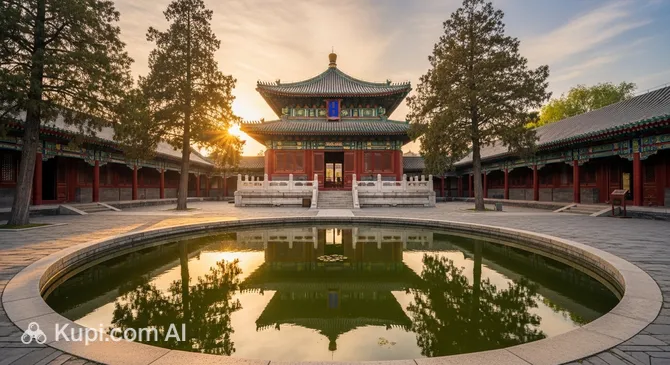
Imperial College (Guozijian). Illustration.
Source: Kupi.com AI

Traveler photos:

One of the academy's main highlights is Bicheng Hall—a magnificent square building with yellow roof tiles surrounded by a circular moat. This "palace of learning" was intended for lectures delivered by the Emperor himself. Equally impressive is the glazed arch (liuli paifang), adorned with royal calligraphy, symbolizing the high ideals of education and wisdom.

Contacts

When planning a visit to the Imperial Academy (Guozijian), we recommend checking for the latest information in advance, as seasonal changes may occur in the museum schedule or access conditions.

Below are the primary contact details and official resources to help you prepare for your visit to this historical complex in Beijing.

How to contactContact
Address13 Guo Zi Jian Jie, 国子监 Dong Cheng Qu, Bei Jing Shi, Китай, 100011

What to Do

Visiting Guozijian is an opportunity to journey into the past and feel the spirit of ancient Chinese enlightenment. Begin your walk by inspecting the Jixianmen (Gate of the Gathering Sages) and move deeper into the complex, admiring the majestic pavilions and ancient wells. Be sure to stop at the famous glazed arch to appreciate the fine craftsmanship and exquisite artwork.

The highlight of your visit will be the Bicheng Hall. This building, which appears to float on water, is a masterpiece of engineering for its time—its spacious interior has no supporting columns. Here, you can imagine the Emperor lecturing to thousands of students gathered in the courtyard. The academy's quiet courtyards with centuries-old trees are perfect for taking atmospheric photos and finding respite from the bustle of the metropolis.

The museum halls now house interesting exhibitions detailing the imperial examination system, Confucian canons, and the daily lives of students from past eras. It is recommended to purchase a combined ticket, which also grants access to the neighboring Temple of Confucius, to fully immerse yourself in the intellectual and spiritual culture of old Beijing.

Getting There

The Imperial Academy (Guozijian) is conveniently located in the historical center of Beijing, in the Dongcheng District. The exact address of the complex is 13 Guo Zi Jian Jie. It is situated in a picturesque hutong neighborhood near the Andingmen Gate, making for a very pleasant walk.

The easiest way to get here is by metro. Take Line 2 or 5 and exit at Yonghegong (Lama Temple) or Andingmen station. From either station, the entrance to the academy is just a 5–10 minute walk. If you prefer surface transport, buses No. 58, 116, 130, and 684 stop at the "Guozijian" station.

For those traveling from the city center, such as the Forbidden City, a taxi ride will take about 15–20 minutes and cost approximately 20–30 yuan. The area surrounding the academy is pedestrian-friendly and very atmospheric, making it an ideal place for a leisurely exploration of China's architectural heritage.

Nearest city: Beijing

History & Facts

The history of the Imperial Academy (Guozijian) dates back to the Yuan Dynasty. The construction of this vital educational institution was initiated in 1287 and completed in the early 14th century. For many centuries, Guozijian served as the supreme state university (Taixue) and the central administrative body for education throughout the vast empire.

During the Ming Dynasty, after the capital was moved from Nanjing to Beijing in 1404, the complex was fully restored and expanded. Much of its current architectural appearance is due to large-scale renovations under Emperor Qianlong in the 18th century. It was during this time, specifically in 1783–1784, that the famous Bicheng Hall was built, becoming the architectural centerpiece of the complex.

Following the fall of the monarchy in 1912, the institution's functions changed: it housed libraries and hosted exhibitions for the future National Museum. An education museum has been open here since 2003, and since 2008, Guozijian, along with the neighboring Temple of Confucius, has formed a single museum complex that carefully preserves the traditions of China's intellectual elite.

Time Needed

A thoughtful exploration of the Imperial Academy (Guozijian) usually takes about 1.5–2 hours. During this time, you can walk through all three courtyards, examine the unique glazed arch, and study the architecture of the central Bicheng Hall, which is surrounded by a moat.

If you plan to visit the academy along with the adjacent Temple of Confucius (which is highly recommended as they form a single ensemble), you should set aside at least 3–4 hours for your walk. This will allow you to browse the museum exhibits dedicated to the history of education and Confucian rituals in China without rushing.

Working Hours

The Imperial Academy (Guozijian) is open to the public daily, making it accessible to tourists any day of the week. The museum complex operates on a consistent schedule: from 9:00 to 17:00.

Please note that entry to the grounds stops half an hour before closing, at 16:30. To avoid rushing and ensure you have time to see all the pavilions, we recommend arriving in the morning. Before your trip, it is advisable to check the museum's official website or confirm details on-site, as slight seasonal adjustments to opening hours may occur.

Nearby

The Imperial Academy's location in one of Beijing's most colorful districts makes it easy to combine a visit with other iconic sites. Just a few hundred meters away is the majestic Yonghe Temple (Lama Temple), the city's most famous Tibetan Buddhist monastery, which impresses visitors with its vibrant colors and enormous Buddha statue.

A stroll through the surrounding hutongs can lead you to Prince Gong's Mansion or picturesque parks such as Jingshan and Beihai. Exploring this historical quarter will allow you to deeper experience the atmosphere of old China and see how ancient traditions intertwine with the modern life of the metropolis.

NameDistance
Yonghe Temple (Lama Temple)0.3 km
Prince Gong Mansion2.6 km
Jingshan Park2.8 km
Beihai Park3.1 km
Da Dong Roast Duck3.6 km
Forbidden City3.6 km
The Palace Museum3.7 km

Reached the end of the page?

That means the route is fully explored